Why the New York Jets must draft offensively at No. 23

New York Jets

It’s a foregone conclusion that the New York Jets will draft a quarterback at No. 2. But what will they do with their latter Thursday choice?

If this is the most pressing of problems the New York Jets have for the remainder of 2021, they’ll be one of the most, if not the most, blessed teams in all of professional sports.

The Jets have a welcome dilemma when the first round of the NFL Draft is held in Cleveland on April 29 (8 p.m. ET, ABC/ESPN/NFL Network). They’re one of a handful of teams with multiple first round picks, first choosing in the second slot before reaping the fruits of the Jamal Adams trade at 23rd overall. Though the second pick is more than likely spoken for…barring a jaw-dropping pre-draft surprise, the Jets will undoubtedly be taking a quarterback…there’s a major decision to be made in the latter station, a place where this draft’s predictability should be long gone.

When you’re a team like the Jets…coming off a two-win season, one even more brutal than this star-crossed franchise’s usual standards…

 Mandatory Credit: Jasen Vinlove-USA TODAY Sports

Make the quarterback as comfortable as possible

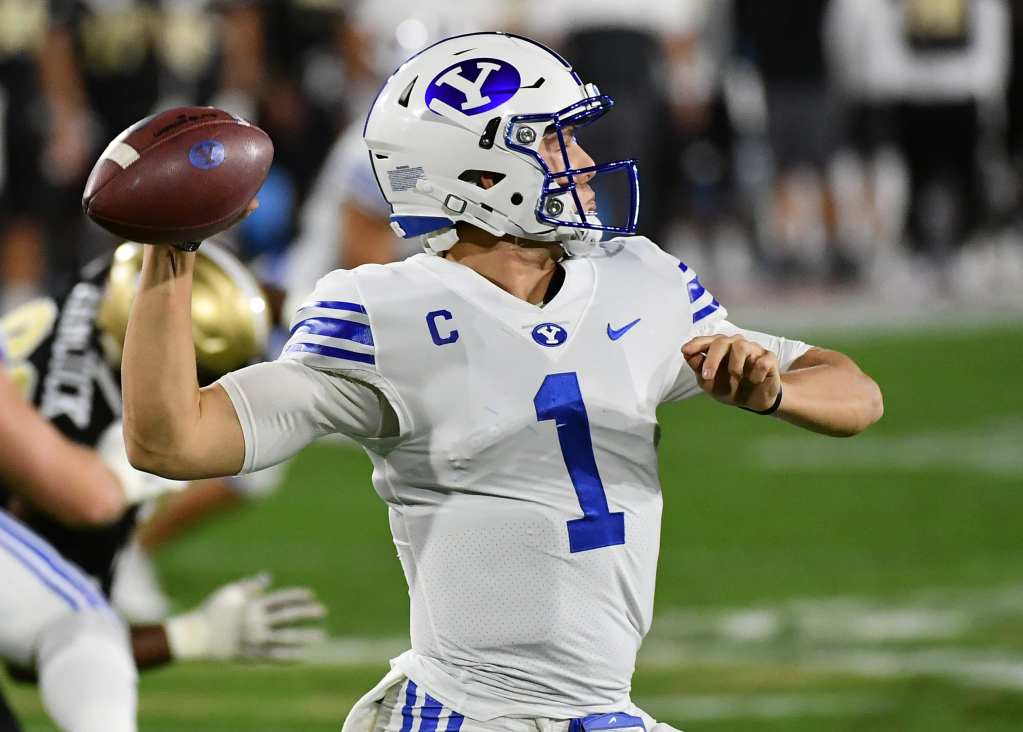
When it comes to the second overall pick, the Jets have answered the question of what. Unless they plan on starting James Morgan, their 2020 fourth-round choice who has yet to wear an NFL game jersey, they’re drafting a non-Trevor Lawrence quarterback, be it Zach Wilson, Justin Fields, or an unknown third party.

Whoever it is, he’s going to need help, whether it’s through protection or weaponry (more on each of those in a minute). One of the things that doomed Sam Darnold’s New York career was the lack of stability on his end of the ball. By the time his third season began, no receivers from his rookie season (with the exception of tight end Chris Herndon) remained on the New York roster and his starting offensive line was completely different from even the year prior. The Jets need homegrown talent to help their new, young franchise man get used to the NFL game in a hurry.

The draft is also a more attractive option for the Jets to find offensive help because their last few big-ticket offensive arrivals from elsewhere (i.e. Le’Veon Bell) haven’t worked out. If they can build through the draft…and there’s a prime opportunity with 21 picks over the next two years…they can lay a foundation and rebuild a winning culture.

 Mandatory Credit: Vincent Carchietta-USA TODAY Sports

Big plays are here again

So the Jets need offense, but that decision begets a decision: should they take a box score contributor or build the wall in front of Wilson/Fields/Other?

In the case of the former, it’s been a while since the Jets have had a truly explosive offense. It’s only been five seasons since Brandon Marshall and Eric Decker put up dueling 1,000-yard tallies during the bittersweet 2015 campaign, but that might as well be an eternity in football years. Making matters worse is that the Jets made little effort to keep Robby Anderson, the closest thing they had to a consistent playmaker. He posted career-best number in Carolina last season and now reunites with Darnold.

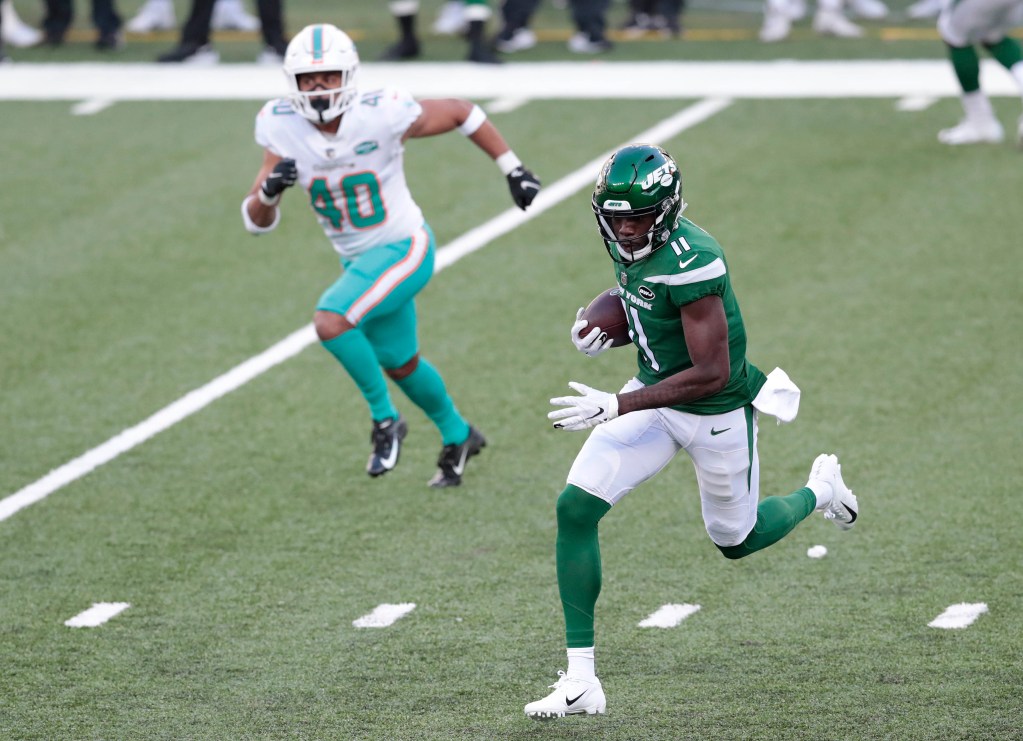
The Jets have assembled a decent core of veterans with Corey Davis and Keelan Cole joining the fray alongside incumbent slot man Jamison Crowder and sophomore Denzel Mims. But while drafting Mekhi Becton was a move no one could truly quarrel with, the Jets passed on name-brand receiving talent like Henry Ruggs, Jerry Jeudy, CeeDee Lamb, and future All-Pro Justin Jefferson. This supposed sin can be rectified at No. 23, where names like Rashod Batman, Kadarius Toney, Terrace Marshall, and Tutu Atwell should all be available. Sure, the receiving class is deep enough that the Jets could find a receiver at No. 34…the second pick in Friday’s drawings…but the lack of offensive firepower has reached crisis levels in New York. Over the past five seasons, have the Jets have reached the four-touchdown/extra point plateau in 16 games, a mark besting only four teams (Chicago, Washington, Denver, and the Jets’ blue roommates in East Rutherford). That lack of production is ridiculously unsustainable in today’s NFL, and it shows: that group, including the Jets, has failed to win a playoff game over the last half-decade.

Many have theorized that the Jets could take a running back in the slot, but the Jets have resolved that issue, if only temporarily, through an affordable one-year deal with Tevin Coleman and a trio of young projects (La’mical Perine, Ty Johnson, Josh Adams). Besides, the recent first-round running back crop…especially when it gets to the later stages has shown it’s not worth it, at least not for their needs. It’d be great to bring in a, say, Rashaad Penny (drafted 27th by Seattle in 2018), but they can’t afford to use a first-round pick on a reliable spell option with a first-round pick. If they do address rushing, a power option like Rhamondre Stevenson could be a valuable latter-day steal.

New York Jets, Mekhi Becton
Credit: Joe McManus

Continue Construction

General manager Joe Douglas has had a small habit of having his football cake and eating it too, even if the dessert isn’t fully baked yet. When he took Becton with his first draft pick last season, he filled the big-play receiving potential slot with Mims, a Big 12 star from Matt Rhule’s Baylor Bears.

This offseason, Douglas has noticeably improved the team’s offensive chances through skilled talents that should at least keep fantasy football players’ eyes on Jets games (Davis, Coleman, Cole). He addressed the defense as well through 4-3 talents that will fit the preferred scheme of Robert Saleh and Jeff Ulbrich. But the Jets remain understaffed on their blocking despite Douglas opening his checkbook for Connor McGovern, George Fant, and Greg Van Roten. Their quarterbacks were still on the run and little has been done to rectify that this offseason. Dan Feeney is high in personality but low on analytical rankings. Corey Levin hasn’t partaken in a regular season game since 2018.

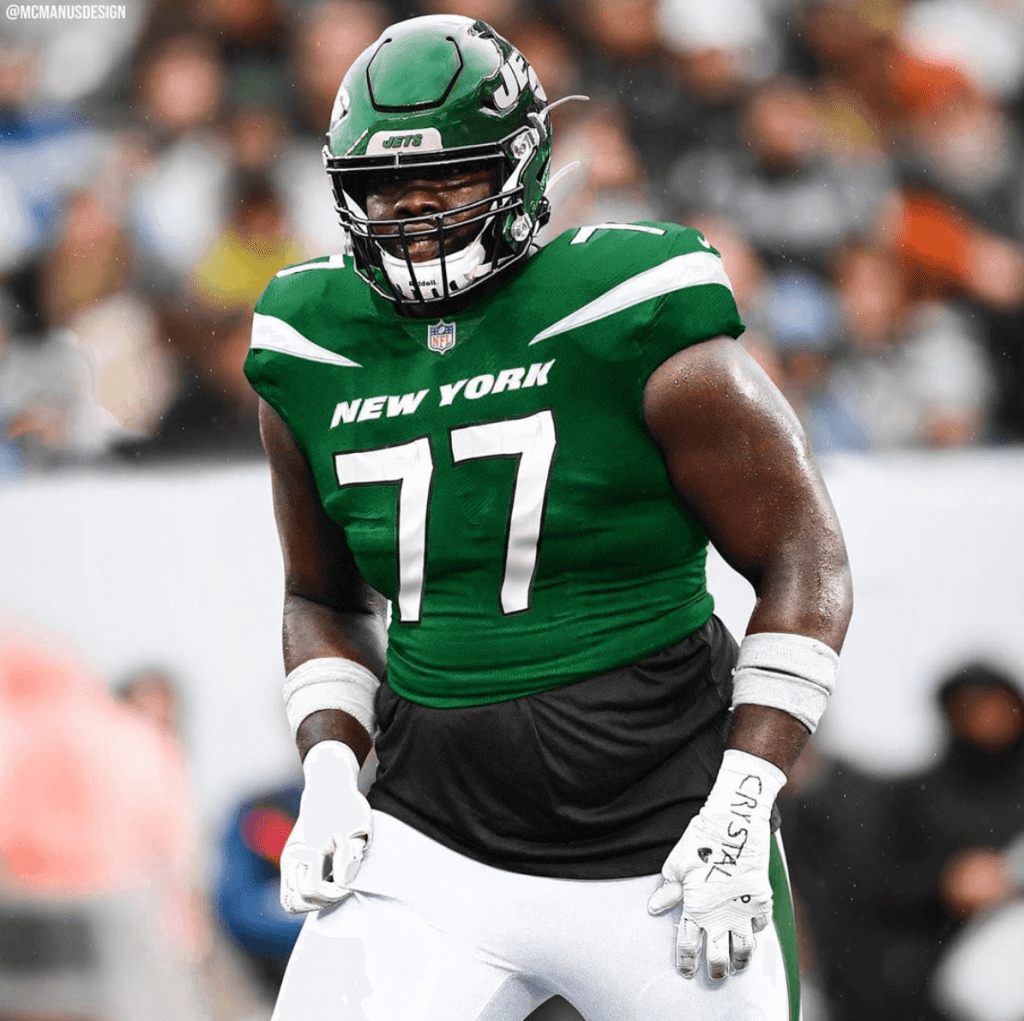
Thus, it might help to continue building their fortress around the new thrower and improved rushing attack. Blocking draftees rarely send the draft parties into a frenzy…legendary blocker D’Brickashaw Ferguson was booed by a fanbase lusting after Matt Leinart…but no one’s complaining when the quarterback has time and the rushers have room to move.

Geoff Magliocchetti is on Twitter @GeoffJMags

New York Giants: Why trading down for an edge rusher in round one makes sense

The New York Giants are preparing for the 2021 NFL Draft. New York has set itself up nicely for the draft with a successful free agency period. The Giants made some splash signings, landing top-of-the-market wide receiver Kenny Golladay and solid tight end Kyle Rudolph, along with their new CB2 in Adoree’ Jackson.

The Giants addressed most of their needs in free agency and plugged those holes. But there is one glaring positional weakness on the defensive side of the ball that the Giants still have not fully addressed. New York does have a stable of solid edge rushers, but no singular standout option off the edge.

Many predict that New York will select an edge rusher with the eleventh overall pick in the 2021 NFL Draft. However, the fan base does not seem too warm to that idea. This year’s edge class is thin and filled with controversy. If the New York Giants really want to address the edge rusher position in round one, they should do so in a trade-down scenario.

Why trading down makes sense

There are talented edge rushers in this year’s draft class. However, there are not many edge prospects that are widely considered to be top-ten talents or even talents worthy of being selected eleventh overall. If New York takes an edge rusher at eleven, they’ll be “reaching” to address a significant need. But if the Giants were to trade down into the second half of the first round and select an edge rusher, they would be making a good-value selection.

There are copious amounts of benefits to trading down. If the Giant were to trade down, they would be able to select the player they are targeting at a sufficient value where the level of talent meets the overall selection. But the even greater benefit the Giants would gain by trading down is the addition of extra draft capital.

The Giants could potentially yield an extra second-round pick by trading down. The accumulation of extra draft capital could go a long way for the Giants as they fill out their roster and address any weaknesses entering the 2021 season. Trading down was instrumental for the rebuild of the Indianapolis Colts in 2018. The Giants were interested in trading down from four overall in 2020 but found no buyers. 2021 could be the year that Dave Gettleman finally trades down. And it would make sense for this to also be the year that the Giants invest heavily in the edge rusher position.

Which edge rushers could the Giants target?

There are a few intriguing edge rusher prospects in the first round of this year’s NFL Draft. Nearly all of these players have draft projections that land them past the first twenty picks. But they are still talented, first-round prospects that would make an instant impact on the Giants’ defense.

Azeez Ojulari

Azeez Ojulari out of Georgia is a draft prospect whose stock has been steadily rising in the past month. The Giants also reportedly have a particular interest in Ojulari. According to Jordan Raanan of ESPN, New York sent Chris Pettit, their director of college scouting, to scout Ojulari’s Pro Day. Raanan also reports that the Giants are “high on” Ojulari.

Kwity Paye

Jordan Raanan also reports that the Giants are interested in Michigan edge rusher Kwity Paye. Raanan was quoted saying this about Paye and Ojulari: “Those two guys I think in particular pique their interest the most… They fit what the Giants are trying to do.”

Gregory Rousseau

There is also a pair of Miami edge rushers to keep an eye on in this year’s draft. Gregory Rousseau is a prospect that has been connected to the Giants frequently. He could have been a legitimate option at eleven overall, but his disappointing Pro Day has caused his draft stock to tumble to the back end of the first round or maybe even the early second round.

Jaelan Phillips

Rousseau’s counterpart, Jaelan Phillips, is looked at by many as the best pure pass-rusher in this draft class. Many view him as a top-ten talent. However, his lengthy and significant injury history is a major red flag that caused most analysts to view Phillips as a round-two prospect. That was until his dominant Pro Day that sent him back to being a first-round prospect. If he stays healthy, Jaelan Phillips could be the steal of the draft for the Giants in a trade-down scenario.

College teammates the New York Jets should consider for their new QB

The New York Jets are likely set to take a quarterback with the No. 2 pick this month. Adding one of his teammates could work wonders.

For the New York Jets, the easy part ends on draft day.

With the trade of Sam Darnold, it’s all but assured that Gang Green and general manager Joe Douglas will choose a quarterback with the second overall pick of April 29’s NFL Draft proceedings. But then comes the dirty work: grooming him and developing him into a reliable franchise man.

That’s something the Jets have had major trouble with. Their quarterback problems have been well-documented, the franchise slot changing hands more often than the roundball at a New York Knicks game. Darnold joins a list of endless false saviors, a list grown through injuries (Chad Pennington), age (Brett Favre), or simply general inconsistency (too many examples to list). It’s great that Douglas has yielded an embarrassment of draft riches, but he knows that it’s imperative that the right choices are made in those slots.

“We have a lot of opportunity in front of us, 21 picks in the next two drafts, including 10 in the first 3 rounds,” Douglas said of the Jets’ draft future, per notes from the team. “But with that opportunity, we know we have to make the most of it and hit on these picks.”

One way the Jets can smooth out the transition to a new quarterback is to perhaps find some of his teammates, familiar faces in a strange new locale. Though the general consensus appears that the Jets will choose Zach Wilson with their top pick, ESM goes over some of the top throwers and their alma maters to find perfect matches…

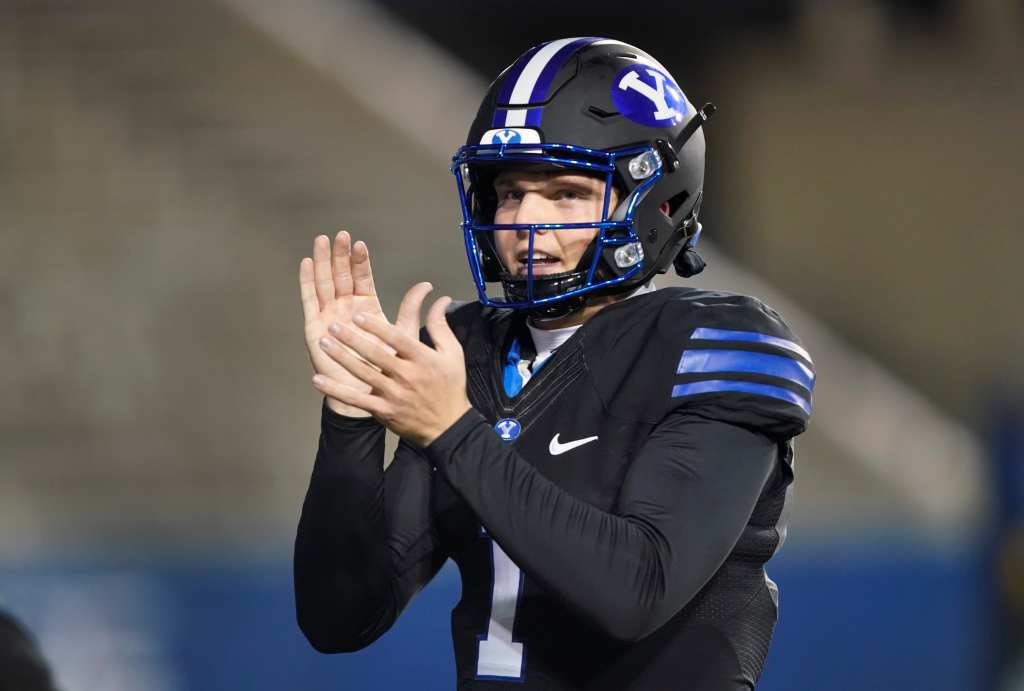
If they draft Zach Wilson from BYU

T Brady Christensen

BYU’s offensive fireworks were allowed to commence thanks to stellar protection. Three of their starting blockers, including Christensen, Chandon Herring, and Tristan Hodge, each opted for early entry. Christensen, a consensus 2020 All-American, worked primarily as a left tackle, a spot the Jets did fill in reasonably well with Mekhi Becton, but has been complemented for a strong football IQ that could allow him to make the shift to right. If the Jets don’t address their blocking woes with their extra first-rounder, Christensen could be worth looking into during the Friday session.

TE Matt Bushman

Adding Bushman, whose 2020 was washed away after an injury, would not only put some hit on the current crop of tight ends (namely starter Chris Herndon) but provided a familiar target for Wilson. Their last collaboration came in the Hawaii Bowl on Christmas Eve 2019, uniting for 91 yards on six hook-ups. Though lack of his speed and aggressiveness has attracted criticism, Bushman could wind up becoming a serviceable day three find, be it through the draft or free agency afterward.

WR Dax Milne 

Wilson’s favorite 2020 target was Milne by far, a finalist for the Burlsworth Trophy (awarded to the nation’s most outstanding walk-on). Milne burst onto the scene with a stellar junior year, respectively ranking seventh and fourth in FBS play with 70 receptions for 1,188 yards. He probably would’ve been better off with an extra year in Provo, but a friendly face could help Wilson learn the offense more quickly, which could prove vital in a shortened preseason (down to three exhibitions after the addition of a 17th regular season game).

If they draft Justin Fields from Ohio State

G Wyatt Davis

Another unanimous All-American (in a season he nearly missed out on, originally declaring for the 2020 draft before the Big Ten opted-in to football antics), Davis should be a target for the Jets at Nos. 23 or 34 whether they draft Fields or not. No matter which thrower the Jets draft at No. 2, he’s going to need protection. A dominant, smart mind like Davis, who brings forth a lot of upside, can help that transition. Davis knows what it’s like to be called upon in unusual situations. His Big Ten debut came in the conference’s 2019 title game and he later partook in the ensuing Rose Bowl win over Washington over his first two collegiate starts.

RB Trey Sermon

In the rare cases that Fields struggled, perhaps the most notable instance coming in December’s conference title game, Sermon had his back. The rusher surged up draft boards during the collegiate postseason, torching Northwestern for a jaw-dropping 331 yards before earning 193 in the Sugar Bowl upset win over Clemson. If the Jets draft Fields, they could look to create some further heat in their running back room, joining fellow young projects like La’mical Perine, Ty Johnson, and Josh Adams.

If they draft Mac Jones from Alabama

C Landon Dickerson

One (of many) thing(s) Sam Darnold was never blessed with in New York was a truly reliable center, often working veteran castaways from elsewhere (I.e. Spencer Long/Jonotthan Harrison). Should the Jets go with the surging Jones (ranked third to San Francisco in Mel Kiper’s latest mock), Dickerson can help him avoid such a conundrum while putting some heat on incumbent Connor McGovern. He hauls a sizable trophy case to his professional destination, including the Rimington Trophy as the best center in college football.

G Deonte Brown

While the Crimson Tide’s skill players may be gone by the time the Jets are on the clock, they have valuable blocking assets that Jones or another can work with. Known for his power and strong run blocking, Brown might have to wait until day three due to length issues and mobility. But he has been know to open holes for the Crimson Tide’s run game and earned rave reviews for his in-line blocking, which would make him invaluable as a goal-line escort.

If they draft Trey Lance from North Dakota State

OL Dillon Radunz

Don’t let the small-school nominee Radunz get lost in a tackle noticeably sized in talent. Radunz got an opportunity to impress amongst elite talent at Mobile’s Senior Bowl. Some scouts have questioned his work ethic, though having a steady leader like Lance to potentially help him out could prove to be grounding. His strength and initial burst have earned positive reviews, and his raw power and talent could propel him to day two status.

Geoff Magliocchetti is on Twitter @GeoffJMags

New York Jets: Why everyone wins the Sam Darnold trade (for now)

It’s hard to assess a trade five months before a single down is played, but the New York Jets and Carolina Panthers came out looking good.

Despite Jerry Seinfeld’s best efforts, there’s probably is no such thing as a “mutual breakup”.

But the New York Jets and Sam Darnold might’ve come as close as one can, especially when it comes to severing the relationship between an NFL squad and its franchise quarterback.

Darnold confirmed as much in his first statements as a Panther on Monday, a week after he was dealt from New York for a trio of draft picks. While Darnold ruefully stated that he throught he was destined to be the Jets’ quarterback for a long time, he’s ready to embrace a new opportunity in Charlotte.

“I imagined I was going to be the franchise quarterback of the New York Jets for a long time…once you realize that the team that drafted you is moving on, it stings a little bit,” Darnold said, per Carolina reporter Darin Gantt. “Getting that news that you’re going to be traded, of a team saying, ‘Hey, we didn’t want you,” for whatever reason, is hard. But right now, I feel great about it.”

How did each side find something to celebrate? ESM investigates…

zach wilson, new york jets
. Mandatory Credit: George Frey/Pool Photo-USA TODAY Sports

Grounded Controversy

Through social media schadenfreude, the Jets are a team whose simplest mistakes are turned into memes within minutes. That concept has hit a fever pitch during their decade-long playoff drought (an NFL-worst), but there may well be light at the end of their tunnel of rebuilding. Rare optimism can be found at One Jets Drive after the hire of Robert Saleh, whose arrival has spawned positive reviews both domestically and abroad.

But the good vibes bring forth a perilous responsibility: it must be surrounded by as little controversy as possible. Holding a quarterback competition would be an unwelcome distraction during. Once the games do get underway, it’s widely expected that fans will be back at MetLife Stadium. The last thing the Jets needed was spectators, no matter the capacity limit, screeching for Darnold’s backup every time he threw an incomplete pass.

But, having traded Darnold, the Jets have a clear-cut plan. Their quarterback controversy will end no later than the evening of April 29, when they choose second in the 2021 NFL Draft in Cleveland. General manager Joe Douglas more or less confirmed as much when speaking after the deal was done.

“There was…a discussion about us taking a quarterback at pick number two and having Sam here for the season…ultimately, we felt that that wouldn’t be the best situation for Sam, the rookie quarterback, Coach Saleh and his staff, and the locker room,” Douglas said, per notes from the Jets. “We felt like this was the best decision for the entire organization moving forward, in hitting the reset button.”

Mandatory Credit: Vincent Carchietta-USA TODAY Sports

Darnold Gets Stability 

On paper, Carolina isn’t too far removed from the Jets in terms of where they are on the NFL barometer. They won only five games last season and are seeking stability under a first-time NFL head coach in Matt Rhule. But one look at the Carolina ledger shows that they provide a more stable offensive situation than Darnold ever had in New York.

Darnold’s burden is immediately lightened through a run game headlined by Christian McCaffrey rather than a disgruntled Le’Veon Bell and a tandem of projects. The biggest sign of Panther progress was perhaps shown through McCaffrey’s absence: despite enjoying only three games with the 2019 All-Pro in the backfield, Carolina remained competitive. All but three of their 11 losses came by one possession while Robby Anderson, Darnold’s favorite New York target in his first two seasons, tallied a career-best 1,096 yards despite relative turmoil at quarterback. Teddy Bridgewater was inconsistent in his first full-time starting gig since enduring a contact-free camp injury in 2015 and was relieved by XFL star P.J. Walker.

The coaching staff is also a welcome sight to any offensive player seeking his NFL fortune. Head coach Matt Rhule turned downtrodden college programs at Temple and Baylor into offensive blockbusters while offensive coordinator Joe Brady over saw the rise of Joe Burrow as the passing game coordinator during the LSU Tigers’ dominant national title run in 2019. Darnold took the time to appreciate the culture that Carolina is building during his opening statements.

“The culture that’s being set here is amazing,” Darnold said in Gantt’s report. “That’s probably the part that intrigues me the most about this.”

(Photo by Joe Robbins/Getty Images)

A Fine Addition to the New York Collection

While the immediate yield from the Darnold trade isn’t flashy…the Jets earned the 226th overall pick in the coming Cleveland selections…it’s pretty impressive on Douglas’ end that he was able to net a second-round pick (coming in 2022) for an injury-prone quarterback with a 13-25 ledger as a starter, even if the circumstances weren’t the greatest.

“With the premium picks, your first, second, third-round picks, those are the picture you’re looking to become starters on your team,” Douglas remarked through the Jets. “So, those ultimately end up being the picks that you spend the most time talking about.”

As a young Queens webslinger was told, however, with great power comes great responsibility. Quantity doesn’t automatically equal quality, and that axiom rings especially true in the NFL Draft. The Jets learned that lesson the hard way during the 2014 proceedings through John Idzik’s doomed dozen and it’s a nightmare that Douglas doesn’t take lightly.

“We have a lot of opportunity in front of us, 21 picks in the next two drafts, including 10 in the first three rounds,” Douglas said in Jets notes. “But with that opportunity, we know we have to make the most of it and hit on these picks.”

New York Jets, Joe Douglas
(Photo by Al Pereira/Getty Images)

Joe’s Jets

Douglas presents himself as a guy who’s not interested in looking for excuses. But he’d have a good few in the holster.

He joined the Jets under unusual circumstances, placed in charge weeks before training camp opened after Mike Maccagnan’s post-draft firing. His first years with the organization have been handicapped by decisions he had no jurisdiction over (namely the Adam Gase hire).

Now, Douglas’ signings are getting closer to becoming the majority after several Maccagnan/Gase staples were shipped elsewhere. He has a handpicked head coach in Saleh and he’s about to have a handpicked franchise quarterback.

It’s official: Douglas is the captain now. For better or worse, this was a step the Jets needed to move toward. There are no more excuses, there are no more “wait untils”. Douglas’ era can officially begin and he can thus be judged appropriately.

“I think you feel pressure every day you walk into the building,” Douglas said in Jets notes. “You want to do this job to the best of your ability. You want to take the information that you have at hand and make the best possible decisions that you can make.”

Jets fans and the football-loving public at large are about to find out if they’re truly the right moves to end the perpetual rebuild…a rebuild Douglas now officially owns.

Geoff Magliocchetti is on Twitter @GeoffJMags

New York Giants draft scenario: Micah Parsons or Rashawn Slater at eleven?

new york giants, rashawn slater, micah parsons

The New York Giants are gearing up for another crucial NFL Draft. The 2021 NFL Draft will kick off in a few short weeks. After months of preparation and hard work, teams will finally put their plans in motion and draft in their franchises’ future building blocks. The New York Giants hold the eleventh overall pick in the draft this year. This year’s selection for the Giants is fascinating because they can successfully go in several different directions.

The Giants filled their major needs in the 2021 free agency period. New York spent big in free agency and added two playmakers on offense in Kenny Golladay and Kyle Rudolph. Still, the Giants could draft another weapon at eleven, but now they don’t have to. They also do not have to draft a cornerback early on since they filled that hole with the splash signing of Adoree’ Jackson.

There are a couple of needs, though, that the Giants could fill at eleven. One primary need that New York did not address in free agency is the offensive line. New York’s front line was amongst the worst in the league in 2020. They need to fix the offensive line in front of Daniel Jones to allow him to enjoy his new stable of weapons. But should they reach to draft for need or take the best player available regardless of position?

There are two top-tier prospects that can heat this debate to a boil. One of the draft’s top offensive tackles, Rashawn Slater, could potentially be available at eleven overall. But the draft’s top defensive prospect, linebacker Micah Parsons, could also be available for the Giants. What happens if both of those players are on the board? Do the Giants draft the best player available, or do they draft to fill a crucial need?

The best player available: Micah Parsons

Micah Parsons – a former top-five lock

Entering the pre-draft process months ago, Micah Parsons was a top-five lock and potentially a top-three talent in this year’s draft class. In fact, if at this time last year someone asked a Giants fan, “would you rather have Rashawn Slater or Micah Parsons in next year’s draft?” many fans would have responded with, “Who is Rashawn Slater? Micah Parsons could be a generational talent, so he is the pick for sure.”

Now the debate is much less black and white and a lot more gray. Some fans say “Rashawn Slater, not even close,” and others say “Micah Parsons, no debate.”

Neither one of these players played in 2020. They both opted out of the COVID-riddled 2020 collegiate season. But one player’s draft stock (Slater) has risen tremendously in the past year, and the other player’s draft stock (Parsons) has slid and taken a bit of a hit. This time last year, Parsons was never expected to fall outside the top five, and Slater was not even expected to be a top-ten pick. Now, many believe Parsons will fall outside of the top-ten, and many have a tough time envisioning a world where Slater is not a top-ten pick. Why is that?

The conversation around positional value

The reason for Parsons’s and Slater’s swap in draft projection is simple: positional value. Offensive tackles are a premium. An NFL offense is only as only good as its offensive line. An elite offensive lineman can transform an offense. But does an elite linebacker do that for an NFL defense? In some cases, sure.

But when you are the New York Giants who have a young quarterback entering his third season on a rookie contract, you want to know what you have in him before you pay him. It has been tough to evaluate Daniel Jones due to the lack of playmakers around him and the poor offensive line in front of him. In theory, solidifying the offensive line would allow the Giants to get a good look at Daniel Jones and decide if he is or is not the future of the franchise.

The Giants already have a top-notch defense. Micah Parsons could propel New York’s defense to be arguably the best unit in the league. But, unless the Giants see significant progress from the guys on the roster or hit on an offensive line prospect in the later rounds, their biggest weakness will still be their biggest weakness in this scenario.

Micah Parsons’s “red flag”

Granted, there is another factor at play other than the positional value with Micah Parsons. He had some off-the-field question marks regarding a hazing scandal at Penn State. But most scouts and analysts seem to have moved on from those allegations, and most seem to believe it will not be a problem in the NFL. Parsons himself explained that he was a 17-18-year-old kid when the hazing happened.

Now, Parsons is a 21-year-old young man and father that has presumably aged and matured past those freshman shenanigans. But this murky history could hold teams back from drafting Micah Parsons.

Micah Parsons – the best linebacker prospect since Luke Keuchly?

NFL Draft scouts and analysts love to make player comparisons. Last summer, before the 2020 NCAA and NFL seasons kicked off and before everyone dove deep into this year’s draft class, Micah Parsons was getting insane player comparisons.

Brad Kelly, an acclaimed NFL Draft analyst and offensive coordinator for Portsmouth, declared Micah Parsons as the best linebacker prospect since Luke Keuchly in March of 2020. Pro Football Focus made the same comparison in August of 2020. Last summer around Micah Parsons, the consensus was that he is a truly rare and special (maybe even generational) defensive talent. Now he is barely even a top-ten pick. That is confusing, considering Micah Parsons did not play in 2020 but still showed up and dominated his Pro Day.

Micah Parsons ran a 4.36s 40-yard dash at his Pro Day. His relative athletic score was a 9.59 out of 10 with elite speed grades, great size grades, great explosion grades, and good agility grades. Micah is a freak athlete. He is also a near-perfect linebacker prospect.

According to Pro Football Focus, Micah Parsons missed only 11 tackles on 188 attempts in his career and improved his missed-tackle rate from 2018 to 2019. Also from PFF, “on 127 career pass-rush snaps, the Penn State linebacker has racked up 29 pressures and a 91.4 pass-rush grade.”

Micah Parsons is a rare talent. He has the rare blend of size, speed, and athleticism, combined with elite instincts, tackling, pass-rushing, and playmaking ability. If the Giants are trying to draft the best player available, they are drafting the next Luke Keuchly, and they are spending the eleventh overall pick on a home-run selection in Micah Parsons.

Drafting for need: Rashawn Slater

If the New York Giants are drafting for need, they are taking the best offensive lineman on the board and never looking back. Penei Sewell is widely considered to be the best offensive lineman in this year’s class. But Rashawn Slater is deemed to be a close second, and, in some rare cases, he is the top offensive lineman on some draft boards.

The Giants’ lowly 2020 offensive line performance

The Giants’ pass-block win rate in 2020, according to ESPN, ranked dead-last in the NFL at 46%. Their run-block win-rate ranked 18th at 70%, which is about average or slightly below. So while the Giants did upgrade Daniel Jones’s weapons in free agency, they still desperately need to fix the offensive line in front of him.

When the value of talent meets the importance of the need in the first round of the draft

The Giants need an upgrade on the offensive line. Whether that be at right tackle or offensive guard, the Giants need to add some talent to their front line more than any other position. 2021 is the year of Daniel Jones. New York needs to evaluate how he plays when he has sufficient talent around him. The painful truth is that the Giants’ talent on the offensive line is insufficient. Changes need to be made.

Rashawn Slater would be that massive upgrade on the Giants’ offensive line. He would be the talented player to fill that enormous need for the Giants. Slater was a dominant left tackle at Northwestern that deleted Chase Young in pass protection during their 2019 matchup. But in his 2018 freshman season, Slater played right tackle and was excellent on that side of the line, too.

Rashawn Slater and the importance of versatility

If the Giants drafted Slater, they have a plethora of options in front of them, thanks to Rashawn’s positional versatility. He is naturally an excellent left tackle, but the Giants just drafted their left tackle in 2020 with Andrew Thoams. Potentially, Thomas could make the switch to right tackle, and the Giants could plug in Rashawn Slater to protect Daniel Jones’s blindside. But Slater’s distant history at right tackle in 2018 could make him the day one starter at right tackle.

New York feels confident in its current starting tackles, though. They love Andrew Thomas and feel confident in Matt Peart’s potential as a future starter. On the interior, though, the Giants are expected to roll out former fifth-round pick and eight-game starter Shane Lemieux alongside the former starting guard who was benched for Lemieux, Will Hernandez. That is kind of scary, especially considering Lemieux is a clear work in progress.

Rashawn Slater was an excellent left tackle in college and deserves a chance to start outside in the NFL. However, he is pretty severely undersized for an offensive tackle. Many believe that Slater will find more success playing guard in the NFL. The most significant need on the Giants roster is at offensive guard. If he is there at eleven, the Giants could draft Rashawn Slater and get a day-one starter and a massive upgrade at offensive guard. Rashawn Slater is the top pick for the Giants to fill their most significant need, even if he is not the top talent on the board at eleven.

Rashawn Slater – the second-best player available?

While Micah Parsons would be the best player available if he is on the board at eleven, the argument could be made that Parsons and Rashawn Slater’s talent gap is not that wide. Just like Parsons, Slater is a guy with All-Pro potential. Some might even argue that Slater is the best player available, though the consensus would seem to indicate that Parsons is the higher-grade prospect between the two.

But Slater and Parsons might have relatively similar prospect grades. Not to say that Rashawn Slater is a potentially generational offensive tackle talent, but he is potentially an elite offensive lineman and long-term starter at the next level.

During Rashawn Slater’s dominant 2019 season that saw him lock up Chase Young, Slater produced a 90.0 PFF grade and allowed just five pressures over 11 games in his final season at Northwestern in 2019. According to Pro Football Focus, Slater was one of just five offensive linemen in 2019 with a grade of 87.0 or better in both run-blocking and pass-protecting. He allowed just five pressures on 355 pass-blocking snaps as a 20-year-old true junior. Slater also allowed only one hit on the quarterback, and no sacks surrendered all season.

Rashawn Slater could step in and fix the Giants’ pass-protection issues overnight. Slater could have an impact on the Giants’ offensive similar to the impact that Tristan Wirfs had in Tampa Bay last season. Wirfs was an undersized rookie near-All-Pro right tackle for the Super Bowl champion Buccaneers. Slater could be that athletic, undersized tackle that exceeds expectations in 2021.

The decision?

Realistically, the Giants cannot go wrong in this scenario. With one pick, New York lands the best defender in the draft class and tries to fix the offensive line in round two. Micah Parsons transforms New York’s defense, aiding in run support and boosting their pass-rush. The Giants potentially have the best defense in the NFL next season while the offense makes strides and the team is hopefully looking at their first playoff berth in years.

The other scenario is pretty, too. Drafting Rashawn Slater gives the Giants long-term security on the offensive line. Andrew Thomas and Rashawn Slater hold down the fort for the next decade. New York gets to evaluate Daniel Jones properly as the offense takes a huge step forward and goes from a weakness to a potential strength.

Maybe Rashawn Slater is the better long-term choice. Maybe Micah Parsons makes the Giants a contender overnight. Of course, the draft is a crapshoot, which is why many teams go “best player available” with every pick. But this crapshoot aspect also leads teams to think, if it is so hard to hit on a pick, we might as well try to hit on a player we need.

Either one of these players would be looked at as home-run selections for the New York Giants. Micah Parsons and Rashawn Slater are both worthy of being the number eleven overall pick in the draft. The Giants are in a great position and have the chance to leave fans happy no matter whom they select in the first round.

My opinion:

To me, the easy pick is Micah Parsons. He is a talent that you do not pass up. I’m going best player available and looking to land one of the interior offensive linemen in round two. This is a deep draft class for offensive linemen. But no class is ever deep in potentially generational defensive talent. Parsons would be a rare find and a true weapon in Patrick Graham’s defensive scheme. For me, if he is on the board at eleven, Micah Parsons is the pick, no questions asked.

Fans’ opinions:

The fanbase is split on this decision, but seemingly leaning towards Rashawn Slater out of Northwestern. I asked the question on Twitter: Rashawn Slater or Micah Parsons? I received over 100 responses. It seems that the consensus among fans is to fill the most significant need with Rashawn Slater. The most frequently given reason is Daniel Jones’s development. Fans are sick and tired of seeing their rookie quarterback get beat up game after game. Rashawn Slater is the fan selection because fans want to see Daniel Jones get a fair chance in 2021.

Personally, I can respect this opinion and still stan firmly with my own. As I said, the Giants cannot go wrong at eleven. If these two prospects are on the board, they would both be home-run selections, and I cannot wait to see what happens at the end of the month. The New York Giants are one step closer to turning this thing around and becoming a playoff team once again.

The New York Jets must fix their kicking situation now

The New York Jets have been through six different legs since Jason Myers absconded to Seattle. The next one must last.

Even with a decent free agency haul, the New York Jets still have holes to fill with the NFL Draft looming large. Contending in a crowded AFC…one whose East division likely belongs to Buffalo for the time being and one packed with established contenders…might be difficult anyway even if all those needs are satisfied.

The Jets’ first choice, second only to Jacksonville on April 29, will undoubtedly be used on a quarterback, many presuming the choice to be BYU’s Zach Wilson. Afterward, however, there’s a lot of flexibility, especially with nine further picks in a surplus gained through trading Jamal Adams, Leonard Williams, Sam Darnold, and Jordan Willis. The Jets can thus upgrade areas of major need, such as the gaps in their blocking and secondary.

But there’s one underrated area where the Jets are in desperate need of help: their kicking game.

One could be excused in overlooking the current situation. The Jets, losers of ten games decided by at least two possessions, didn’t drop any games because of a missed kick, after all. But having a reliable leg at this point of the franchise timeline is supremely vital.

For one thing, having this much turnover in a position that often takes up a single slot on the gameday depth chart is troubling. Since 2019 Pro Bowl nominee Jason Myers absconded to Seattle, the Jets have gone through a disturbingly jaw-dropping six kickers, including those who appeared only in preseason games. But the biggest reason why the Jets need to settle this is the sake of their offense.

In a modern NFL that worships a fantasy football deity, the Jets have lagged behind. In the highest-scoring season in NFL history (teams averaged 24.8 points per game, breaking a record set in 1948), the Jets ranked dead-last at an average of 15.2. New York was also dead-last in another vital category: only 16 of their (again, league-low) 38 visits to the red zone ended in a touchdown.

Time will only tell if the Jets will be able to raise any of those numbers this season. But, even with the potential of Wilson (or another rookie party like Justin Fields), there’s no doubt it’ll be tough to build on it with a freshman thrower in tow. But this year of building must end with an offense full of confidence as they try to end this perpetual rebuild. The perfect way to build that poise and assertiveness is by ensuring that drives that end within the opponents’ 20-yard-line yield points. When you’re a team that has had issues…and might continue to have issues…getting balls in the end zone, a good kicker is a must.

Right now, it’s debatable as to whether the Jets have that. They have two kickers on the roster, the most recent pair of the aforementioned six. A competition is all but assured to assume once training camp commences this summer. Each one returns from last year’s roster, with Sam Ficken, the two-year incumbent, coming back on a future/reserve contract and Chase McLaughlin being retained from the Week 17 trip to New England, meaningless if not for being the final stand of Adam Gase.

Both Ficken and McLaughlin could stick around in the NFL for a while. Ficken has floated around in gameday rosters since 2015, while McLaughlin has racked up frequent flier miles as an injury replacement since entering the league four years later. Though McLaughlin has a minuscule sample size (converting two extra point attempts in the aforementioned futile Foxboro visit), Ficken established a new career-high by converting just over 86 percent of triples (13-of-15). The Penn State alum well could’ve been the Jets’ long-term solution, but a groin injury sustained in November could prove concerning.

What the Jets need right now is a reliable, proven leg, one where fans don’t have to hold their breath as long when his name is called. It’s probably too late to turn to free agency to solve that problem. The most reliable available name, Ryan Succop, re-upped with the defending champions while veteran Matt Prater moved from Detroit to Arizona. What’s left is a group of names past their prime (Dan Bailey/Stephen Gostkowski) or inconsistent (Brett Maher/Zane Gonzalez).

Thus, the means toward a solution may come from an unusual source: the NFL Draft.

It’s true that the Jets could probably scour the undrafted free agent wire to add to the special teams festivities at camp. Four of the five most accurate kickers last season (the exception being Mason Crosby) were, after all, UDFA finds. But the Jets need to be confident in the name they have going forward, unlike the 2019 season. The team scooped up former Minnesota preseason hero Kaare Vedvik mere days before their season opener against Buffalo. Vedvik lasted just one game in green, missing an extra point and a field goal, the indirect difference in a 17-16 loss to the Bills.

In this era, the Jets need a proven name that has succeeded at a high level of football, and this year’s selection pool has some strong names to work with. Reigning Lou Groza Award winner Jose Borregales perhaps headlines the class out of Miami, while his fellow finalist Evan McPherson hails from Florida. Senior Bowl standout Riley Patterson from Memphis could also hear his name called during the four-round, final day process on May 1.

Drafting a kicker often gains your team only postmortem mockery in the immediate aftermath. Tampa Bay’s aforementioned Super Bowl triumph may only now finally end the Roberto Aguayo jokes after they chose the Florida State booter in the second round in 2016. The Jets themselves endured some of this the last time they opted for a leg in the draft, shockingly choosing Mike Nugent with their second-round choice (47th overall) in 2005 (passing on future Pro Bowlers like Nick Collins, Vincent Jackson, and Frank Gore).

This time around, though, the Jets can afford such a risk. That’s part of the gifts that come with ten draft picks, a surplus gained through trading several franchise staples. Quantity, as the Jets found out through John Idzik’s doomed dozen in 2014, doesn’t always equal quality, so they have to make the most of the extras granted to them. Drafting a kicker might be a great way to do that. There’s obviously no need to go the Nugent route…there are far greater holes to fill…but using one of their later picks could be a good way to find an immediate contributor and gain some consistency at a position where there’s been endless turnover.

Using a draft pick on special teams and valuing the group isn’t unheard of in this new era of Jets football. In his first draft at the helm, general manager Joe Douglas used his final choice on punter Braden Mann and special teams coordinator Brant Boyer is a rare survivor of the purge of Gase’s coaching staff, having also survived that of Todd Bowles’ group. Douglas knows that football is a three-pronged game, and getting the right guy at the vital positions is going to be crucial to building what he and Robert Saleh are trying to build.

Drafting a kicker’s an unusual situation in any NFL era. But desperate times, times that would welcome even the simplest form of football stability, call for unusual measures.

Geoff Magliocchetti is on Twitter @GeoffJMags

New York Giants: Cornerback prospects to target in the later rounds

New York Giants, thomas graham

The New York Giants are gearing up for the 2021 NFL Draft after a successful free agency period. The Giants made a few splash signings in free agency. One key signing that the Giants made was that of Adoree’ Jackson, a talented cornerback that could help make the Giants’ defense one of the top units in the NFL this season.

But the Jackson signing was a case where the Giants took a chance on a talented player with the potential for excellence, but the same amount of risk that brings the potential for disaster. Adoree’ has dealt with significant injuries over the past couple of years. But now he is healthy and the Giants are confident he can remain healthy and return to form.

Regardless, the Giants should look to add more depth to their secondary. It never hurts to have extra defensive backs on the roster. Cornerbacks and safeties are injured pretty frequently and New York knows all too well the struggles that can come from starting backup cornerbacks on Sundays. To prepare for that scenario, the Giants should target some solid cornerback prospects in the later rounds of the 2021 NFL Draft.

Cornerback prospects to target in the later rounds

Tay Gowan

The Giants love tall, physical cornerbacks with the speed and length to matchup on the outside. Tay Gowan out of UCF fits that bill perfectly. At his Pro Day, Gowan was listed just under 6 feet 1 inch, 186 pounds, and flew in the 40-yard dash at 4.41 seconds.

Gowan’s speed and athleticism are noticeable on tape. However, there is not much tape to watch. This is why Gowan could be overlooked and fall to the later rounds of the draft. Tay Gowan opted out of the 2020 NFL season due to COVID-19 concerns. But in 2019, he was phenomenal. Tay has allowed the second-lowest passer rating allowed in single coverage since 2019 with a rating of 26.6 (PFF).

We had the opportunity to speak to Tay Gowan on Fireside Giants. Check out that exclusive interview here.

Thomas Graham Jr.

The Giants love drafting Senior Bowl standouts. Oregon cornerback Thomas Graham Jr. stood out as one of the best prospects at the Senior Bowl this year. Graham is a day two or three cornerback prospect for the Giants to target this month.

Graham Jr. is another prospect that opted out of the 2020 season. Mike Renner of PFF mentioned how many of the opt-out players at the Senior Bowl looked rusty. But according to Mike and every other talent evaluator in Mobile during the Senior Bowl, Thomas Graham Jr. was not one of those players. Graham did not look rusty at all.

Thomas Graham Jr. locked down all the top wide receiver prospects at the Senior Bowl. In his career at Oregon, Graham racked up 183 tackles, 40 Passes Defended, 8 Ints, and 10.5 TFL. He was an exceptional talent on Oregon’s defense.

Benjamin St-Juste

Benjamin St-Juste is another big-bodied outside cornerback that would make a nice addition to the Giants’ defense in the middle rounds. St-Juste is freakishly built for a cornerback, 6-foot-3, 205 pounds with an insane 80 1/4 wingspan.

This lengthy cornerback out of Minnesota has all the physical tools to be an elite press-man cornerback in the NFL. He has the size, length, and strength to succeed as a boundary cornerback. He is not an elite athlete, but he is a technical cornerback that the Giants could develop into a capable player outside.

Benjamin St-Juste is another player that stood out at the Senior Bowl. His 2019 season was an impressive campaign that saw Benjamin break up 10 passes and total 45 tackles. St-Juste is a physical cornerback and a textbook tackler. If he is available for the Giants in the later rounds, Benjamin St-Juste seems like a player that could fit nicely into Patrick Graham’s defensive scheme.

New York Jets: A seven-round, post-Sam Darnold mock draft

With Sam Darnold having moved on, ESM envisions how the New York Jets’ replenished draft haul will look come April/May.

Sam Darnold is gone, resolving the question of his New York Jets fate. Now, another rises in his place: now what?

Following Darnold’s dealing to Carolina earlier this week, the Jets now hold ten picks in the 2021 NFL Draft, which begins on April 29. The last came from the Panthers along with two further choices in next year’s selections.

With Darnold’s New York term ended, how should the Jets spend this surplus? In the immediate aftermath, it’s a terrific note on Douglas’ resume that he has earned the Jets double-figure offerings in a single draft. But draft day quantity, of course, is never a guarantee of quality. The Jets learned that lesson the hard way during the 2014 proceedings. Then-general manager John Idzik held a dozen picks in the final draft in New York, but none of them remain on the Jets’ current roster and, in fact, only one (fourth-rounder Dakota Dozier, now a starting blocker in Minnesota) partook in NFL action last season.

How can the Jets make the most of their excess choices, especially in the wake of the Darnold news? ESM investigates through a full New York mock…

1st Round (2nd overall): QB Zach Wilson, BYU

One of the biggest wins of the Darnold trade was that the Jets now have an official deadline for their current quarterback controversy: the evening of April 29, after they make their second pick. Deshaun Watson is out for obvious reasons and they certainly won’t entrust Week 1 starting duties to Mike White or James Morgan. Thus, it’s a near-certainty that they’ll choose a non-Trevor Lawrence thrower with the second overall choice.

With a New York triumvirate (Joe Douglas, Robert Saleh, Mike LaFleur) in tow for his pro day in Provo, it’s beginning to look like a Wilson-based future for the Jets. ESPN NFL insider Adam Schefter took it a step further, flat out texting Wilson “Welcome to New York” after the Jets-Panthers deal was completed. With this move, Douglas has officially solidified the Jets as his “own”, as the modern Jets will work with a head coach and quarterback exclusively chosen by the current GM.

1st Round (23rd overall): C/G Landon Dickerson, Alabama

So the Jets have traded Darnold, the latest of several offseason moves that have made them a better team on paper (if only because there’s nowhere to go but up after a 2-14 campaign). But their offensive line negligence has only gained a brighter spotlight. Dan Feeny and Corey Levin are acceptable options for depth, but they’re not guys that are going to push the Jets’ offensive needle in the right direction.

Dickerson, on the other hand, can be a difference-maker. Going 23rd would almost be an injustice to the 6’6, 325 lb. national champion, who was injured on a scoring play during the SEC title game. It was the last of several injuries he endured in Tuscaloosa, which has served as a red flag in several teams’ draft preparation. But Dickerson’s loss in position could be the Jets’ gain, as he brings an impressive resume that goes beyond his championship ring. He’s the current holder of both the Rimington and Jacobs Blocking trophies (sharing the latter with teammate Alex Leatherwood) and was a unanimous All-American last year.

2nd Round (34th overall): LB Zaven Collins, Tulsa

The hullabaloo around a new quarterback…as well as some shrewd offseason maneuvering from Douglas and Co…has somewhat masked the fact that the Jets still have some defensive renovations to make. One of the smarter moves of Douglas’ winter was bringing in Carl Lawson and Jarrad Davis, both of whom have extensive experience with the 4-3 defense that Saleh and Jeff Ulbrich are set to install in New York.

Don’t be surprised if the Jets take a similar approach on draft weekend. Collins is among the top, if not at the top, of the 4-3 linebackers in the coming class. He likewise brings in a sizable trophy case to his NFL destination, one that includes the AAC Defensive Player of the Year Award (guiding the Golden Hurricane to an undefeated regular season in conference play) and the Chuck Bednarik Award (whose previous three winners include Minkah Fitzpatrick, Josh Allen, and Chase Young). Critics feel like Collins would have to improve his physicality to move into the first round proper, but he’s the type of day two pic that can contribute immediately.

3rd Round (66th overall): CB Paulson Adebo, Stanford

As the post-Jamal Adams carries on, the Jets are still relatively thin in their secondary. Their safeties are on relatively solid ground…having franchise-tagged Marcus Maye and working on Ashtyn Davis as a project. But they’re still understaffed in the cornerback spots, where the current top options are veteran newcomer Justin Hardee (who’s primarily used on special teams) and raw, young talents like Bless Austin and Bryce Hall.

Thus, it’s worth exploring some cornerback options on day two, some more proven potential that can contribute immediately. Perhaps unfairly, Adebo has seen his stock fall after opting out of the 2020 season. He was previously projected to be among the first safeties to go in Mel Kiper’s 2020 draft board. He’s thus another project, but he has at least has some proven potential to work with (primarily as a player with the “ballhawk” classification) and could insert himself into a starting lineup fairly quickly.

3rd Round (86th overall): T Spencer Brown, Northern Iowa

The Jets have a perfect opportunity to make up for their relative inactivity in terms of upgrading their protection through the extra picks gained on the first two days. Their thrower’s blindside is protected through the first-round arrival of Mekhi Becton last season, but their questions on the right side. George Fant appears to be back in the starting lineup with Chuma Edoga behind him.

Brown, an FCS standout, could provide the proper heat to a veteran like Fant on the right side. His 2020 showcase has been thrown into disarray with uncertainty in what was Division I-AA football, but Brown managed to impress at both the Senior Bowl and UNI’s pro day. He has earned particularly strong reviews for his pass blocking and, in lieu of partaking in UNI’s ongoing shortened year, has been training with former All-Pro blocker (and Saleh’s fellow San Francisco alum) Joe Staley.

4th Round (107th overall): RB Rhamondre Stevenson, Oklahoma

The Jets have an interesting running back situation. Signing Tevin Coleman can not only give the offense a proven weapon both on the ground and through the air, but also take the pressure off the new quarterback. Behind Coleman is a trio of projects who have raw potential: La’mical Perine, Ty Johnson, and Josh Adams. It wouldn’t be surprising for the Jets to add an upstart rookie to create a training camp competition. The addition of Coleman allows the Jets to address other areas over the first few rounds.

A failed drug test suspension kept Stevenson, a former JUCO star at Cerritos College, out of the Sooners’ College Football Playoff trek at the end of the 2019-20 season, as well as the first five games of last year’s campaign. He nonetheless led the Sooners with 665 rushing yards (6.6 average carry), capped off by a dominant 186-yard showing in OU’s dominant Cotton Bowl victory over Florida. Stevenson’s build (230-240 lbs.) could also allow the Jets to reestablish a fullback role, especially with Saleh and LaFleur knowing the benefits of such a position, having worked with Kyle Juszczyk in San Francisco. The Jets toyed with tight end and 2019 draftee Trevon Wesco in the spot over the last two seasons, but more or less abandoned the project last year.

5th Round (146th overall): WR Shi Smith, South Carolina

At receiver, the Jets did a solid job of upgrading their receiving weaponry for the incoming quarterback. In addition to Coleman (111 receptions from 2016-19 with Atlanta and San Francisco), they added promising young veterans Corey Davis and Keelan Cole to a group that already includes Denzel Mims and Jamison Crowder. But the third day of the draft would be a good time to find some depth.

Smith could be a potential project, especially one in the slot with Crowder due to hit free agency next year. His development in Columbia was slightly hampered by the Gamecocks’ unstable quarterback situation, but he still garnered some professional looks for his speed and athleticism (which could allow the Jets to establish the screen). Smith’s 57 receptions earned last season were good for fifth in the SEC’s shortened 2020 season. He can also add a little heat to the Jets’ return situation, currently headed by Corey Ballentine and Braxton Berrios, as he was second in the conference with a 21.9 kick return average during the 2019 campaign (albeit on a 12-return sample size).

5th Round (154th overall): S Ar’Darius Washington, TCU

As Brian Poole remains unsigned, the Jets could use a nickel/dime upgrade while potentially working on a safety project. While Washington’s size (5’8, 178 lbs.) is a concern, his ball skills make him an intriguing prospect to work with in the secondary. The underclassman has constantly defied odds, not only working his way through a tough size situation but also making an immediate Fort Worth impression by winning the Big 12’s Defensive Freshman of the Year Award. Working with Hardee could also allow him to make an impact on special teams.

6th Round (186th overall): TE Matt Bushman, BYU

At tight end, Chris Herndon is the one player left over from the Jets’ new uniform showcase in the early stages of 2019. While they did add Tyler Kroft…who will be a decent goal line option…Herndon still appears to be the top man in the position. Adding Bushman would not only put some heat on Herndon but also give Wilson a friendly face to work with in his NFL debut. Though Bushman missed all of the Cougars flirtation with a New Year’s Six bowl with an injury, he was their top receiver in 2019, notably uniting for 91 yards on six receptions in their final collaboration in the Hawaii Bowl.

6th Round (227th overall): K Jose Borreagales, Miami (FL)

The current pick gained from the Panthers in the Darnold trade can allow the Jets to address one of their most problematic areas: kicking. With an offense still struggling to consistently visit the end zone, having a reliable kicker will be vital if they want to remain competitive. Since the Pro Bowler Jason Myers left for Seattle two offseasons ago, the Jets have gone through six different kickers. The most recent pair (Sam Ficken and Chase McLaughlin) remain on the roster, with a competition potentially set to ensue. Last year’s draft showed that they wouldn’t hesitate to use a pick to bolster their special teams, using their last on Texas A&M punter Braden Mann.

New York needs a reliable name as their leg, and the primary boot in this draft is Borreagales. A native of Venezuela, Borreagales established himself as a South Beach kicking legend, first starring at Florida International before spending a fifth season with The U. Mirroring Mann’s Ray Guy Award, Borreagales would bring a Lou Groza trophy with him as the current holder. He was successful on all 35 of his extra point attempts last season and was 18-of-20 on field goals. One conversion was a 57-yard boot in a September win over Louisville, a primetime showdown that saw him score 17 points in a 47-34 win.

Geoff Magliocchetti is on Twitter @GeoffJMags 

New York Giants: Offensive playmakers to target in the middle rounds

New York Giants, Amari Rodgers

The New York Giants spent big in free agency this offseason to give quarterback Daniel Jones a competent stable of offensive weapons. New York gave Kenny Golladay a massive contract to be the Giants’ new alpha dog receiver. They also signed Kevin Rudolph to be a reliable tight end with the ability to make plays in the red zone.

But many get the sense that the Giants are not done adding playmakers this offseason. With three weeks until the 2021 NFL Draft, many still believe that the Giants will spend their first-round pick on an offensive weapon if the right one is on the board. But even if New York goes another route in round one, there are plenty of options on offense for them to consider adding in the middle rounds.

Mid-round offensive playmakers

Dyami Brown

UNC’s Dyami Brown is an intriguing option for the Giants to consider. This 6-foot-1, 185-pound wide receiver has drawn comparisons to Giants route technician Sterling Shepard. Dyami Brown is a dynamic outside wide receiver that racked up over 1,000 receiving yards in back-to-back seasons for the Tar Heels.

Brown’s draft stock has him projected to go in the second or third round of the draft. Dyami to the Giants in round three would be an absolute steal if he falls to them. But taking him in round two is a safe bet. Primarily playing the X receiver role in college, Dyami Brown is an outside, vertical threat that has elite upside. He does not have any slot experience, but his skill set of great route running and physicality could translate and allow him to thrive in that role at the next level.

Dyami Brown is a playmaker. He hauled in 20 touchdowns over his final two collegiate seasons. Per Pro Football Focus, Brown averaged 3.11 yards per route run last season, 14th among 68 qualifying draft-eligible wide receivers. Dyami is an intriguing wide receiver prospect that could turn the New York Giants’ offense into a dominant machine.

Brevin Jordan

Miami tight end Brevin Jordan had a disappointing Pro Day that could cause him to slip in the 2021 NFL Draft. But on film, Jordan is one of the more explosive tight ends in this draft class. Brevin Jordan has elite abilities after the catch with the ball in his hands. According to PFF, Jordan racked up 845 yards after the catch in his collegiate career.

Brevin is an undersized tight end that is a dynamic matchup weapon. But his Pro Day left a lot to be desired as Jordan’s RAS score came back at a lowly 4.52 out of 10. This is concerning considering many viewed Jordan as more “big athlete” than an actual tight end.

Brevin Jordan’s disappointing Pro Day could indicate a few things. It could indicate a fall in draft stock, causing him to slip and be a solid value selection for the Giants in the later middle rounds. But it could also indicate that Brevin is not the athlete many thought he was, or that he was not able to keep himself in shape and train properly for his Pro Day. If Jordan does have athletic or training problems, he could struggle to make it in the NFL. But there was enough electric play by Brevin Jordan during his collegiate career to make him a valuable mid-late-round pickup for any NFL team.

Amari Rodgers

The New York Giants cut veteran Golden Tate this offseason to save salary cap space. In the 2021 NFL Draft, the Giants could replace Golden Tate with his clone in Amari Rodgers. The two wide receivers have a near-identical playing style, a style that Daniel Jones greatly enjoyed playing with during his 2019 rookie season.

Golden Tate was a YAC king with a shorter body and a stocky frame. Amari Rodgers is in many ways the same. He has a running back build paired with quality route-running skills and an impressive catch radius for his size. Amari Rodgers thrived in 2020 as the primary receiver in Clemson’s explosive offense, racking up 1,020 receiving yards and 7 receiving touchdowns.

Amari Rodgers’s draft stock has hovered around the third or fourth round. Despite finding great success in an SEC offense, many have questions regarding Amari’s frame and how his skill set will translate to the NFL. Some have suggested that Amari moves to running back at the next level. But as a low-cost player for the Giants to take a flier on in the middle rounds, it is hard not to see the young Golden Tate similarities and fall in love with Amari Rodgers’s fit in New York.

Who should start at right tackle for the New York Giants in 2021?

New York Giants, Matt Peart

The New York Giants appear to have a position battle brewing on their offensive line. New York has its projected left tackle of the future in first-round pick Andrew Thomas. But on the other side of the line, the Giants have a giant question mark at right tackle.

In 2020, that position was manned by stop-gap journeyman Cam Fleming. Rotated into that position was also rookie offensive tackle Matt Peart out of UConn. With Fleming no longer on the Giants’ roster, many have assumed that Peart will take over the starting job.

But the Giants have a familiar face returning to the lineup as a potential starting offensive tackle. Nate Solder opted out of the 2020 season but will return in 2021 and compete at right tackle along with Matt Peart. It will likely come down to a camp battle between Peart and Solder. But the possibility remains that New York adds another right tackle candidate to the mix in the 2021 NFL Draft.

Matt Peart

The New York Giants selected Matt Peart in the third round of the 2020 NFL Draft. Peart saw limited playing time in his rookie season, playing just 15% of the Giants’ offensive snaps (150 snaps). But Matt Peart looked good during his time on the field with the Giants.

Matt Peart finished the 2020 season with a respectable 69.7 overall Pro Football Focus grade. He allowed only 2 sacks on the year and recorded an elite performance in Week 6 against Washington (89.7 PFF grade). Peart also surrendered 0 pressures in the Giants’ second matchup with the Washington Football Team.

Matt Peart flashed a lot of potential as a rookie. Albeit, he did not see the field that much. But when he was on the field, Peart’s play was impressive. Dave Gettleman also stated that he feels comfortable going into 2021 with Matt Peart as the starting right tackle. If Matt Peart can build on his rookie season with more playing time in 2021, he could solidify himself as a long-term starter at right tackle for the Giants.

Nate Solder

Veteran offensive tackle Nate Solder has not played right tackle since his rookie season in 2011. In 2012, Solder made the switch to the left side of the line and never turned back. In 2018, the Giants paid him a historically large contract to be their starting left tackle. Solder never lived up to that contract, opted out in 2020, and is now looking to play a new role with the Giants in 2021.

Nate Solder will compete for the right tackle job this season. His contract numbers have been reduced significantly this offseason and the Giants want to see him remain with the team in an undetermined role. Solder could potentially win that right tackle job. But it is possible that he gets pegged into the role of a swing tackle.

Of course, the Giants could add a new offensive tackle to their roster before the season begins. The 2021 NFL Draft will take place at the end of this month and New York could land themselves a new right tackle to add to the competition. It will be interesting to see how the right tackle position shapes out for the New York Giants in 2021.