New York Yankee Top 10s: The best Yankee relievers throughout history

New York Yankees, Mariano Rivera

In the past, I’ve done about every New York Yankees Top 10s, that there could be.  From the best pitchers, catchers, infielders, outfielders, to the best and worst acquisitions.  One area that I have not addressed is the best Yankee relievers of all time.  Over the years, the definition of reliever has been blurred.  What was a closer in the 70s might be considered a middle reliever now.  Most of the great relievers with the Yankees have been set-up men and closers.  Here are my arbitrary selections for the top 10 relievers.

10. Delin Betances

Delin Betances didn’t have his option taken up by the Yankees two years ago, and he is now with the New York Mets.  Delin deserves to be on this list due to his eight-year tenure with the Yankees and his 2.36 ERA over the span.  He was primarily the setup man for Aroldis Chapman.  In the postseason, he pitched in five series for a 1-1 record and an ERA of 3.27.  Betances, in his years with the Yankees, was a dependable solid reliever.  Due to injuries, he did not pitch in the 2019 postseason.

9.  John Wetteland

John Wetteland has two solid years with the New York Yankees. In 1995 acting solely as a closer, he built up 34 saves, and in 1996 he led the league with 43 saves. The Yankees went to the postseason both of his years.  He was dominant in the postseason except for game 1 of the 1995 ALDS when he allowed seven runs in just four innings.  In 1996, for the Yankees, he won all three of his postseason games.  Wetteland was a strange guy, and with Rivera ready to take over for him, the Yankees and Wetteland parted ways following the 1996 season.

8. David Robertson

David Robertson pitched for the Yankees in two separate stints, the first for seven years from 2008 to 2014 and again from 2017-2018.  At nine years as a Yankee reliever, he deserved to be on this list.  He went 53-33 a .633 winning percentage. Although in his years with the Yankees, he was primarily the setup man for Mariano Rivera, however, he did manage 53 saves when Rivera was not available.

7. Luis Arroyo

Luis Arroyo is on this list primarily for his 1961 league-leading 29 saves. The New York Yankees got Arroyo from the Reds in 1960, where he was a full-time starter.  The Yankees converted him to a reliever.  His history with the Yankees is a tale of two different pitchers.  In his first two years, he was dominant, and in his last two years, he stank.  But in 1961, he closed 54 games for the Yankees. In his four years with the Yankees, he was 22-10 with a 3.12 ERA and a .688 winning percentage.

6. Wilcy Moore

Wilcy Moore is another pitcher that pitched long before the reliever was conceived.  He was just a pitcher that came in if the starting pitcher wasn’t pitching well.  He was also a starter who started 15 games while finishing 161 in his five years with the Yankees.  He had a 36-21 record while pitching to a 3.31 ERA.

Moore was one of the most dominant postseason pitchers in his era.  Back then, there was no ALDS OR ALCS just a World Series, and Moore was unhittable. In the 1927 World Series, he pitched 10.1 innings, and in 1932 he pitched 5.1 innings for a total of 15.2 innings while allowing a run to cross the plate, that’s an ERA of 0.56.

5. Dave Righetti

Righetti was a great relief pitcher for the New York Yankees but rated lower than Rivera, Lyle, and Gossage due to his lack of wins in the postseason that was the hallmark of the other three.  In 1986 he set the record for the most saves ever by a baseball player in a single season with 46 saves.  Mariano Rivera only bested that number of saves twice in his nineteen years.  He saved 224 games in seven seasons in the Yankees’ bullpen. He began his career as a starter and had a no-hitter in July of 1983 against the Red Sox, which made him a Yankee favorite.  Although he is most known as a reliever, he is one of the most successful pitchers in both fields.

4. Johnny Murphy

Johnny Murphy was closing games for the New York Yankees from 1932 to 1946, except for two years away for military service.  That’s 13 years of closing games for the Yankees before there was an official closer category. He was an All-Star three straight years, 1937-9, as a reliever. Saves weren’t yet a stat, but he led the league an amazing four times during the period. He closed in 415 games while starting only 40.  For his career, he went 93-53 with a 3.50 ERA.

3. Goose Gossage

Rich “Goose” Gossage is often credited as being one of the first pitching relievers in baseball.  Gossage was a frightening figure on the mound with his fierce look and electric pitches.  He saved 151 games for the Yankees in his remarkable 22-year career, six of them with the Yankees 1978-1983.  That’s an average of 25 saves a year.  Gossage was elected to the Baseball Hall of Fame in 2008.

2. Sparky Lyle

The most difficult of my selections was whether to place Goose or Sparky in the second placement.  I choose Sparky due to his dominance in 1977, and his postseason performance.  In the ALCS, he pitched in four of the games against Kansas City.  In game three he closed 5.1 innings for the Yankee win, in game four he pitched the last 1.1 innings for the Yankee win.  In the World Series, he pitched 3.2 innings to close out the Yankee win over the Dodgers. All in all, in the postseason in 1977, he pitched to an ERA of 1.24 over 14.1 innings that is dominance.

Both Sparky Lyle and Gossage pitched seven seasons for the Yankees (but Gossage pitched only six prime seasons, returning for 11 games late in 1989). Both led the league twice in saves for the Yankees. Both dominated in the post-season for World Series champions, Lyle in 1977 and Goose in 1978.  Even though Gossage made the Hall of Fame, Lyle, in my opinion, was the better pitcher for the Yankees. Lyle is the only Yankee reliever ever to win a Cy Young Award. Gossage had some similar seasons statistically, but none that stood out as the best pitching performance in the league that year.

1. Mariano Rivera

Mariano Riveria is probably the greatest closer of all time. When Mariano Rivera entered a game to the sound of the Sandman, Yankee fans knew the game was over. Of course, he didn’t save every game but has the most saves of any pitcher (652) not only for the Yankees, but that’s for all of baseball history. Before he became the most dominant closer in baseball, he was the successful setup man for Yankee closer John Wetteland.

Consider the fact that it is near impossible for a pitcher to allow less than a run over nine innings, and you see why bests number two on this list by a mile.  If you break down his postseason years with the Yankees into two seasons, the first from 1995 to 2001, his stats look like this: seven runs allowed over 71 innings for a 0.89 ERA. His second season from 2002 to 2011 was even better; six runs allowed over 70.1 innings for an ERA of 0.64. In his longest tenure in Yankee history of 19 years, he pitched to an ERA of 2.21 in 1115 games.  Many forget in 1995, he started ten games for a 5-3 record. Rivera is the only player ever to be elected to the Baseball Hall of fame in 2019 by a unanimous vote.

Honorable Mentions:  Lindy McDaniels, Ryne Duren, Andrew Miller, Joe Page, and at some point in the future, Aroldis Chapman may find himself on this list.

Method of selection:  In determining this list, I regarded tenure with the Yankees, overall performance, postseason performance, peak performance, Hall of Fame was important, but if on multiple clubs, performance with the Yankees overrode the Hall of Fame induction.  Also, players that may have been excellent relievers, if they were considered more a starting pitcher, were excluded from this list.

EmpireSportsMedia.com’s Columnist William Parlee is a member of the Society for American Baseball Research.  Follow me on Twitter @parleewilliam.

New York Yankees News/Rumors: A case for the return of Brett Gardner, details here

New York Yankees, Brett Gardner

The New York Yankees have many decisions to make this offseason.  All of those seem to be on the back burner while determining whether they can re-sign DJ LeMahieu. It is no secret that that is the Yankee’s main priority this offseason. The Yankees need to do that and strengthen the starting pitcher rotation, and beef up the bullpen. Two other problem areas are already set. It appears the Gleyber Torres will be the shortstop again, and Gary Sanchez has been signed for another year. If the Yankees add a third catcher as they have always had, remains to be seen.

Another issue the Yankees have is whether to re-sign Brett Gardner to another year with the Yankees. Although one of the most popular Yankee players, many fans think his time with the team has come and gone. Today I will try to make the case as to why the Yankees need him and find a way to keep him in pinstripes. Brett wants to continue playing and wants to end his career as a New York Yankee.

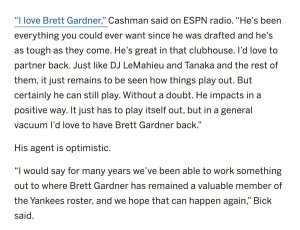
His detractors will say last season is evidence of his decline and the Yankee’s decision not to exercise his 2021 option for $10 million. Although I still think “Gardy” has much to offer the team, $10 million is too much to retain his services for a team with plenty of outfielders. In an earlier article written after the World Series, I declared that Gardner would probably not return to the Stadium. Although little has changed for the Yankee during the offseason, the plight of Garder seems to be more positive. General Manager Brian Cashman has recently said:

Gardner’s agent is Joe Bick, who seems optimistic for Gardner to return to the New York Yankees.

For those that say Gardner had a down season this year, you may be correct, but he has had ups and downs throughout his 13 years with the Yankees. In 2019 he had a breakout season with the Yankees. Here’s another fact that shows he is not in decline. Not known as a power hitter, he has hit far more home runs in the last five years than in his first five years. Even though his regular season was not the best, the final 13 regular-season games this past year were elite for Gardner, as he produced surprisingly good stats: .394/.524/.667. He also played well in the postseason, showing that he can be an integral part of the outfield at 37 years old.

He also walked 16.5% of the time, and he finished with a .354 OBP, his highest since 2010. Add to that he is the Yankees’ heart and soul and a leader in the clubhouse for the young Yankees to look up to and depend on his advice on how to be a New York Yankee. He always plays with everything he has and provides energy to the team that other players seldom exhibit at any age.

That last thing I am going to talk about is the seldom explained WAR. Wins Above Replacement (WAR) is an attempt by the sabermetric baseball community to summarize a player’s total contributions to their team in one statistic. You should always use more than one metric at a time when evaluating players, but WAR is all-inclusive and provides a useful reference point for comparing players.

You may ask, what does this have to do with Brett Gardner? Brett Gardner has a WAR of 43 for his career. That’s better than the following Yankees: Jorge Posada (42.7), Don Mattingly (42.4), Daryl Strawberry (42.2), Phil Rizzuto (42), Goose Gossage, Giancarlo Stanton, and many other Yankees. To make his 43 WAR even more, distinguishing his WAR is higher than Hall of Famers  Catfish Hunter and Lefty Gomez. It’s higher than All-Stars Bryce Harper, Manny Machado, Jose Altuve, Buster Posey, and others. He is 446th on the WARS list out of 15,213 baseball players.

Brett Gardner still has much to offer for a team that so often has injuries to outfielders. He is as solid of a 4th outfielder as any fielder in free agency. The Yankees should work with Bick and bring him back for $5 million so that he can let his family see him play once more and grace the outfield of Yankee Stadium.

New York Yankees: All-Time Starting Rotation and Bullpen

The New York Yankees have a great history of starting pitching and relievers. They arguably have the best closer of all time and a top 5 pitcher in the league every decade.

Ace: Whitey Ford

Ford won 25 games in his CY Young award-winning season, which is almost unreachable in this day and age. He was probably the most consistent pitcher in the 50s and never had an ERA over 3.24, helping him win the ERA title twice.

He was also a 10-time all-star, 6-time World Series champion, and even won a World Series MVP. A sure hall-of-fame player if the game has ever seen one.

2nd Starter: Vernon “Lefty” Gomez

The triple crown is usually associated with hitters, but Gomez won the triple crown for pitchers twice! In 1934 and 1937, he led the league in wins, ERA, and strikeouts.

Gomez was also clutch when it counted, he did not lose a single postseason game in his career. This made him the main reason for the 5 World Series titles the Bombers won in the late ’30s.

3rd Starter: Ron Guidry

In 1978, Guidry had one of the best seasons ever for a pitcher. He won 25 games, had an astounding 1.74 ERA, and nearly 250 strikeouts. That is a type of dominance only a few pitchers have reached in their careers.

He was even a slick fielder throughout his career, earned himself 5 Gold Glove awards.

4th Starter: Charles “Red” Ruffing

Along with Babe Ruth, the New York Yankees stole another piece from the Red Sox, Ruffing helped them win 6 World Series and achieved 6 all-star appearances.

Ruffing and Gomez was a deadly one-two punch back then, both had 20-win seasons in the late ’30s. If they held their opponents to under 4 runs on average, them they were guaranteed to win a lot of games with Ruth, Gherig, and others in the lineup.

5th Starter: Andy Pettitte

The model for health and longevity, Pettitte led the majors in games started three times in his career. He pitched 200+ innings in 10 seasons of his career and even won 20 games, in 1996.

Pettitte, as well as other pitchers above, helped the Yankees win 5 World Series rings in the late ’90s and early and late 2000s. He pitched in and won many big games for the New York Yankees, making it hard to leave him out of this rotation.

An argument can be made for Spud Chandler, Mike Mussina, CC Sabathia, and Mel Stottlemyre to be in this rotation, but the five pitchers above allowed the Yankees to be. most successful throughout their history.

Bullpen

Long Reliever/Middle Reliever: Johnny Murphy

Murphy helped the ’30s New York Yankees win 6 World Series.

He even pitched 200 innings one season as a reliever, proving he can stay in games and consume innings. He led the league in saves four times as well.

Middle Reliever: David Robertson

His slider and ability to escape bases-loaded jams throughout the mid-2000s gives him a spot on this team. He could come out of the bullpen in the middle of an inning and let up no runs.

Robertson’s stuff allowed him to earn the second-best strikeout percentage in Yankees’ reliever history. He is the only active pitcher on this team.

Middle Reliever: Joe Page

Page only had an 8-year career, however, he led the majors in saves twice. He was also a 3-time all-star and lit up the radar gun.

Middle Reliever/Setup Man: Sparky Lyle

Lyle was a huge contributor to the 1977 and 1978 World Series Champion teams.

He led the league in saves in ’76 and would usually finish off games when he appeared. His most significant statistic was winning the 1977 CY Young award as a reliever.

Lyle could pitch multiple innings in relief, making him a good candidate for middle relief and setup man.

Setup Man: Dave Righetti

Beginning his career as a starter, Righetti was converted to the bullpen.

In 1986, Righetti led the majors in saves with 46. He won the 1981 Rookie of the Year award and reliever of the year twice.

He is second on the Yankees all-time saves list, behind none other than Mariano Rivera.

Setup Man: Rich “Goose” Gossage

He led the majors in saves three times, made 9 all-star appearances, and had his best years with the Yankees.

Gossage dialed up the radar guns and blew away hitters with his high 90s fastball. Not many pitchers in the league could throw with such velocity in the ’70s, making it even tougher to react to and make contact.

Closer: Mariano Rivera

There should be no argument here, Rivera won pretty much every award one can win as a reliever. He is the first unanimous hall of fame player in the history of Major League Baseball.

He has the most saves out of any closer ever (652), the most games finished (952), and the best ERA+ (205).

Any time “Enter Sandman” played on the loud-speaker, everyone in the budding knew the game was pretty much over. In 96 playoff appearances, Mo’ only lost one game.

He also had one of the most unhittable pitches ever, his cutter. He threw it inside on lefties and generated a lot of broken bats. He played on a level only a few relievers have reached in their careers.

When a bullpen consists of a Cy Young winner, two live arms, and the best closer ever, there is almost a guarantee the current game result as a win. A full 25-man all-time Yankees roster has been formed. This team could easily be the best group of players ever assembled.

New York Yankee Legends: Hall of Famer Rich “Goose” Gossage

The early years

The New York Yankee Richard Michael Gossage was born on July 5, 1951, in Colorado Springs, Colorado, where at age 68 he still lives. He was one of six children that lived in a one-bedroom house as his father was an unsuccessful gold prospector. Every evening before dinner, his father Jake would take Rich out to the backyard for a game of catch. Goose would later say, after dinner, we would sit on the front porch and talk baseball and all the stars like Mikey Mantle, Willie Mays and the like.

Jake died in Rich’s junior year of high school. Even though he would not play in the field as well as some of his friends, his father always said that due to his strong arm, his son would play in the majors.  Mother Sue also played a key role in her son’s early development as a player. After one tough loss as a schoolboy, she sat with Rich on the bed and hugged him. She taught him to respect rival players.

Gossage’s career at Wasson High impressed the Chicago White Sox, who took him in the ninth round of the 1970 amateur draft. He was sent to the Sarasota White Sox and, after getting just 21 strikeouts on four walks, was promoted to the Appleton Foxes, and he didn’t fair very well. But as a starter the following year, he went 18-2, opening everyone’s eyes. He attributed his wins to an off-speed slerve he learned at Sarasota. In 1972 threatened by his manager that he wouldn’t make the team. Rich went out and struck out nine batters in a row while only throwing 2 balls.

One day while up north, the star player Dick Allen, told Goose to be aggressive and move them off the plate. Let them know you mean business. In 1975 manager Tanner decided to move Goose from starting to the bullpen. Bullpen pitchers back then were unusual and Tanner may have been ahead of his time. He figured after hitters hit to a Knuckleballer of a pitcher with a curve, that putting Goose out there after six or seven with his grunting and snorting in 98 mph increments, it would set the hitter off and it did. Goose began to pitch regularly out of the pen. By the way, when Goose would watch for signs, other players noticed he would stick his head forward like a goose, and you know the rest.

You really can’t compare relievers of today, like Chapman or Rivera to Gossage. Pitchers today, for the most part, will pitch an inning or two. Back then, if the starter got knocked out in the forth, Goose would come in and close the game, so you can’t really make stat comparisons. Many that study the game say that Goose was one of the earliest that could be called a closer.

He would pitch five years for the White Sox and one in 1977 for the Pirates, mostly because Tanner moved to the Pirates. He really liked Tanner, and when he found out the Pirates were not going to extend his contract, he and his wife packed up their bags, their last stop was Three Rivers Stadium to clean out his locker. Tanner wished him the best. Goose went out to his car and just sat there crying while being consoled by his wife, Cornelia. He wouldn’t be able to be sad for long, for New York Yankee owner George Steinbrenner was trying to beef up his team by buying the best talent out there and he signed Goose to a six-year contract on November 27, 1977.

Gossage becomes a New York Yankee

Gossage had a horrible start with the Yankees, blowing saves and making errors. He was so bad that one day Micky Rivers jumped on the hood of the car they used to transport pitchers to prevent him from entering the game. But despite blowing the save of the 78 All-Star game, he quickly found his form leading the American League with 27 saves. He helped the Yankees to come back after trailing Boston by 14 1/2 games in the American League East. He saved a one-run lead in the one-game playoff against the Red Sox. He went 2 2/3 rather rocky innings, finally getting Carl Yastrzemski to pop up to Graig Nettles to end the game. There was no way to measure pitch speed, but many guessed the pitch was over 100mph.

In 1978, Gossage got a win apiece in the AL Championship Series against Kansas City and the World Series against Los Angeles. In 1979, the Yankees didn’t win the World series; most think it was because Goose was out for three months with a torn ligament in his thumb. Gossage appeared in the postseason in two other years for the Yankees. In 1980, he lost one game as the Royals advanced to the World Series behind a booming George Brett homer off the Goose. In 1981, he recorded six saves against Milwaukee, Oakland, and the Dodgers.

The 1981 season was also when Gossage first grew a mustache. It soon became the Fu Manchu version that he still sports today. It was no secret that Goose and George didn’t get along very well, the mustache below the lip was just to irritate the “boss”. The clashes became more frequent, finally, Goose had had enough and signed with the Padres.

After leaving the Yankees he would pitch from 1984 to 1994 for seven different teams as a closer. Many say that the Goose was the greatest reliever of all time, during a time when there were few closers. In interviews, Gossage would say pitchers are babied today. Starters are taught to get the team through five or six innings and then be replaced by a reliever. When he pitched the team didn’t care if your arm fell off, if you were out, there you were there to finish the game. He once pitched seven innings of a fourteen inning game. He said of today’s relievers, if you don’t stretch them out they will only pitch an inning.

Gossage inducted into the Baseball Hall Fame

Richard “Goose” Gossage ended his career saving 310 games in 1810 innings pitched.  He was elected to the Baseball Hall of Fame in 2006. Gossage remains active in youth sports in Colorado Springs. For several years, he has served as an instructor for the New York Yankees in spring training. When he pitches in the Old Timer’s Day games at Yankee Stadium, it sure looks like at age 68; he’s still got it.

To read about any of my other New York Yankee Legends, just enter New York Yankee Legends in the search at the top of the page.

EmpireSportsMedia.com’s William Parlee is a member of the Society for American Baseball Research.

New York Yankees News: The unexpected consequences of COVID-19, and much more

The unexpected caused by no baseball in America

The lack of baseball games has left New York Yankees fans starved for the national pastime.  Fans are starting to care less about the details of whether they can attend in person or even where or how many games will be played, the just want to be able to watch a new season of baseball games.

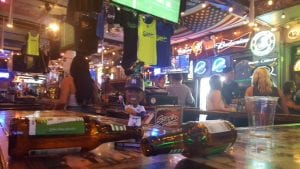
That is obvious, but what many fans don’t realize is the unexpected results of games not being played.  Baseball scouts have no players to scout. Players miss playing as much as fans miss watching, maybe even more so.  Businesses around spring training sites have taken a financial hit when spring training was halted. Businesses around major league stadiums have no business.  A good example of that is the famous Stan’s Sports Bar in the Bronx.  It’s a huge bar where hundreds of fans meet on game day and every day.  Usually bustling with Yankee talk, the bar and other bars and restaurants remain dark.

Many don’t realize that many ex-Yankees rely on the baseball season to still earn a living off baseball.  Players like Goose Gossage, Mickey Rivers, Dwight Gooden rely on appearance fees at baseball parties, conventions, and all types of events, like celebrities golf.

“My living is baseball camps, clinics, appearances at the ballpark. Everything is baseball,” Dwight Gooden said. “Everything’s on hold. I’ve got seven kids, six grandkids and two ex-wives. They don’t want to hear that. They just want to know where their check is.”

Hall of Famer Goose Gossage, although not hurting, also depends upon a baseball season and the appearances it allows.  Gossage on if he misses it said:

“Do I enjoy my appearances? Absolutely. It keeps my head above water,” Hall of Famer Goose Gossage said. “Being with the fans and doing some things, it allows my baseball life to keep giving.”

These are just a few of the unexpected consequences of no baseball.  There is a definite domino effect that financially that rumbles through the baseball world, from workers not working to cities, not collecting revenue and businesses going dark.

The MLB Draft

The 2020 baseball draft was supposed to happen between June 3 and June 5.  That now has been pushed back to sometime in July.  It has also been reduced from 40 rounds to something like 5 to 10 rounds.  Its also a new world with baseball scout pouring over stats, talking to people, rather than watching players play.  There are no high school or college games being played during this coronavirus pandemic.

Because of how the New York Yankees played last year, they have the 28th draw in the draft.  As it stands now, they are eyeing RHP Tanner Burns of Auburn College, RHP Cade Cavalli of Oklahoma, shortstop Casey Martin, among others.

New York Yankees scouting director Damon Oppenheimer recently said:

“In terms of scouting, we’re doing a lot of the same reports or watching video or looking at stats or digging deep into their performance history.  We’re just not used to not watching a baseball game and not meeting face-to-face with baseball people to talk about players. We’re just not getting out to do what you love to do and that’s watch and scout a baseball game.”

This week in New York Yankee history

In 1951 the voice of Yankee Stadium first echoed through the stands as the legendary Bob Shepard welcomed fans for the very first time.  Little did he know at the time, but he would be making that greeting for the next 56 years.  Also, on the same day, further Yankee star Mickey Mantle made his major league debut. The 19-year-old would go 1-4 in a Yankees win over the Red Sox.

In 1967 something big changed for the New York Yankees.  When the famous Lou Gehrig retired from the Yankees in 1939, the Yankees were left without a captain for the next 28 years.  But upon the insistence of owner George M. Steinbrenner, a new captain would be named.  This week 44 years ago, catcher Turmon Munson would be called the new Yankee captain.

Going back 108 years, the Yankees (then the Highlanders) responded to another disaster, unlike the coronavirus.  They raised $9k ($240k in today’s money).  They raised the money by putting on an exhibition game between the then New York Giants and the Highlanders at the New York Polo Grounds.  The disaster relief was for the victims of the Titanic that had recently sunk in the Atlantic after hitting an iceberg.