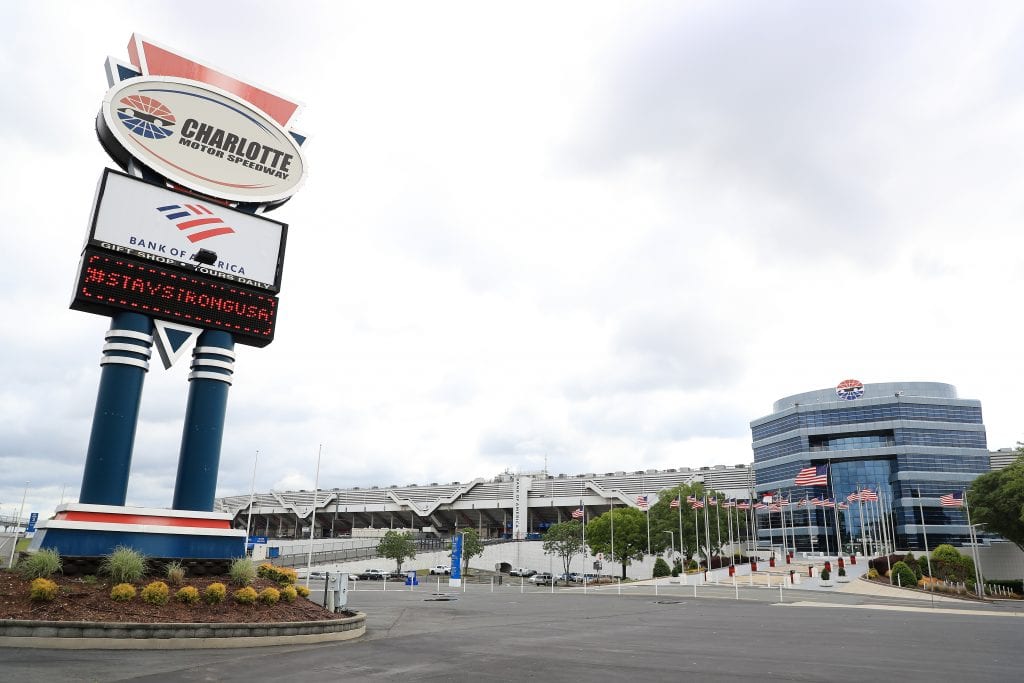
NASCAR: Kevin Harvick finally earns a win at Pocono Raceway

A bold strategy allowed Kevin Harvick to win at the Tricky Triangle on Saturday, the first half of a rare weekend doubleheader.

For Kevin Harvick, the 39th time at Pocono Raceway was the charm.

Harvick took home his third win of the NASCAR Cup Series season and his first at Long Pond, Pennsylvania landmark known as “The Tricky Triangle” in his 20th season on the circuit. His win at the Pocono Organics 325 in partnership with Rodale Institute also marks the 52nd career Cup victory of his career.

“Everybody from Stewart-Haas Racing has done a great job. We’ve had really fast cars every time we’ve come to Pocono, just hadn’t got to Victory Lane,” Harvick said in a postrace Zoom conference. “It was definitely awesome to get to Victory Lane today with our Busch Beer Ford.  Proud of all the men and women at Stewart-Haas Racing for everything they’re doing right now.”

Harvick won with a bold strategy instituted by he and crew chief Rodney Childers. The No. 4 car pitted on lap 66 of 130 but only took two tires. In the early stages of the final 53-lap stage, he and teammate Aric Almirola were running in the top two spots when each hit pit road with 37 circuits to go. Duplicating the two-tire strategy, Harvick emerged from pit road with about a 12-second advantage over his Stewart-Haas teammate that had won the second stage and led the most laps on the afternoon/early evening.

The win at Pocono was the first win for both Harvick and Childers. They previously had collaborated on four runner-up finishes at Long Pond and Childers brought over an additional such finish while working with Mark Martin in 2012. Harvick has now won at every track on the Cup Series circuit with the exceptions of Kentucky and the Charlotte road course. He’ll get the respective opportunities on July 12 and October 11.

“I want to win everywhere,” Harvick said. “As well as we’ve run here, you definitely talk about it. For us, it was kind of one of those things where you joke around about it. We’ve run plenty good enough to win races here. It’s kind of like Texas. We finally knocked down that wall and won three years in a row.  Hopefully that’s the same trend that happens here at Pocono.”

There’s hardly any time for Harvick to celebrate the victory, as the Cup Series immediately returns to action in Long Pond on Sunday for the Pocono 350 (4 p.m. ET, FS1), which will run 10 laps and 25 miles longer than its predecessor. With the top 20 of the starting lineup set up through inversion of Saturday’s results, Harvick will have to start 20th. Drivers are also mandated to use the same car than ran in the 325-mile event.

That was the reason Harvick opted not to perform a celebratory burnout after scoring his victory. Even if he wasn’t planning on saving the motor for Sunday, Harvick declared that he has no interest in celebrating until fans are back in the stands on a full-time basis and he can celebrate his triumphs in victory lane with his race team.

“‘Im not doing any more celebrations with nobody out there to celebrate with. Until the fans come back, I’m not doing a burnout, standing on the car, doing any of that stuff. It doesn’t feel right not having my team in Victory Lane,” Harvick said. “We miss the fans. I miss my team being able to be right in there with us because those are the guys and gals that are making it happen. It’s tough to give an elbow bump or wave at them.”

The pole-sitter Almirola (having won the position through a random draw) finished third behind Denny Hamlin while rookie Christopher Bell finished a career-best fourth. Hamlin’s Joe Gibbs Racing teammate Kyle rounded out the top five.

Race Notes

  • The 350-mile event will actually be the final of three Sunday races at Pocono. All three of NASCAR’s national series will be racing on the same day for the first time in the association’s history. The Gander RV & Outdoor Truck Series race, the Pocono Organics 150 to benefit Farm Aid was originally supposed to be run on Saturday but was postponed due to inclement weather (9:30 a.m. ET, FS1). In the middle will be the Xfinity Series’ Pocono Green 225 Recycled by J.P. Mascaro & Sons (12:30 p.m. ET, FS1). The Cup Series itself saw their own Saturday event delayed by an hour due to the aforementioned rain.
  • Ryan Blaney (12th) saw his streak of consecutive top-five finishes end at four. Blaney nonetheless moved up to the runner-up spot in the current NASCAR standings, 29 points behind Harvick.
  • Michael McDowell (8th) earned his first top-ten finish at a track other than Daytona and Talladega since the November 2016 race at Homestead-Miami Speedway. Driver of the No. 34 Ford for the underfunded Front Row Motorsports, McDowell has finished in the top 20 in seven of the last nine races.
  • By virtue of his 20th place finish, Ryan Preece will Sunday afternoon’s pole-sitter. Preece previously earned the pole at May 20’s Darlington race via the same method. Austin Dillon finished 19th and will start alongside him in the front row.
  • Tyler Reddick and Erik Jones were each involved in a tough wreck in the front stretch that played a major role in forming the latter stages of the Cup Series playoff picture. Reddick entered holding the 16th and final postseason seed, beating Jones out by a single point. Jones’ No. 20 Joe Gibbs Racing Toyota was forced to the garage, relegating him to a 38th-place finish. Reddick managed to get back on the track to finish 30th. He continues to lead Jones by eight points for the final spot on the playoff grid.
  • Quin Houff also failed to finish after he was involved in a wreck on lap 16 while B.J. McLeod was ousted due to a transmission failure.

For full results, click here

For full standings, click here

Geoff Magliocchetti is on Twitter @GeoffJMags

NASCAR: Drivers ready for fresh, new chaos at Talladega

NASCAR’s visits to Talladega Superspeedway have always been unpredictable, but adjustments to Sunday’s race could bring a new form of bedlam.

The NASCAR Cup Series’ yearly pair of visits to Talladega Superspeedway produce untold gallons of sweat even during their normal visits in April and October. Affectionately known as “‘Dega”, the longest track on the circuit (2.66 miles) routinely hosts tightly-packed racing and speeds that regular linger around 180-190 miles an an hour. These factors often play a big role in producing “The Big One”, the name given to the multi-car pile-ups that can turn contenders into afterthoughts in the blink of an eye.

Now add a new rules package and a lack of practice and testing…all on the first full day of summer.

The potential for chaos in Sunday’s GEICO 500 (3 p.m. ET, Fox) became so great that NASCAR forced James Davison to push his series debut a week. Davison, an Australian-born driver whose experience has come mostly on the open-wheel and sports car disciplines, was set to pilot the No. 77 Chevrolet for Spire Motorsports (the car that won last year’s rain-shortened summer race at Daytona with Justin Haley behind the wheel), but NASCAR rescinded their approval just days prior to the race. Davison will instead premiere at next weekend’s doubleheader at Pocono Raceway and was replaced by B.J. McLeod (who will start 30th).

NASCAR’s ability to be one of the few American sports leagues running during the coronavirus pandemic has been built on its ability to shorten race weekends from a whole weekend to a single day. Cup Series haulers arrived at Talladega on Saturday evening while the lower-tier Xfinity circuit ran its 300-mile event (won by Haley). In this shrinking process, practices and qualifying have been eliminated (save for a session prior to last month’s Coca-Cola 600 in Charlotte) and the field has been set by either inverting the finishing order from the prior race or through a random draw. That latter format is how Martin Truex Jr.’s No. 19 Joe Gibbs Racing Toyota will lead the field to the green flag on Sunday. In another metaphorical victory lap for the sport, Talladega will welcome in 5,000 fans to the race.

Those who repopulate the grandstands will see 40 cars take their first laps in a track characterized by its chaos. It’s an idea that makes even some of NASCAR’s most seasoned names a bit more cautious. Kurt Busch, for example, is worried not about his No. 1 Chip Ganassi Racing Chevrolet, but rather how other cars will be as they pack into Talladega’s congested lanes.

“With our group at Ganassi and the restrictor plate races that we’ve run together, our set-up balance has been really good in practice right off the truck,” Busch said in a Friday afternoon press conference. “So there haven’t been those challenges of where are we for balance, it allows go on offense right away. The problem with that is other teams. Are they just as good right off the truck? We don’t need to be caught up in a goofy situation early-on.”

Talladega is one of two “restrictor plate” tracks on the NASCAR circuit, the other being Daytona. Installed at an engine’s intake to restrict air and limit its power, the concept was introduced in 1987 and used through last season’s Daytona 500. Currently, NASCAR uses a modified plate concept known as tapered spacers similar to the ones used on other tracks and effectively keep the cars under 200 miles an hour. These modifications are for the safety of the drivers and fans but produce tight racing that often led to massive get-togethers in the cramped asphalt quarters.

Further safety innovations now come into play as NASCAR prepares to make its first visit a restrictor plate track since the most recent Daytona 500 in February. That race ended in near-tragedy, as Ryan Newman’s No. 6 Roush Fenway Racing Ford was involved in a violent airborne wreck while going for the win on the final lap. In the tense aftermath, Newman was removed from the mangled car and taken to the hospital, where he was diagnosed with serious but non-life-threatening injuries.

Two days later, Newman walked out of the hospital unassisted, accompanied by his daughters Brooklyn and Ashlyn. A head injury sustained in the accident temporarily sidelined him, but the pandemic-induced pause caused him to miss only three Cup Series events. Ironically, a safety feature known as the “Newman Bar” (a bar across the front of the car’s roll cage) was the result of Newman’s crusade to improve driver safety after he was involved in a separate airborne wreck at Talladega in 2009. Some credited the innovation for saving Newman from further injury in February.

Though Newman walked away relatively unscathed, NASCAR made some further adjustments in the name of safety to Talladega set-ups. Smaller holes in the tapered spacers will lead to lowered horsepower and the elimination of aero ducts on superspeedways could cut down on tandem drafting (further analysis on the changes can be found from Fox Sports’ Bob Pockrass here).

“The idea there is reducing the speeds of the car, slowing them down,” NASCAR’s Senior Director of Safety Engineering John Patalak explained in another conference call. “In general, when we can slow the speeds down, it’s going to be of benefit for the crash itself, for the driver in the car. It will also affect the loads on the vehicle and how the SAFER barrier responds. Directionally, it’s the right way to go.”

While the speeds are expected to be down, the fact that not a single lap has been run with such a setup only ensures the potential for chaos to rise.

Drivers, however, are confident in both their own and their rivals’ abilities to keep things under relative control. Ryan Blaney, the winner of last fall’s Talladega playoff event, was particularly excited about the new adjustments.

“There’s a fine line. You need the draft to work to where you get runs on cars, but not monstrous drafts where it’s dangerous to kind of block them and things like that,” Blaney said after a top-three run at last Sunday’s Dixie Vodka 400 at Homestead-Miami Speedway. “Hopefully, we can find a fair in between. I’m looking forward to it.  I know NASCAR did their research on hopefully trying to figure out a good balance of that.”

“I’ll know in the first couple laps how big the runs are, what kind of gap I need to have to the person behind me to give me the run forward. I’ll know pretty quick what to do with the package,” Homestead winner Denny Hamlin added. “I think we have probably a pretty good idea of it anyway. These ducts are actually a pretty new thing.  Obviously the horsepower being down, that might counter the ducts a little bit with the runs.”

“These drivers are so good, they’re going to figure it out pretty quick. I wouldn’t expect anything out of the ordinary.”

For those spaced out in the massive Alabama gallery, eager to see yet another exciting installment in NASCAR’s return, that last sentence is all they want to hear when it comes to Talladega.

Geoff Magliocchetti is on Twitter @GeoffJMags

NASCAR: Denny Hamlin takes home Cup Series-best third victory of 2020

Denny Hamlin swept all three stages of the Dixie Vodka 400 en route to the 40th victory of his NASCAR Cup Series career.

Denny Hamlin is giving an all-new definition to “Florida Man”.

Nearly four months after his victory at the season-opening Daytona 500, Hamlin pulled off a clean sweep at Homestead-Miami Speedway. The No. 11 Joe Gibbs Racing Toyota won all three stages en route to victory, his third of the 2020 season, at the Dixie Vodka 500. It’s Hamlin’s third victory at Homestead and the 40th of his Cup Series career. He joins 19 other drivers in that exclusive realm. Every member of the club has reached the NASCAR Hall of Fame with the exception of Hamlin and the three other active drivers (Jimmie Johnson, Kyle Busch, Kevin Harvick). Hamling previously took home the Toyota 500 at Darlington Raceway last month.

Weather threatened to end Hamlin’s dominance before it truly began. Rain showers delayed the start of the race by over an hour before a brief five-lap run that was stopped by lightning. Further strikes led to a delay of over two hours and one more awaited the drivers at lap 34.

Once the skies became relatively clear, Hamlin took over. He led a race-high 137 laps and became the first 2020 driver to take all three stages in his victory trek. The winning move came on lap 238 of 267 when he took advantage of pesky lapped traffic in the form of Joey Logano to pass Chase Elliott’s No. 9 Chevrolet. Elliott kept pace with Hamlin for a majority of the final laps, but an overzealous challenge at the lead in the last stanzas forced him to settle for the runner-up spot. Hamlin won the race by an 0.895-second margin and replicated Michael Jordan’s famous shrug after exiting the No. 11 Toyota for his postrace interview with Fox. The Jordan Brand is one of No. 11’s sponsors and Hamlin later revealed that the NBA legend was among the first to congratulate him on his victory.

The victory was the finishing touch on a joyful return for Hamlin’s crew chief Chris Gabehart. Hamlin’s second-year pit boss was suspended for four races when ballasts fell out of the No. 11 at the start of the Coca-Cola 600 on May 24 in Charlotte. The two have since united for nine wins in 48 races together and collaborated on a fourth-place finish in last season’s championship standings.

Elliott settled for second-place, his third top pair placing over the last seven races. Ryan Blaney also continued a hot streak in third (his fifth top-four finish over the last six events) while rookie Tyler Reddick came in a career-best fourth. Aric Almirola rounded out the top five, his first such finish of the season.

The NASCAR Cup Series returns to action next Sunday afternoon for the GEICO 500 at Talladega Superspeedway (3 p.m. ET, Fox).

Race Notes

  • Spectators returned to the track on Sunday, as 1,000 South Florida servicemen and women and first responders were welcomed into the grandstands. Florida Governor Ron DeSantis was also in attendance and opened the race by waving the green flag prior to the first lap. Next weekend’s event at Talladega, Alabama will up the ante with 5,000 fans in attendance.
  • New Orleans Saints running back Alvin Kamara was also in attendance, welcomed as a guest by NASCAR. Kamara was adorned in gear supporting Bubba Wallace, who drove the No. 43 Richard Petty Motorsports Chevrolet to a 13th-place finish.
  • Back in March, Hamlin also won the Dixie Vodka 150 at a virtual recreation of Homestead on the iRacing platform. The event was part of the eNASCAR Pro Invitational iRacing Series formed during the coronavirus-induced pause.
  • Hamlin is one of three of Homestead Cup Series winners that has yet to win a Cup title, joining Greg Biffle and Carl Edwards (the trio own a combined 77 circuit wins between them). Each of the 11 other winners has won at least one championship on the premier circuit.
  • All three NASCAR national series ran races at Homestead this weekend, but, for the first time since 2001, the track will not play host to the circuits’ season finales. Phoenix Raceway will have the honors for the first time in November.
  • Sunday was an eventful excursion for Austin Dillon. Hours before the race, Dillon and his wife Whitney welcomed their first child, a son named Ace. Dillon later overcame a pit road penalty to pilot his No. 3 Richard Childress Racing Chevrolet to a seventh-place finish.
  • Reddick’s fellow Rooke of the Year contender Christopher Bell finished a career-best eighth. The two became the first rookies to finish in the top ten at Homestead since David Ragan did so in 2007.

Geoff Magliocchetti is on Twitter @GeoffJMags


NASCAR: Shortened weekday races earning rave reviews

Shortened, weekday NASCAR races have become a necessity as the circuit tries to complete its full slate. But drivers are loving the change.

Unlike their NFL counterparts, NASCAR’s attempts at Thursday night proceedings earned some positive reviews.

With the circuit emerging as the first North American team sports unit to return from its coronavirus-induced hiatus, NASCAR has embarked on an ambitious plan to complete its full schedules. Such an endeavor required the premier Cup Series, as well as the lower-tier Xfinity and Truck circuits, to run races beyond their normal weekend timeslots. The latest endeavor came on Thursday night, as a busy week at Charlotte Motor Speedway wrapped up with the Alsco Uniforms 500 at the Cup level. Weather played a factor in the Thursday scheduling, as storms from Tropical Depression Bertha washed out the original date on Wednesday. CMS had previously played host to the Cup Series’ Coca-Cola 600 on Sunday as well as Xfinity and Truck races earlier in the week.

Fans old and new have been treated to the exciting racing NASCAR has become known for, but there have been some changes. To turn race weekends into single-day events, qualifying has been mostly eliminated, as has practice. These races have also been run sans spectators and in front of limited in-person media. Social distancing mandates have also limited the number of team personnel at the track.

(Photo by Jared C. Tilton/Getty Images)

The plan, while ambitious, was rife with concerns. Was it right to subject drivers to such a workload? How would drivers work without on-track practice? Could social distancing realistically be maintained?

So far, NASCAR has been able to alleviate these concerns, giving other sports a model to follow as they slowly start to make their own plans toward a revival. They might be learning a thing or two about their own sport along the way.

Weekday races haven’t been perfect. The weather has been a bit uncooperative (a Cup event at Darlington Raceway ended early and both Charlotte races featured delays) and there have been some early on-track incidents in the early going of some races (i.e. Garrett Smithley and Joey Gase wrecking on Thursday’s opening lap). But, in rare unanimity amongst participants, the drivers are responding well.

“I feel really good,” Thursday winner Chase Elliott said about the short turnaround time in a postrace Zoom conference call. “I feel like I tried to stay biking and doing things throughout those two months off, and honestly coming back and going back to Darlington where it was hot and then coming into the 600, it kind of just threw us back right to the wolves, and I think that was really a good thing just to really get some hot races and some long races in right off the bat and just jump right to it.  I feel good, and I’m certainly tired, it’s been a long week, but I’m going to rest these next couple days and get ready for Bristol.”

One of the most glaring differences in the weekday events is how long they last. Whereas most races operate by miles, often those seen in the race’s label, the races run during the week have gone by titular kilometers. The Alsco Uniforms 500, good for 208 circuits around a 1.5-mile oval, was the shortest-ever Cup Series event held at Charlotte, which is best known for hosting the longest race in NASCAR (the aforementioned Coca-Cola 600).

Everyone loves to go racing, but some drivers actually prefer the short lengths. The difference has also been seen on a different kind of stopwatch. Thursday’s race, removing the circa 75-minute rain delay, took just over two-and-a-half hours to finish. Thursday’s runner-up Denny Hamlin likened such a runtime to a regulation NBA contest.

“Heck with tradition; you’ve got to advance with the times,” said Hamlin, the winner of the Cup Series’ previous weekday event at Darlington’s Toyota 500. “I think that keeping people’s attention span for three hours is a good thing. It’s a very good thing. These cars are different now than what they used to be.  It used to be a battle of machine, you’re going to wear out your tires and your brakes and whatnot. They just don’t wear out anymore, so essentially it just becomes a long race after that.”

Elliott himself felt that the shortened race raised the on-track tenacity, in contrast to the time-biding strategies often seen in lengthy events like Sunday’s 600-mile competition.

“I think it’s great. I think it ups the intensity. I think you have to have your car driving really well from the start, and if it doesn’t, you have to make those big swings early.  I feel like it just ramps up the intensity and everything that comes with that. Just the clock is ticking and you don’t have a lot of time to do much of anything.”

The pace of play argument has become prevalent across major sports. Baseball has perhaps led the way with numerous time-saving proposals (including pitch clocks and opening extra innings with a man on base. One of the XFL’s tenets before its cancellation was maintaining a manageable game length.

Weekday races could well become the new norm, even when sports and society begin to revert to even more familiar settings. It could be one of the ways NASCAR maintains the newfound popularity it has discovered through fans perhaps biding their time until their usual favorite sports return.

NASCAR’s season is far longer than its competition, beginning with candies on Valentine’s Day and running until its end breaches the Thanksgiving turkey’s territory. It’s good to leave an impact on the calendar, but with such a long season comes the challenge of making every single portion relevant. NASCAR’s biggest event remains the season-opening Daytona 500 but its ten-race playoff proceedings happening in the heat of fall’s jam-packed schedule. Basketball on both the professional and amateur levels is reopening, as is the NHL. The NFL season is in full swing, and their college counterparts are battling for bowl and playoff positioning. The fact that a majority of NASCAR events are held the weekend during popular exploits on the gridiron can serve only as a detraction. Even in NASCAR’s supposed southern hubs, viewership isn’t guaranteed. It’s cruel to convince a fan in, say, Alabama to choose between Talladega and Tuscaloosa.

Weekday races could be a way to create autumn separation.

If anything, NASCAR’s status as one of the only major professional team sports leagues operating gives it a chance to experiment as they continue to roll out their slate. The Cup Series enters more familiar territory with a Sunday race at Bristol Motor Speedway this Sunday (3:30 p.m. ET, Fox), and there’s at least one experiment coming. On Wednesday, June 10, Martinsville Speedway will host its first-ever night race. That event is currently the last weekday event on the slate (with the exception of some previously scheduled Truck races) but the modern flexibility afforded (NASCAR currently has races confirmed through June 21) could change that.

If the drivers’ comments are any indication, they’ll certainly hope for some revisions.

“I certainly like the change, and on a weeknight time slot that we have, it’s got to be tightened up anyway, so I think this was a good taste of it,” said Hamlin, driver of the No. 11 Joe Gibbs Racing Toyota. “They’ll gather the data and figure out what’s best for them in the future.  Maybe it’s keeping them long, I’m not sure. Let the people that know a lot more about it speak on it.”

Geoff Magliocchetti is on Twitter @GeoffJMags 
NASCAR: Denny Hamlin wins shortened, fiery Darlington finale

A rare foray into weeknight racing produced fireworks for NASCAR, whose Cup Series event on Wednesday ended in rain and controversy.

The NHL and NBC may have abandoned the concept, but the NASCAR Cup Series apparently ensured that “Wednesday night rivalries” were alive and well in the most recent stage of their return at Darlington Raceway.

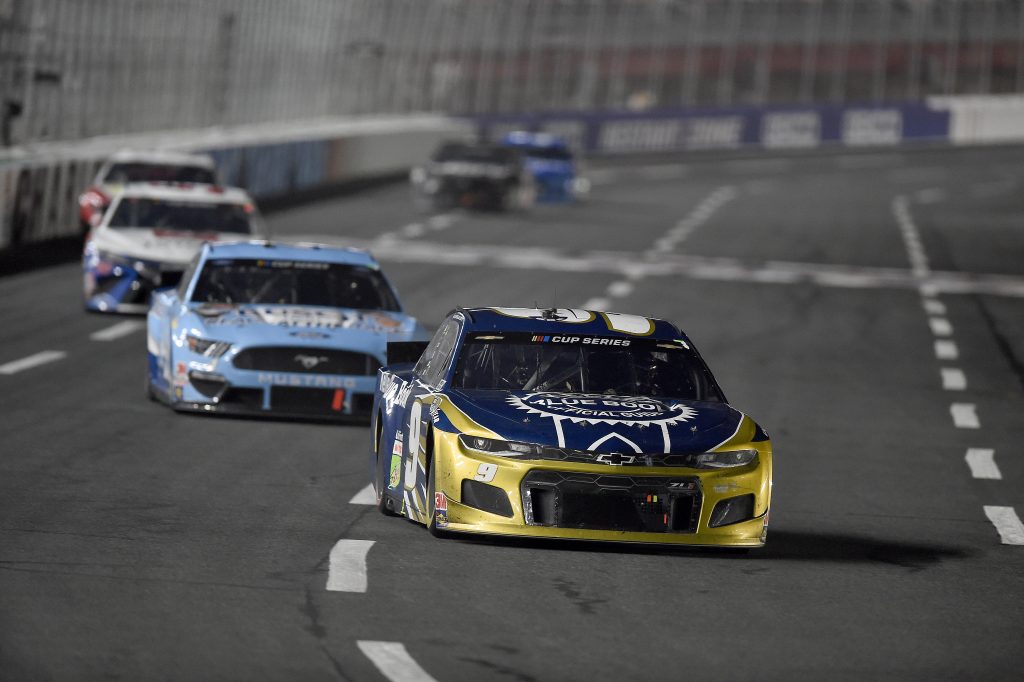
Wednesday’s Toyota 500 ended in a literal storm, as Kyle Busch clipped Chase Elliott’s No. 9 Chevrolet with 28 laps to go, sending Elliott’s car into an inside wall. The caution flag emerged, but as the skies opened up after eight laps under the yellow, the active leader Denny Hamlin was awarded the victory. Hamlin’s No. 11 Joe Gibbs Racing Toyota team brings home their second trophy after winning the season-opening Daytona 500 in February.

“I just love the racetrack. It’s one of my favorites, certainly in my top two or three,” Hamlin said in a postrace conference call hosted on Zoom. “I think it’s a driver’s racetrack. I think the driver can make up a little bit of maybe what his car doesn’t have with moving around the racetrack, different lines, throttle, and brake application. There’s a lot of things that a driver can do to make his performance better at this type of racetrack. That’s why I like it so much. Really from my very first start here in the Xfinity Series back in 2004, I just took to it quickly. We’ve had a ton of success ever since. It’s been a lot of fun.”

Hamlin took the lead from Elliott at lap 197 of the event, which was scheduled to go 228 circuits (500 kilometers at the 1.366-mile egg-shaped track), as one of several drivers who decided to remain on the track after the penultimate caution came out for a Clint Bowyer spin caused by a downed right rear tire. He was one of two cars (the other being the No. 21 of Matt DiBenedetto) that opted to stay out on the track while Elliott, Busch, and the rest of the lead lap cars pitted. Hamlin and DiBenedetto (who wound up finishing ninth) were working with tires that were just younger than ten laps old, pitting under another a prior caution accounting for a Matt Kenseth spin.

When the race got back to green, Hamlin held off a furious to challenge and avoided the carnage behind him. Rain was a constant threat all week (postponing an Xfinity Series race scheduled for Tuesday and delaying the Cup’s start time by two hours) and it finally made itself known with 20 laps to go. The competitors were brought to pit road and Hamlin was awarded the win after a brief attempt to wait the precipitation out.

After he received word of his victory, Hamlin revealed a humorous facemask adorned with the image of his smiling face. He certainly has reasons to be happy after the 39th Cup Series win of his career and his third at Darlington.

“(The mask) covers my face, covers everyone’s face. You’re kind of like, you really don’t get any sense of any emotion,” he said. “(I needed) to find someone that can paint me a happy face and a sad face. It depends on how the race finishes. We only had happy masks today, so I guess it was a sign that we didn’t need the sad one.”

Hamlin’s win, however, was overshadowed by the antics between his fellow Joe Gibbs teammate Busch and Elliott of Hendrick Motorsports. After Elliott emerged from his downed machine, he displayed his middle finger to Busch at the latter’s No. 18 Toyota was running his caution laps. Busch was later confronted by the No. 9’s crew chief Alan Gustafson. The longtime Hendrick employee previously served as Busch’s crew chief for three seasons when he drove the No. 5 Chevrolet during his first years at the Cup level (2005-07).

Busch took responsibility for the incident afterward. While he stated that he would reach out to Elliott and denied he spun him out intentionally, he mentioned that the incident was part of a normal racing experience.

“I’ve known him since he was 12 or 13 years old, been racing with him ever since then, late models, super late models, trucks, Xfinity cars, all that sort of stuff. Obviously I just made a mistake, misjudged the gap, sent him into the wall. That was entirely unintentional. Yeah, I mean, I’ll definitely reach out to him and tell him I’m sorry, tell him I hate it that it happened. All I can do. That doesn’t change the outcome of the night.”

“I can say whatever I can say. I’ve never been a very good politician anyways. His fan base is going to have the hatred to me anyways. I just deal with what I got to deal with. Rowdy Nation will have my back and we’ll go after it after that.”

Busch finished in the runner-up spot behind his teammate Hamlin. Kevin Harvick, who won the first half of NASCAR’s Darlington doubleheader in their return from a coronavirus-induced pause on Sunday, finished third, while Brad Keselowski and another JGR driver, Erik Jones, rounded out the top five.

This week’s Darlington doubleheader in Myrtle Beach, South Carolina was the first stage of NASCAR’s return, replacing previously scheduled events at Chicagoland Speedway and Richmond International Raceway. One more event will be run at Darlington this week, as the postponed Xfinity Series race will take place on Thursday (12 p.m. ET, FS1). Cup action returns to Darlington for the Southern 500 on September 6, the first race of the postseason.

The NASCAR Cup Series returns on Sunday in the form of the Memorial Day weekend tradition known as the Coca-Cola 600 at Charlotte Motor Speedway (6 p.m. ET, Fox). Such a race is NASCAR’s longest at 600 miles and will be the first part of a similar doubleheader format enacted at Darlington.

Race Notes

  • The race was one of heartbreak for Bowyer, who swept the first two stages of the race and led the most laps (71). His spin relegated him to a 22nd-place finish.
  • Harvick maintained his lead in the Cup Series point standings, leading sixth-place finisher Joey Logano by 34 points.
  • Hamlin’s third win at Darlington made him the 14th driver to earn at least a trio of Cup Series triumphs at the track, which hosted its first NASCAR race in 1950. David Pearson leads all drivers in Darlington wins with 10, while Hamlin is tied as the active leader with Jimmie Johnson.
  • Ryan Preece sat on the pole thanks to a 20th-place finish in Sunday’s event, as NASCAR, in an effort to limit on-track activity to a single race day, inverted the top 20 finishers in Wednesday’s starting lineup. Preece’s final slot wasn’t as desirable, as engine woes relegated him to the final spot of 39th.
  • Rookie John Hunter Nemechek was one of the more uplifting stories of Sunday, coming home ninth in his No. 38 Front Row Motorsports Ford. However, he brought out two cautions within the first ten laps, putting him six laps off the pace and into a 34th-place finish.
  • Not all news was bad on the rookie front. Christopher Bell posted a career-best Cup Series finish of 11th in the No. 95 Toyota of Leavine Family Racing.
  • All four Joe Gibbs Racing Toyota finished in the top ten, as Martin Truex Jr.’s No. 19 took the final spot.

For full results, click here

For full Cup Series standings, click here

Geoff Magliocchetti is on Twitter @GeoffJMags

The 2020 NASCAR season: 10 things you need to know as the sport returns

NASCAR is one of the first major North American sports leagues to return to live action. Here’s what you need to know as the season resumes.

Live sports are back, America, at least those of the pistoned variety.

NASCAR will be among the first major American sports leagues to return to live-action as the country continues to battle the COVID-19 pandemic. All three of the organization’s national circuits will return to action in the coming days, beginning with the premiere Cup Series. Proceedings get underway with the Real Heroes 400 at Darlington Raceway in Myrtle Beach, South Carolina on Sunday afternoon (3:30 p.m. ET, Fox). The Cup Series will run two races at Darlington (the other coming on Wednesday night) with a lower-tier Xfinity Series race commencing on Tuesday. Charlotte Motor Speedway will then host all three national realms (including the Gander RV & Outdoors Truck Series) next week, complete with the Cup Series’  traditional running of the Coca-Cola 600 on Memorial Day weekend.

The appetite of the American sports fan may lead to many new viewers for the sport. ESM has primed up what you need to know as things get back underway…

(Photo by Streeter Lecka/Getty Images)

1. The First Lap in Sports’ Return

While NASCAR is indeed making a return, the comeback won’t exactly be a fully typical day at the races. 

In adherence to ongoing social distancing policies, the scheduled races will predictably be run sans spectators. Media attendees will be kept to a minimum and there will be no qualifying or practice sessions. The starting lineup for Sunday’s race will be determined by random drawings through divisions via car owner points standings (i.e., a random drawing of the top 12 will make up the first dozen spots). Qualifying will still be run for the 600-mile race on May 24. 

Pit stops will also look different, especially during competition yellow flags that will be thrown at a specific point in the race (it will come on lap 30 of Sunday’s event). During these caution sessions, cars will not gain or lose positions, provided they beat the pace car out of pit road. Teams are also limited to no more than 16 individuals at the track.

Sacrifices are already being made. Several tracks (including Sonoma Raceway, Chicagoland Speedway, and Richmond Internation Raceway) had to give up their dates as NASCAR intends to run full schedules.

It’s certainly not the perfect storm, but drivers are looking forward to the challenges presented and are confident that they will be able to adapt to the necessary changes.

“We’re going to be able to do this and it should be pretty effective,” Denny Hamlin said in a conference call last weekend. “Obviously there will be a huge microscope on how we’re doing things, making sure it’s done in a safe manner. For all of us, it’s just the unknown of making sure we’re doing it the right way. After the first week, I think it will be easier and people will have a better understanding. Certainly the first week there will be some questions that I’m sure drivers will have.”

2. Getting Finer in Carolina

NASCAR’s return comes in familiar territory, its hub of the Carolinas. Two of its most familiar tracks will host the opening, with Myrtle Beach’s Darlington dropping the green flag next Sunday and Wednesday before Charlotte duplicates the process further north next week. Both tracks hold special places in the hearts of fans and drivers alike.

Darlington is renowned for its treacherous semi-egg shaped track, earning a reputation as “The Track Too Tough to Tame” thanks to drivers’ repeated encounters with the wall and each other. It has hosted NASCAR races since 1950. Nearly seven decades of exciting races have ensued. One such occasion was the 2003 Carolina Dodge Dealers 400, when Ricky Craven held off Kurt Busch in the closest finish in NASCAR history (0.002 seconds).

The unusual layout of Darlington often makes preparation and practice imperative, but that’s not possible in the current environment.

“The team aspect of things is going to be difficult because those guys are going to have to turn cars around, and your shop efforts are going to have to be really exceptional to prepare good cars,” William Byron said in another conference earlier this spring. “I think that, honestly for me as a driver, I’m just going to have to manage my time really well. I’m going to have to be in good physical shape but not be too worn out training too hard or anything like that.”

“I’m looking forward to seeing what that is like. I know our team on the 24 will do a good job of preparing and adapting to the circumstances, so I’m just looking forward to seeing how that plays out.”

After the Darlington events, the circuit shifts to Charlotte, the site of NASCAR’s headquarters and its Hall of Fame. Fans who are getting into the sport for the first time will certainly have their fill after the Coca-Cola 600. The race has annually been run on Memorial Day Weekend since 1961 and is the longest race on the NASCAR circuit at 600 miles (400 laps around the 1.5-mile track).

3. Feelin’ 22

If you’re looking for a name to root for, it’s probably not too late to jump on Joey Logano’s bandwagon. After all, it’s hard to top the year the 2018 Cup Series champion has been having so far.

The No. 22 Ford won two of the first four races on the Cup slate (including the most recent event in Phoenix) before its driver welcomed his second son alongside his wife Brittany last week. Logano holds the runner-up spot in the standings, a single point behind Kevin Harvick.

4. Hello, Newman!

The 2020 season began in February. as it always does, with the running of the Daytona 500. Hamlin’s third win in the event was overshadowed by a scary last-lap crash involving Ryan Newman. The No. 6 Ford was leading the race when it was inadvertently spun out by the No. 12 Ford of Ryan Blaney. Newman hit the wall hard, before his car flipped into oncoming traffic. After Corey LaJoie’s No. 32 machine slammed into Newman head-on, he crossed the finish line upside down in a shower of sparks.

After several tense hours, it was revealed Newman had sustained serious but non-life-threatening injuries. Less than 48 hours after the crash, he walked out of Halifax Medical Center alongside his daughters Brooklyn and Ashlyn. Newman would miss the next three races to recover while Ross Chastain temporarily took over his Roush Fenway Racing car. Darlington will mark his first time back in the No. 6 car since the accident.

The pause has left Newman in a manageable position in terms of the playoffs. He restarts competition 54 points out of a playoff spot, though a win would certainly solidify his case.

5. A Familiar Face in An Unfortunate Case

Newman isn’t the only NASCAR star of the 2000s returning to the track. Matt Kenseth has emerged from retirement to pilot the No. 42 Chevrolet for Chip Ganassi Racing. The ride was vacated after regular driver Kyle Larson used a racial slur during a streamed iRacing event.

Kenseth, the 2003 Cup Series champion, has 39 Cup wins under his belt, including two triumphs in the Daytona 500. Ganassi’s No. 42 has been rather successful with top ten finishes in each of the last four final standings. His most recent race was the 2018 season finale (subbing for the fired Trevor Bayne in Roush Fenway’s aforementioned No. 6), but his competition is wary that it won’t take much for Kenseth to rediscover his racing groove.

“From my standpoint, I’m like, I don’t want him back,” said Hamlin, a teammate of Kenseth’s at Joe Gibbs Racing for five seasons. “I know he gives great information. He can give an organization information. It’s another voice that that organization will hear that’s different than what they’ve had over the last few years. Not better or worse, but just different. So I think he’s probably going to lift that program up, similar to what he did to Roush towards the end. He’s my buddy, but I prefer him just to stay home at this point!”

6. See You Again

It’s obviously the least of our concerns at this point, but the pause created a level of awkwardness in the final season of full-time racing for Jimmie Johnson. The seven-time Cup champion confirmed that 2020 would still be his final season in Rick Hendrick’s No. 48 Chevrolet, refusing to budge from a plan established last November.

Johnson well might’ve been saving the best for last. After struggling over the past two seasons (his last win coming in June 2017 and missing out on the NASCAR playoffs for the first time in his career last year), the No. 48 began to resemble its old, victorious self. A late crash took him out of contention at Daytona but he followed it up with three consecutive finishes in the top dozen. That stretch includes a seventh-place showing at Auto Club Speedway in Fontana, California, the El Cajon native’s de facto home track and site of his first victory in 2002. Johnson was honored before the race and his family got things started by waving the green flag.

7. Cups by Hendrick

Johnson’s resurgence is only one of the positive stories coming out of the Hendrick Motorsports stables these days. The iconic race squad has amassed 16 NASCAR titles since its 1984 inception but had fallen on hard times in recent years. Granted, they were results other teams would potentially salivate over, but Hendrick cars have finished in the final standings’ top five only once since Johnson’s last title in 2016.

However, the team was on a roll at the time of the temporary shutdown. Hendrick’s quartet has united to lead 313 laps (led by Chase Elliott’s tally of 186) over the first four races and three of those drivers appear in the top five of the standings. Such a resurgence was prominently on display in Fontana, where Alex Bowman’s No. 88 led 110 of 200 laps en route to victory. While William Byron (currently 19th in the standings) may be struggling in the iconic No. 24 car, he was able to build momentum during simulated iRacing events that helped fill the void of sports in the pandemic’s early days. Byron won three of the seven virtual races run during the eNASCAR Pro Invitational iRacing Series. His teammate Bowman likewise earned a win at pixelated Talladega.

8. King of the Hill

Speaking of iRacing, no one emerged from the simulated circuit better than Timmy Hill.

Standings were not kept in the Pro Invitational Series, but mathematics and NASCAR’s point system determined that Hill emerged as the de facto champion of the temporary circuit. He finished every race on the lead lap and finished no worse than 11th. His success probably should’ve come as no surprise, as he’s closing in on making 1,700 iRacing starts.

Hill’s actual racing career has been far less illustrious. Trapped in racing purgatory of microbudget teams, his best finish to date is a 14th place showing at the 2017 Indianapolis race. But his iRacing showcase may have been his ticket to at least start to turn the corner. His MBM Motorsports team is simply looking to finish the season, a task that became incredibly more difficult when they were forced to let go 30 employees during the shutdown. However, his performance allowed them to gain some extra sponsors for both Hill’s No. 66 Toyota and the Xfinity program. Hill probably won’t be contending for a title any time soon, but his success in the iRacing proceedings and how a small-budget team performs in these uncertain economic times will certainly be worth watching.

9. Minor League NASCAR

If you’re really looking to fill the live sports void in your life, you might want to keep track of the lower-tier national circuits as well. Thus far, the Xfinity series (the NASCAR equivalent of AAA-level baseball) has been dominated by a legacy selection. 19-year-old Harrison Burton (son of former driver Jeff) has finished in the top five in each of the first four races so far, part of a torrid start to his early NASCAR career (which includes a 12th-place finish in last season’s Truck standings). He’s pursued closely by Chase Briscoe at three points behind.

The Gander RV & Outdoors Truck Series was only able to run two events before the shutdown. Grant Enfinger won the season-opening event at Daytona, besting Jordan Anderson by 0.010 seconds. Of note, Natalie Decker made history in that same race, as her fifth-place posting was the best by a female driver in Truck Series history. Veteran Truck Series driver Austin Hill currently leads the points in his No. 16 Toyota.

2020 NASCAR Cup Series Standings (After 4 of 36 Races)
Driver Points/Behind Wins Car/Primary Sponsor
1. Kevin Harvick 164 0 #4 Busch Ford
2. Joey Logano -1 2 #22 Shell/Pennzoil Ford
3. Chase Elliott -20 0 #9 NAPA Auto Parts Chevrolet
4. Alex Bowman -26 1 #88 Valvoline Chevrolet
5. Jimmie Johnson -33 0 #48 Ally Bank Chevrolet
6. Ryan Blaney -41 0 #12 PEAK Ford
7. Kyle Larson (out) -43 0 N/A
8. Aric Almirola -43 0 #10 Smithfield Ford
9. Matt DiBenedetto -46 0 #21 Menard’s Ford
10. Brad Keselowski -46 0 #2 Miller Lite Ford
11. Denny Hamlin -53 1 #11 FedEx Toyota
12. Kyle Busch -53 0 #18 M&M’s Toyota
13. Clint Bowyer -59 0 #14 Rush Trick Centers Ford
14. Chris Buescher -62 0 #17 Fastenal Ford
15. Martin Truex Jr. -68 0 #19 Bass Pro Shops Toyota
16. Kurt Busch -74 0 #1 Monster Energy Chevrolet
NASCAR PLAYOFF CUTOFF LINE (Points behind 16th)
17. Ricky Stenhouse Jr, -2 0 #47 Kroger Chevrolet
18. Bubba Wallace -3 0 #43 World Wide Technology Chevrolet
19. William Byron -3 0 #24 Axalta Chevrolet
20. Austin Dillon -13 0 #3 Dow Chevrolet
21. Erik Jones -13 0 #20 SportClips Toyota
22. Cole Custer (R) -17 0 #41 Haas Automation Ford
23. Corey LaJoie -22 0 #32 RagingBull.com Ford
24. Ty Dillon -22 0 #13 GEICO Chevrolet
25. Tyler Reddick (R) -22 0 #31 Caterpillar Chevrolet

10. The Standings and the Playoff

Now a good a time as ever to update you on the NASCAR playoff picture.

As has been customary, the current plan is to run 26 “regular season” races. After such races, 16 drivers are invited to the ten-race “playoff” session. The easiest way to reach the playoffs is by winning races and finishing in the top 30 in points. If there are fewer unique winners than playoff spots, the rest of the field is filled via points. Once the playoff begins, each qualified driver’s point total rests at 2,000.

Drivers are seeded by a number of combined factors that accumulate into playoff points. These special tallies are earned via individual victories (five points each) and winning in-race stages (one point). The regular season champion also earned an additional 15 playoff points.

Once the playoff begins, elimination rounds are held in three-race increments. Drivers can automatically advance to the next round by winning one of three races in the interim. Four drivers per round are eliminated leading up to final, tenth race in which the best finisher wins the title.

Geoff Magliocchetti is on Twitter @GeoffJMags


NASCAR: iRacing winner Denny Hamlin feeling confident as NASCAR nears return

Denny Hamlin completed a bookend of victories in NASCAR’s virtual setup. Afterward, he talked about the circuit’s return to real racing.

Denny Hamlin has accomplished plenty over 16 seasons of FedEx-branded racing in the NASCAR Cup Series. His trophy case holds three Harley J. Earl Trophies (earned by the winner of the Daytona 500), the 2006 Cup Series Rookie of the Year Award, and the laurels from 54 other races over NASCAR’s three national series. He added another victory on Saturday afternoon, winning the North Wilkesboro 160 virtual event on the iRacing platform.

His most cherished racing memory, however, might be a last-place finish.

The moment came when the driver of the No. 11 Joe Gibbs Racing Toyota was competing in an eNASCAR Pro Invitational iRacing Series race at a recreation of Talladega Superspeedway last month. Hamlin’s day was ended by no competitor, but rather someone bearing his name.

His seven-year-old daughter Taylor accidentally turned off Hamlin’s monitor during the race, putting him off the pace and relegating him to a posting of 39th in the event labeled the GEICO 70.

Taylor’s gaffe, as well as her father’s exaggerated reaction, immediately went viral. On Saturday, Hamlin declared he wouldn’t have traded the comedic sequence for anything on the track.

“To see Taylor’s shenanigans reaching huge media outlets in L.A., here, everywhere, on TMZ, that’s good,” Hamlin said in a conference call. “Even though I’m (angry) because my day is over, I wouldn’t have traded that moment for anything. I would take that moment and keep it versus winning Talladega.”

“To me, it was just something that I enjoy talking about. Taylor gets such a kick watching it, the highlights and everything that’s been put together about it. It’s just a life moment that, hey, even though we didn’t win, it didn’t turn out well results‑wise, it still was a life moment that was really good for both of us.”

The eyes of the nation will turn to NASCAR under more serious circumstances this week. Most North American sports organizations have been mired in “one step forward, two steps back” stagnance as the continent tries to reclaim some semblance of normalcy during the COVID-19 pandemic. NASCAR, on the other hand, has embarked on an ambitious plan to move forward.

Over the next few weeks, the NASCAR Cup Series will descend upon two of its most renowned tracks to restart its engines. The reopening begins on Sunday afternoon at Darlington Raceway in South Carolina (3:30 p.m. ET, Fox).

Myrtle Beach’s Darlington will host a second race next Wednesday night before the circuit holds another pair of races at Charlotte Motor Speedway. Among the latter track’s offerings will be the Coca-Cola 600 on May 24, continuing a Memorial Day weekend tradition dating back to 1961. The race is the longest event (600 miles) on the Cup Series ledger. NASCAR also plans to run races from its lower-tier national circuits, the Xfinity and Gander RV & Outdoors Truck Series, at the tracks as well.

 (Photo by Nick Laham/NASCAR via Getty Images)

Hamlin knows the series will be watched with great scrutiny as one of the first major leagues to return on the wake of the ongoing situation.

“I have two kids. They run a temperature all the time. It’s a little nervous for me knowing that you could get a fever or something like that, and it maybe will scare you into thinking you have something that you don’t,” Hamlin said. “Obviously, there will be a huge microscope on how we’re doing things, making sure it’s done in a safe manner. For all of us, (there is) just the unknown of making sure we’re doing it the right way.”

The Ultimate Fighting Championship showed just how hard a return can be. While many fans relished the proceedings in Jacksonville on Saturday night (held in an empty VyStar Veterans Memorial Arena), not everything went off without a hitch. Champion fighter Ronaldo Souza and two of his cornermen each tested positive for COVID-19 but the event was able to press on.

While on-track racing will make its return, it’s apparent the events over the next two weeks are the first phase of a full-on welcome back. After all, using Darlington and Charlotte as de facto bases of operation eliminated events at tracks like Sonoma Raceway, Chicagoland Speedway, and Richmond International Raceway.

The races will be run sans spectators and there will also be no qualifying (with the exception of the 600-mile Cup race) or practice sessions. Social distancing protocols will continue to be maintained. Hamlin, in fact, joked that the required six-feet of separation may be perfect for aggressive racing, as the heated confrontations seen after on-track get-togethers may have to be put on hold until the health situation is further under control.

“If there’s ever a time to be aggressive, probably ruffle some feathers, this is probably the time to do it,” Hamlin said with a laugh. “You don’t have to face consequences right after the race.”

Jokes aside, Hamlin’s confidence was a common theme of his call.

Directly declaring that “we’re going to be able to do this and it should be pretty effective”, Hamlin stated that NASCAR is a bit of advantage due to its status as a non-contact sport…at least in terms of bodies and not sheet metal.

“I’m pretty certain that no matter what, we’re in an advantage because we’re a non‑contact sport, especially with the players themselves,” he said. “I’m confident that we can go from our street car that we drive to the racetrack, into our racecar, not be within six feet of anyone, except for the person that is on the window net.”

Hamlin currently sits 11th in the Cup Series standings with 32 races remaining on the 36-event docket. He’s more or less guaranteed a spot in this fall’s postseason thanks to a win in February’s Daytona 500. Kevin Harvick is the current leader by a single tally over Joey Logano.

The virtual proceedings gave Hamlin a bit of momentum going into the resumption. Saturday’s victory allowed Hamlin to sandwich the Pro Invitational Series with a pair of victories, having also won the opening event at Homestead-Miami Speedway’s recreation back in March.

It should be perhaps no surprise that Hamlin was one of the more successful drivers during the simulations. He had made over 160 starts and had won 30 prior races before iRacing went mainstream.

Virtual races allowed NASCAR to maintain an audience on the networks of Fox Sports during the shutdown of sports. The Food City Showdown at Bristol Motor Speedway on April 5, for example, drew 1.3 million viewers. With team budgets rendered meaningless on iRacing, several new faces breached the top of the leaderboard. For example, Timmy Hill was the de facto “winner” of the Pro Invitational Series, determined to have been leading the points standings had they been kept. Hill is the driver of the No. 66 Toyota for the underfunded MBM Motorsports and has over 1,600 iRacing events under his belt. He finished in the top three (including a runner-up finish at North Wilkesboro) in all but one race.

iRacing also briefly brought some legends of the circuit of retirement. Four-time Cup Series champion and current Fox commentator Jeff Gordon ran the Talladega and North Wilkesboro events, while 2000 Cup champ Bobby Labonte worked as Hamlin’s teammate in a return to Joe Gibbs Racing. Other popular competitors included Dale Earnhardt Jr. and Greg Biffle. North Wilkesboro itself was another blast from the past, given a virtual resurgence after hosting its last NASCAR in 1996.

Hamlin believes the competition during the pixelated races will only up the excitement factor on the track.

“Throughout the entire week, guys are running hundreds and hundreds of laps at these tracks to get better because they want to put on a good showing, they want to be competitive. That’s what drives us to be the racecar drivers that we are in real life, is the fire to want to be better.”

“You have to use the same techniques that make you good in iRacing that make you good in real life. It’s not like playing Madden or NBA 2K where you’re using your hand‑eye coordination pushing the buttons. You’re using the gas, brakes, running two at the same time, steering wheel. Everything is the same.”

“I take pride in that. Hey, if everything is equal, I’ve won a couple of times, I feel pretty good about where I’m at as a driver. Certainly, I think there’s some confidence that will spill over for a few weeks.”

The real track will look a bit different once we get back underway. Returning to the track will be Ryan Newman, who restarts in Roush Fenway Racing’s No. 6 Ford. Newman was involved in a scary wreck at the end of the aforementioned Daytona 500 but walked away with relatively minor injuries.

Also due for a return is 2003 Cup Series victor Matt Kenseth, but his return comes under less pleasant circumstances. Kenseth will take over Chip Ganassi Racing’s No. 42 Chevrolet after its regular driver, Kyle Larson, was caught using a racial slur during an iRacing streaming event.

Hamlin, a close friend of Larson’s, condemned his comments while mentioning there could be a spot for his return in the future.

“Obviously he put himself in a really bad spot saying something that was totally inappropriate. But, you know, people make mistakes. A lot of people make mistakes. Hopefully, he’s back in Cup racing sooner than later,” he said. “I think if he wants to come back, there is a path for him back. He’s been doing all the right things as far as what I’ve heard.”

But the focus is now on the present, where Hamlin will look to chase down an elusive Cup Series title. He has finished in the top four of the final standings in four separate years, including a fourth-place finish last year.

The championship can wait for now. He’s only looking forward to the first laps at Darlington, as a green flag will signal not only the start of the race, but a potential step forward for a reeling nation looking for any semblance of good news.

“I trust my crew chief and team with Joe Gibbs Racing, we have enough smart people that we feel like this is a place where we can get an advantage,” he said. “Everyone thinks that, with all organizations. Hey, I trust my guys, and I like the unknowns.”

Geoff Magliocchetti is on Twitter @GeoffJMags