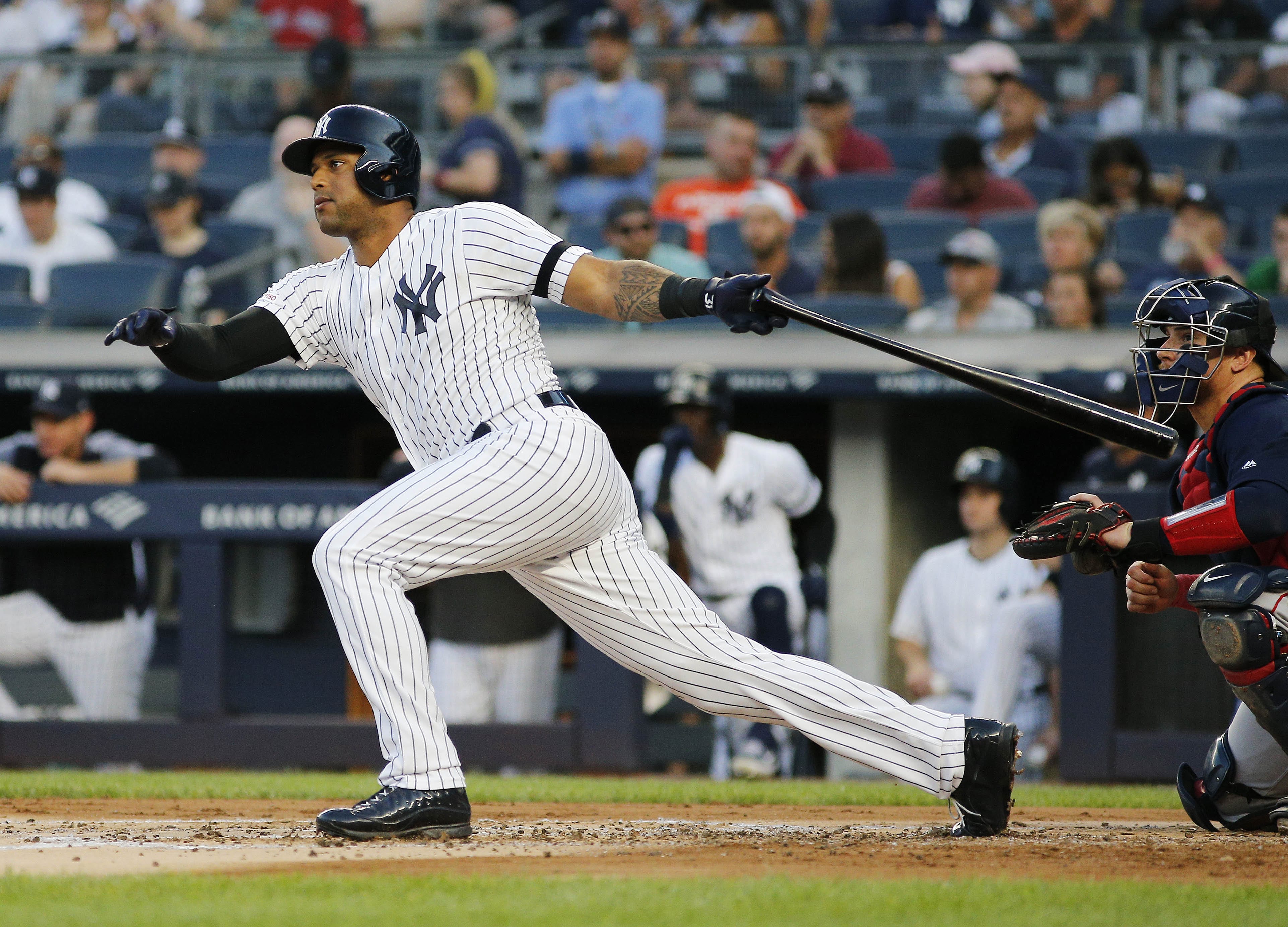
Yankees: Aaron Hicks ends his stint in the Dominican league with good sensations and acceptable numbers

New York Yankees, Aaron Hicks

New York Yankees’ center fielder Aaron Hicks finished his stint with Leones del Escogido in the Dominican League (LIDOM), after completing the 50 plate appearances he was initially assigned by the Bombers.

In a strong pitching league (the average league OPS is around .640), Hicks held his own considering that he hadn’t played competitive baseball since injuring his wrist in May. Overall, he was third in the team among players with at least 40 plate appearances with a .729 OPS.

The Yankees’ outfielder hit one home run and slashed .265/.321/.408, with nine RBI, four doubles, and five runs scored. He took four walks and struck out 10 times. He also stole two bases.

More than the stats themselves, the most important takeaway for the Yankees is that Hicks made it through his winter experience healthy and in one piece. The 2022 campaign is a big one for him, as he will try to prove that he can still be the Bombers’ starting center fielder. New York may or may not bring a capable outfielder to compete with him this offseason when the lockout ends.

The Yankees need him to find his 2018 form

Hicks peaked in 2018, when he slashed .248/.366/.467 with 27 home runs, 90 runs scored, 79 RBI, and 11 stolen bases. That year, he had a very solid 129 wRC+ and 5.0 Wins Above Replacement, or WAR.

He was limited to 59 games with the Yankees in 2019 because he needed Tommy John surgery, and his offensive performance collapsed all the way to a 103 wRC+. He returned to a 124 wRC+ in 2020, but his power was affected: he had a .189 ISO, his lowest mark since 2017.

He slumped badly in 32 games this year, with a .194/.294/.333 line and a 76 wRC+, and then injured his wrist: he suffered a torn left tendon sheath, forcing him to get surgery and miss the remainder of the season.

The Yankees wanted to see where he was at after missing such a high amount of games, and that’s why they sent him to the Dominican Republic, the most competitive Caribbean league. But he will need to have a strong spring training to dissipate any doubts about his future with the team.

New York Yankees Top 10’s: Worst acquisitions, is Aaron Hicks on the list?

In the 2021 season, the New York Yankees looked to improve their team. They re-signed DJ LeMahieu and brought back Brett Gardner for yet another year. They also hired 2-time Cy Young Award winner Corey Kluber and traded for Jameson Taillon to revamp the pitching rotation. They also made several minor league deals to accomplish their goals. None of the changes fared well. Corey Kluber and Aaron Hicks were out most of the year that saw the Yankees reach the Wild Card game, only to lose it to the Red Sox.

Now, as we approach the 2022 season, the Yankees were mostly inactive in the first part of the postseason. In the lockout, all is at a standstill, but when a new Collective Bargaining Agreement can be reached, the Yankees will have to act quickly to improve the team.

The Yankees, in their glorious history, have had some of the greatest players to play the game of baseball. Players like Babe Ruth, Mickey Mantle, Joe DiMaggio, Yogi Berra, Whitey Ford, Ron Guidry, Derek Jeter, etc. Some were farm-raised, and some were acquired.

For some franchises, paying too much for a player that doesn’t work out can be financially devastating. And it can take a club a long time to recover from that purchase. For teams more flush-like, notably the New York Yankees, those poor choices usually can be recovered from in a short time.

In other cases, a club gives up a prime prospect in a trade to get that player while significantly weakening their farm system when that player turns out to be a bomb.

When acquiring a player, the New York Yankees either have to spend money or trade players or a combination of both to get the player they want. Some have been amazingly successful, like Babe Ruth, Alex Rodriguez, El Duque, Roger Clemens, Roger Maris, Ricky Henderson, and many more.  But they also have had some bummers. Today we examine my picks for the Yankee’s worst acquisitions. I based my picks on how the Yankees performed and how much they had to pay to get the performance or lack thereof.  Picks are only from the modern era.

The Last time I wrote this article, Aaron Hicks wasn’t even on the list. But with all the injuries, poor play, and playing in only 32 games last season, he has pushed himself up to number 5 on this list. Also considered is that the Yankees gave him a seven-year extension for $70 million.

10. A. J. Burnett

When A. J. Burnett came to the Yankees in 2009 from the Toronto Blue Jays, where he had an 18 win season.  The Yankee contract with Burnett was for $85.5 million over five years. Burnett was one of those players like Kenny Rogers and, more recently, Sonny Gray that couldn’t adjust to the bright lights of New York Yankee Stadium.  In his three years before being traded to the Pittsburgh Pirates, he was 34-35 with an ERA of 4.79.

9. Pedro Feliciano

Pedro Feliciano was a two-year $8 million disaster with the Yankees. There is little to say here.  He required two shoulder surgeries after leading the AL with the most starts in the previous three years.  For the Yankees, he never pitched a game—end of the story.

8. Spike Owen

Owen was coming off a career year with the Expos, where he won a gold glove, hit .269, and racked up 24 extra-base hits.  He went to the Yankees from the Expos and was so bad at short that he didn’t even complete a year with the Yankees.  In 1993 the Yankees were in dire need of a shortstop with prospect Derek Jeter not yet ready.  So they paid $7 million for a three-year contract.  He hit .234 with a stinking .300 OBP.  The Yankees dealt him to the Angels to play out the contract.

7. Ed Whitson

If you thought Pavano and Igawa and were bad, Ed Whitson was worse.  The New York Yankees acquired Whitson in a five-year deal for $4.5 million from the Padres. For most of his career, he was a near ace pitcher but not for the Yankees.  What followed? Fifteen wins and a 5.38 earned run average over two years with the team. They dealt him back to the Padres in 1986, where they’d fork 90% of his contract the remainder of the deal. The only reason his isn’t higher on this list is that the Yankees didn’t lose many dollars.

6. Hideki Irabu

The big problem with the Irabu acquisition is that he was supposed to be the next great Yankee ace pitcher. He never even came close to being anything more than a 4th or 5th pitcher in the rotation. In his four years, starting in 1997, he went 29-20, 4.80 ERA, 64 starts, 74 games, 395 2/3 IP. For this, the Yankees had to pay the San Diego Padres $3 million to acquire him and give Irabu $12.8 million over four years.

5. Aaron Hicks

In 2019, general manager Brian Cashman gave Aaron Hicks a seven-year $70 million contract extension. It was a puzzle why he did it then and remains a puzzle. From 2016 to 2019, Hicks was an average fielder and only slightly above average at the plate. But from 2019 to date, he has been mostly a disaster, spending almost as much time off the field as on. Since the extension, he has played in only 145 games with a .223, 22 HR, 71 RBI, .748 OPS slash line. This past year alone, he hit just  .194 with four homers while driving in only 14 runs, playing in only 32 games due to back soreness and season-ending wrist surgery.

4. Kei Igawa

Wow-what a mistake this was.  Kei Igawa was a miserable pitcher.  The Yankees signed him to a five-year $20 million contract and paid a $26 million Japanese posting fee to get him in the first place.  In 2006 Igawa started for the Yankees at the major league level.  He was 2-4, 6.66 ERA, 13 starts, 16 games, and 71 2/3 innings for his first two years.  He was then demoted to Scranton Wilkes/Barre for two years and the third year with AA Trenton. While in the minors, Brian Cashman tried several times to send Igawa back to Japan, but Igawa refused to go.

3. Jason Giambi

Some may wonder why I have Giambi so high on this worst deal list. It’s not because he wasn’t a decent player because the Yankees paid far too much for a declining player.  There is no question that he was a star player for the Oakland Athletics.  His 40 points lower batting average with the Yankees did not deserve his $120 million seven-year contract.

While with the Yankees, the first baseman never was a Gold Glover, Silver Slugger, while only being an All-Star once and being nominated for MVP twice, in which he received few votes.  In 2004 due to injuries, he missed half the season.  Giambi was often a liability at first, leading him to play a lot of games as DH.  Oh, and then there was the whole doping thing.  After initially denying doing drugs, he admitted to injecting himself with human growth hormone during the 2003 season with the Yankees.

2. Carl Pavano

Carl Pavano is a pitcher that many Yankee fans don’t remember, as he was seldom on the mound during his four years $40 million deal. Pavano was a pretty average pitcher for the Florida Marlins until 2004; he had an 18-8 year, came in 6th in the Cy Young voting, and was an All-Star.  Based on this, the Yankees decided to take a chance on this break-out pitcher during the offseason. In his first year with the Yankees, he pitched in only 17 games for a 4-6 record and an ERA of 4.77.

His lackluster performance in 2005 was just the beginning things were about to get worse, much worse.  In 2006 he didn’t pitch at all due to injuries.  In his last two years with the Yankees, he pitched in only nine games between injuries.  His record was a dismal 5-2 with an ERA of 5.15. The Yankees were happy to be rid of him.

1. Jacoby Ellsbury

Without a doubt, in recent memory or Yankee history, the acquisition of Jacoby Ellsbury from the Boston Red Sox was the worst ever buy.  And that’s not only in how he performed. It’s what they had to pay for him to be away from the team the majority of his Yankee contract.  General Manager Brain Cashman is undoubtedly one of the savviest traders and purchasers in the business. But in this case, he missed the mark by a mile, not only in the original contract but how this player turned out.

Ellsbury was a good player for the Red Sox, but his best years were early in his center field career.  In 2011 he hit .321 with 32 home runs, and the guy could steal bases.  But he would never hit those figures again.  On December 3, 2013, Ellsbury and the New York Yankees agreed in principle to a seven-year, $153 million deal, including an option for an eighth year that could increase the contract’s value to $169 million. Mistake number one was that he was never worth this gargantuan contract, to begin with.

Ellsbury never enjoyed the fan praise that Red Sox acquisition Jonny Damon received, primarily due to his performance, which never reached the level that the money spent demanded.  In his Yankee employment, in the first four years, he only managed less than 10 home runs a year while hitting a league batting average of .264. That’s when a deplorable trade turned into a disaster.  In 2018 and 2019, Ellsbury never set foot on the field due to continued injuries, which led many Yankee fans to think he was faking it and just wanted to collect the money and not play.

At the 2021 season, Jacoby Ellsbury was finally off the payroll. Many wonder in the future if Giancarlo Stanton will be on this list. He has never been the player he was in his 2017 season with the Marlins, he is often injured, and his huge contract limits what the Yankees can do with new acquisitions. But, if his 2021 season is any indication of what he can become for the Yankees, he may go from consideration of worst to best acquisitions.

Dishonorable mentions go to Jose Contreras: 4-Years, $32 Million, paid too much for his 1 1/2 years, Kenny Rogers 4-Years, $20 million, ERA 5.12, Pascual Perez: 3-Years, $5.7 Million, drugs only won 3 games, Mel Hall: 4-Years, $4 Million, he kept the Yankees from the 1991 postseason due to his constant arguments with Don Mattingly, and finally Jaret Wright: 3-Years, $21-Million, when he became a Yankee his body fell apart.

Most of the New York Yankee bomb acquisitions have been pitchers strangely, but luckily for the Yankees, they have had far more successful acquisitions, and being a rich franchise has been able to handle those that weren’t.

EmpireSportsMedia.com’s Columnist William Parlee is a member of the Society for American Baseball Research.  Follow me on Twitter @parleewilliam.

The Yankees have a huge liability in the outfield that must be solved

New York Yankees, Aaron Hicks

New York Yankees general manager Brian Cashman indicated that he may target another outfielder this off-season in free agency. Allowing Clint Frazier to walk and rejecting the club option of Brett Gardner leaves a hole in the outfield, but it is not the reserve spot he needs to ponder, it is the starting center field spot housed by Aaron Hicks.

Hicks, who signed a seven-year, $70 million deal back in 2019, is going into the fourth season of his contract after being injured for two of the first three years. He’s set to earn a base salary of $10.5 million at 32-years-old, but since the deal only ends in 2025, the Yankees are on the hook for a significant amount of money moving forward.

The veteran outfielder played in just 32 games this past season after featuring in 59 back in 2019 when his contract started. Last year, he recorded a measly .194 average with four homers and 14 RBIs. His 23.8% strikeout rate was the highest since 2019 and 11.1% walk rate was the lowest since 2016.

The very moment he signed that long-term extension his play quality dipped significantly, leaving the Yankees with a major problem in center.

Attempting to work his way back from the issues, Hicks played in the Dominican Republic’s Winter League which ended this past Thursday. Over 12 games, Hicks recorded a .265 average with one homer, nine RBIs, 10 strikeouts, and a .729 OPS.

While his numbers during the Winter League are respectable, the Yankees ultimately need to consider potential replacements. One player they have been linked to is Japanese star Seiyu Suzuki, who could take over in right field, moving Aaron Judge to center. Hicks can be a glorified reserve and designated hitter in the lineup, given his switch-hitting abilities.

There are a few other options Yankees can consider in free agency, including Kevin Pillar or even Ketel Marte in a potential trade. One way or another, Cashman has to make a decision at a spot that is currently owned by a liability in Hicks, who left the Bombers gasping for air with Gardner at the end of his career and Frazier dealing with vertigo.

Yankees News: Star Japanese free agent shuns the Red Sox, former Yankee signs with Korean team

Seiya Suzuki, yankees

The New York Yankees were recently listed as an aggressive player in the sweepstakes for Japanese stud outfielder Seiyu Suzuki. General manager Brian Cashman was rather quiet before the lockout, but it is possible he comes out guns blazing once things return to normal. The expectation is that Suzuki will be one of their primary targets after a stellar season with Hiroshima in the Japanese League.

Suzuki posted a .317 batting average with 38 homers and 88 RBIs, striking out 89 times over 439 at-bats. He’s primarily a right fielder, which could force Aaron Judge to transition to centerfield, a spot he played flawlessly during the 2020–21 season with the absence of Aaron Hicks.

At this point, relying on Hicks to be an everyday option in the outfield may be a bit optimistic given his injury history. If the Bombers are willing to replace him as a starter and relegate him to second-team duties, they could get a bit more value out of his seven-year, $70 million contract.

Suzuki has incredible power as a lefty, showcasing quick hands and a smooth swing. Featuring him as one of their slugging outfielders would likely produce stellar results. The Yankees have had great success in the past utilizing Japanese talent, notably Hideki Matsui, Masahiro Tanaka, and even Ichiro Suzuki.

The expectation is that Suzuki will cost about $55 million over five years, but he could earn a bit more if teams begin a bidding war. Luckily for the Yanks, Suzuki unfollowed the Boston Red Sox on social media, throwing a bit of shade toward one of the “aggressive” teams targeting him post-lockout.

One former Yankee is heading overseas to play in the Korean league:

Former fan-favorite Mike Tauchman signed a new deal with a Hanwha Eagles of the Korean Baseball Organization, receiving a $300K signing bonus and salary of $700K for a total of $1 million. After being selected in the 10th round of the 2013 draft, Tauchman served a major purpose for the Yankees before Covid struck. With his flexibility in the outfield and adequate contact-hitting qualities, he will make the move across the ocean to cash in one last time.

Yankees bring back catcher on minor-league deal, adding depth to weak spot

rob brantley, yankees

The New York Yankees have several weak spots they have to address after the lockout ends, with one of them being catcher. General manager Brian Cashman extended a one-year offer to Gary Sanchez to avoid arbitration, paying him $8 million, a significant pay increase despite his deficiencies.

However, the Bombers recently retained catcher Rob Brantly on a minor league contract, according to Joel Sherman of the New York Post.

Brantly is a career backup, spending time with Scranton/Wilkes-Barre last season and making six appearances with the Yankees at the major league level. At 31-years-old, he posted a .150 average with just three hits during his short stint with the top team.

Given Sanchez and his inability to progress, the Yankees desperately need to find a long-term solution at catcher. Brantly is a decent insurance policy in case Sanchez and Kyle Higashioka are both injured, but otherwise represents nothing but a minor-league body.

How do the Yankees save a dead off-season as lockout pushes on?

carlos correa, yankees

For fans of the New York Yankees and the other 29 MLB teams, it was an exciting few weeks after the World Series was won by the Atlanta Braves, as teams prepared for the 2022 season. Most teams did everything they could to bolster their chances to make the postseason by adding key pieces to their teams. Then came the big funk; the owners and players couldn’t agree on a new Collective Bargaining Agreement. The result was Commissioner Rob Manfred locking out the players.

The old CBA expired on December 1, and the hot stove frenzy came to an immediate halt. Before the expiration, 25 of the top 50 free agents went to new teams, but now with the lockout, all of that has come to a halt. Owners and players can’t even talk to each other. No new contracts, no trades, no nothing until a new agreement can be reached. With the sides still far apart and not negotiation in good faith, it could spell for a long lockout and even a delay in spring training.

Much to the chagrin of Yankee fans, their team didn’t really take part in all the fun. Yankee GM Brian Cashman remained mostly inactive as other teams, some making major moves to improve their teams. The Yankees hired a few coaches and picked up a couple of pitchers in the Rule 5 draft, but that was just about it. Now the Yankees have to wait until there is a new CBA. Although many of the best free agents have already been signed, there still are options for the Yankees, but they will have to act quickly.

“As a team and as an organization, we must grow, evolve and improve. We need to get better. Period,” chairman Hal Steinbrenner said in a statement after the Yankees re-signed manager Aaron Boone to a new three-year contract. But that has not happened; it’s just been talk and not much of it. Instead, the Yankees have taken a wait-and-see attitude, and some insanely huge contracts have been signed by some of the best free agents available.

The Yankees could still salvage the offseason if they are smart and act quickly. Even though they have not supplemented their need for a shortstop, number two starting pitcher, help at first base, and an upgrade in center field, there is still time to make those needs a reality.

Looking at the shortstop situation, Corey Seager, Marcus Semien, and Javier Baez, three of the best shortstops in free agency, are already gone to new teams, some for some incredibly big contracts. That leaves Trevor Story and Carlos Correa, who likely will not go to the Yankees. The Yankees seem to be centered on Andrelton Simmons, who is pretty washed up, and the better choice of Isiah Kiner-Falefa, who would be a definite upgrade to Gleyber Torres. The Yankee might be able to get him on a short contract while they await the development of Anthony Volpe or Oswald Peraza.
However, the Yankees could still surprise with a mega-contract for the services of Carlos Correa, much like they did with Giancarlo Stanton and Gerrit Cole.

One thing we have learned is never to try to outguess Brian Cashman. To make that happen, owner Hal Steinbrenner will have to open the purse, knowing that a hefty contract extension will soon have to be offered to superstar Aaron Judge.
On the pitching front, the Yankees let two-time Cy Young Award winner Corey Kluber go to the Tampa Bay Rays, leaving them without a one-two punch that will be needed going into the postseason. However, the Yankees did make a play for the Astros Justin Verlander, who was coming off Tommy John surgery. The Yankees offered a one-year deal, but he apparently has accepted an offer for the same money ($25 million) from the Astros for two years and a third-year option.

Just like shortstop, some of the best starting pitchers are already gone. Noah Syndergaard has gone to the Angels, Robbie Ray has gone to the Mariners, and Kevin Gausman has signed with the Toronto Blue Jays. Max Scherzer went to the cross-town Mets. Eduardo Rodriguez went to the Tigers. Cashman will have to work his magic with those big names off the market.

As far as center field is concerned, they already have an everyday center fielder in Aaron Hicks; the problem with Hicks is his injury history and ability to stay on the field. The Yankee front office has more than mentioned a backup if he can’t remain healthy. There are still several center fielders available that the Yankees should consider. Kevin Pillar, Brett Gardner, and Odubel Herrera are all available. The smart move would be to trade for Bryan Reynolds or Cedric Mullins; both would cost plenty. One free-agent target, the Yankees, were actively pursuing is Japanese star outfielder Seiyu Suzuki. However, he isn’t the perfect fit.

Likewise, at first base, the Yankees have holdover Luke Voit who is at best adequate, but he too has health problems. So the Yankee should upgrade that position by re-signing Anthony Rizzo. If they want to go big, Freddie Freeman is the best first baseman out there, but it will cost big bucks.

The big question for the Yankees and its fans, is once a new CBA is agreed upon, will owner Hal Steinbrenner open the purse to allow the rebuilding of a championship team? They have the money if they want to spend it. The other is, will Brian Cashman pounce early enough before his options are gone?

Yankees: CC Sabathia torches Clint Frazier after ill-advised exit

New York Yankees, Yankees, CC Sabathia

Once upon a time, New York Yankees outfielder Clint Frazier was expected to be the next big thing. Frazier was an up-and-coming prospect with a lightning-fast bat, presenting surprising power and solid athleticism. However, Frazier dealt with concussions symptoms and vision issues throughout his tenure in pinstripes, playing in a career-high 69 games back in 2019.

This past season with the Yankees, Frazier played in just 66 games, earning a .186 average, .317 slugging percentage, and a measly five homers and 15 RBIs.

General manager Brian Cashman made the tough decision to cut ties with Frazier after years of trying to rely on him as reserve and starting level player. His injury history forced Chasman’s hand. Frazier ended up landing with the Chicago Cubs on a one-year deal but took a few friendly shots at the Yankees on his way out.

Former Yankee CC Sabathia had a few harsh words to send in the way of Frazier, who received plenty of attention for his departure despite doing little to nothing for the team during his tenure.

“If I see another Clint Frazier story, bro, I’m gonna punch somebody in the f–king face,” he said on the R2C2 Podcast, per Audacy’s John Healy. “S–t is ridiculous. That kid played 15 games in the f–king big leagues. Get the f–k out of here with all these stupid ass f–king stories.”

Sabathia is known for his rather hostile approach these days, but Clint’s exit plan was a bit wayward considering the chances and opportunities the Yankees provided him with before signing a new deal with the Cubs. While Sabathia indicated he “hopes” Frazier bounced back with Chicago, the unwarranted shot Frazier took at his former team makes little sense.

The Yankees will now look ahead to replace him with either a prospect from their farm system or a free agent acquisition.

Yankees can land two star infielders for the price of one in free-agency

freddie freeman, yankees

In a perfect world, the New York Yankees would walk away from free agency with an elite shortstop, but they may have to settle for a tier lower, which still isn’t a bad compromise. Carlos Correa was and remains the best SS option on the market, and after Corey Seager signed with the Texas Rangers on a massive deal, Correa is likely salivating at his future contract.

However, the Yankees don’t need to tie themselves at the hip with a 10-year deal worth $300+ million, and for a good reason, they have two stud infielders climbing the ranks of their farm system. That isn’t an excuse to save money but rather a smart move to avoid a frustrated Correa down the line who may refuse a move to thrid-base.

Instead, they can allocate the years and money toward two solutions in the infield at SS and first base. Aside from Correa, the next best option is Trevor Story, who’s a solid defensive player and is plenty productive on offense. The Rockie slashed .251/.329/.471 with 24 homers and 75 RBIs this past season, a down year by most accounts. Nonetheless, he’s only one year removed from hitting .289 and two years removed from launching 35 homers, a number he could replicate in Yankee Stadium with short porches.

Story is undoubtedly an upgrade over Gleyber Torres, who struggled considerably at SS. The Colorado infielder posted a .975 fielding percentage with 10 defensive runs saved, compared to the -10 Torres posted this past year. He allowed just 14 errors over 1,175 innings, indicating efficiency and consistency.

With the money the team would save from paying Correa over 10 years, they could also look to sign star 1B Freddie Freeman to a 5-6 year deal, which would pay him out about $25-30 million per season, but on a far shorter contract. Freeman finished the 2020-21 season hitting .300 with 31 homers, 120 RBIs, and a 15.4% strikeout rate. He would be a welcomed addition to a Yankee lineup that struck out more than 23% on average.

Paying both Story and Freeman would take up a significant portion of the Yankees’ funds, if not all, but the contract would be about half the length of Correa’s, giving them more flexibility down the line for the same total cost. Brian Cashman also has plenty of resources at his expense, including prospects to add more starting pitching talent or take a page out of “Moneyball” and target players who serve a specific purpose for a fraction of the cost. The Tampa Bay Rays have been doing this for years and finding far more success than a Yankee team spending ridiculous money on sluggers.

Yankees already have their long-term shortstop, catcher, and relief ace in the system

anthony volpe, yankees

The New York Yankees have big plans for the future, most of which revolve around their youth prospects rather than lucrative free agent signings and trade acquisitions. It’s unlikely GM Brian Cashman spends big money on a player like Carlos Correa, and trading for a new catcher already seems to be off the table as the Yankees tendered Gary Sanchez for $8 million.

However, if their elite prospects develop into starting talent, they will be in great shape for the future with the flexibility to spend big money with important positions locked up for cheap.

The Yankees have three premium prospects climbing the ranks:

SS: Anthony Volpe

The Yankees’ No. 1 prospect is none other than Anthony Volpe, who hit .294 with 27 homers this past season with Hudson Valley and Tampa. Volpe has sparked interest from around the league for his incredible bat and efficient defense at shortstop.

“He had a very impressive year,” Cashman said recently. “He certainly caught the attention of the entire industry. It really reinforces and justifies everything we heard from our amateur department when we drafted him, and so we’re excited about his future.”

Volpe isn’t only a fantastic player, he’s also humble, indicating his desire to be the best player he can be but understanding he has a long way to go.

“I don’t really pay too much attention to the stuff outside of my control,” Volpe said on YES Network. “It’s definitely an honor and one I don’t take lightly, but at the same time, I just want to be the best player I can possibly be. Whether that’s an unranked bottom-of-the-order prospect or where I am now, the Yankees’ No. 1 prospect, I think I still have a long way to go to reach my potential.”

At this rate, Volpe is about two years out from making an on-schedule MLB debut. His performance in Low-A ball was encouraging, but the Yankees want to see consistency across the farm system, brewing optimism he can perform at the MLB level.

C: Austin Wells

Another premium-level prospect for the Bombers is catcher Austin Wells, taken in the 2018 June Amateur Draft. Wells was phenomenal, posting a .264 average, 16 homers, 76 RBIs, and 16 stolen bases. With incredible athleticism Wells has the ability to be the Yankees’ next big thing at catcher, surpassing Sanchez and his inability to progress at the top level.

“Those two guys continue to reinforce — one, as expected (Wells), and the other, that he’s the real deal (Dunham),” general manager Brian Cashman said on Sunday, via NJ.com:

While Wells has plenty of development left to do, he’s expected to make the jump to AA ball at some point in the near future; that much closer to a debut with the Yankees’ MLB squad. Wells and Volpe seem to be on a similar timetable.

RP: Luis Medina

Whenever you have a prospect hitting 100 MPH out of the bullpen, you know you’ve got something special. Luis Medina is one of the Yankees’ most valuable prospects in the pitching department, and he could earn an opportunity to feature in the MLB this upcoming season.

Medina recorded a 3.39 ERA this past season with Somerset and Hudson Valley over 109 innings. As a strong-armed relief pitcher, the Yankees are extremely high on him and his velocity.

Yankees Analysis: Revenues rise, spending drops, the Yankees need to spend more

hal steinbrenner, brian cashman

The New York Yankees have gone without a World Series Championship since 2009. But at the same time, they have come oh so close. The Yankees have gone 419-289 in the “Baby Bomber Era” (last five years), reaching the Wild Card three times while losing once. They have reached the ALDS four times and reached the ALCS twice, losing both times. Yankee fans are among the most demanding baseball fans in the game, and they are tired of not winning while the team makes more and more money.

The message to owner Hal Steinbrenner is that he must reinvest more into the team to get them over the hump; they have done it before. In the past twenty years, they have reinvested as much as 75% of revenue back into the team, but that figure in 2021 dropped to just 33%, 2020 was even worse at 29.5%. What infuriates Yankee fans is that during the period, the Yankee revenues have risen from $215 million to $689 million in 2019.

There is always the argument that you don’t have to spend the most to win, as evidenced by the Tampa Bay Rays and this year’s World Series-winning Atlanta Braves, but that is a subject for another article. This article is focused on the revenue to payroll issue. The Yankees have the money but fail to use it to gain that 28th World Championship. The common complaint is that if deceased owner George M. Steinbrenner was still running the team, they would be spending with all the money available and winning more Championships.

Throughout the last two decades, the decision-makers for the Yankees have made a conscious effort to keep payroll relatively constant even as they have tripled their revenue from 2001 to 2019. If you fast forward to 2019, when the Yankees won 103 games, they slashed their reinvestment to just 33%. One must understand that revenue is not profit, but there indeed is plenty of money to improve the team. At this point, the fans are saying the hell with the luxury tax, give GM Brian Cashman the money to build a team that can win.

Looking at the same numbers for baseball as a whole, the Yankees are reinvesting less back into the team than all of its rivals. Those self-imposed limitations have made them miss out big time in the postseason. When the Yankees last won the World Series in 2009 they reinvested 50% of revenues back into the team.

Going into the 2022 season, the New York Yankees have glaring needs. They desperately need a shortstop; they also need a valid number two starting pitcher, help at first base, and center field. With what you have read here, all facts, it is hard to imagine why the Yankees don’t spend big to solve these needs, while they still have a fan base to continue to raise those revenues and win Championships.