Two major contributors to the New York Jets’ offense have been placed on injured reserve as they’re set to return to MetLife Stadium.
As the New York Jets return to MetLife Stadium to battle the Miami Dolphins on Sunday (1 p.m. ET, CBS), they’ll be without two of their biggest scoreboard contributors. The team announced earlier this week that running back La’Mical Perine and kicker Sam Ficken were placed on injured reserve. Perine’s fellow rusher Josh Adams and tight end Ross Travis have been promoted from the practice squad.
Perine suffered a high-ankle sprain during Sunday’s loss to the Los Angeles Chargers, an injury that kept him out of the majority of the second half. A fourth-round pick out of Florida, Perine has been splitting the top rushing duties with Frank Gore since Le’Veon Bell’s release. He has tallied 202 yards on the ground this season, ninth amongst rookie rushers in the NFL. Perine also leads the Jets (0-10) with two rushing touchdowns this season, the latter coming on Sunday in Los Angeles on the Jets’ opening drive.
Ficken had already missed three games this season with a groin injury. Sunday’s date in Los Angeles marked his return, but Ficken missed two extra point in the Jets’ 34-28 defeat. It marred what has otherwise been a strong season for the Penn State alum, who leads the Jets with 35 points tallied this season. The failed extra points were his first misses on scores after touchdowns, while he has also converted 9-of-10 field goal attempts, including a career-long 54 yarder in an October loss to Denver. Sergio Castillo will resume the green kicking duties, having gone 6-of-7 in the previous three Ficken-free games. Castillo previously partook in both CFL and XFL action, earning an All-Star nomination with the former’s BC Lions in 2019.
Adams returns to the Jets’ active roster, having previously partaken in the first two games of the season as a substitute for the injured Perine, scoring a touchdown in their opening weekend loss in Buffalo. He began his NFL career under the watch of current Jets general manager Joe Douglas, having arrived as an undrafted free agent out of Notre Dame in 2018. The veteran Travis has been on and off the Jets’ practice squad and active roster in each of the past two seasons. He played a handful of snaps in the Jets’ Monday night loss to New England on November 9.
In another roster move, the Jets released quarterback Mike White and immediately signed him to the practice squad, increasing the likelihood of franchise quarterback Sam Darnold returning to the lineup from a shoulder injury.
Conservative football stifled the New York Jets’ chances at a surprise victory in primetime, as they fell to Denver in an unusual thriller.
At certain points of Thursday night’s showdown with the Denver Broncos, the New York Jets resembled an NFL football team. But that wasn’t enough to steal a win in primetime.
A battle between two winless squads at MetLife Stadium somehow managed to be entertaining, but the Jets (0-4) fell short by a 37-28 final, the endgame of a topsy-turvy thriller that featured lead changes, mistakes, and hurt feelings.
ESM looks back on this latest defeat, highlighting a play from each quarter that doomed the Jets to their weeknight fate…
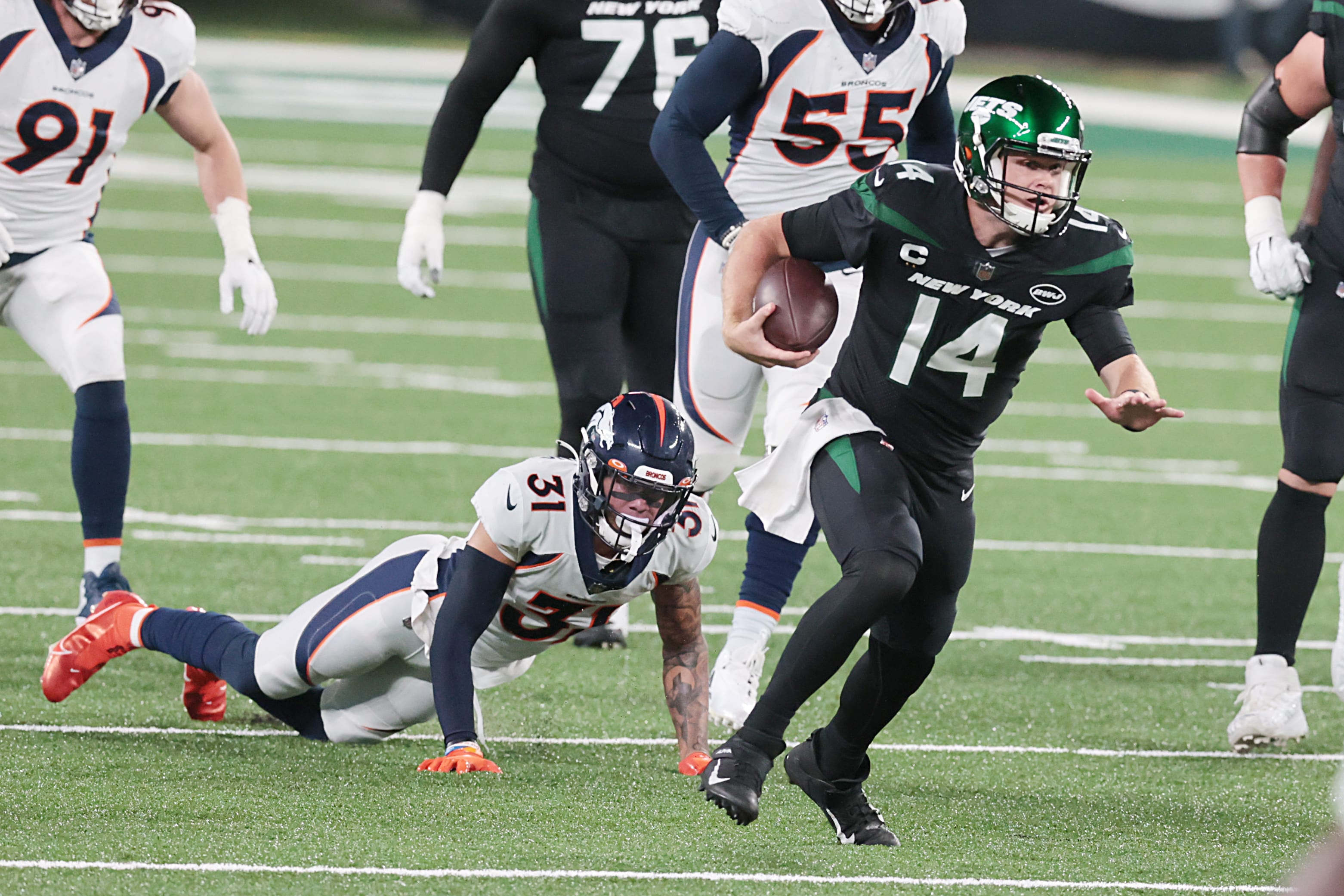
Darnold gained all but two yards on the Jets’ opening 75-yard drive after the first kickoff. Remarkably, only 16 of those yards were gained through the air. He gained a pair of first downs with his legs before breaking loose for the longest run by any quarterback so far this season. It also allowed Darnold to set his career-best in rushing, demolishing a 35-yard output posted in December 2018 against Houston.
Adam Gase quarterbacks have never been known for their scrambling, mostly relegated to a prescience in the pocket. If the Jets can allow Darnold to move around more, through plays like the rollout that has played out well in goal-to-go situations, it can help him develop much-needed confidence.
The handling of Mekhi Becton was one of the most curious developments of Thursday’s game. After enduring a shoulder injury on Sunday, Becton was deemed healthy enough to dress, but not to start. Chuma Edoga’s injury in the opening quarter, however, forced Becton to enter. He didn’t last much longer either, as he sat after the early stages of the second frame.
His last play was a scary one, as it was also Darnold’s first play back in after enduring his own shoulder injury. The ailing Becton was beaten by Bradley Chubb, who sacked Darnold on third down. At that point, the Jets really should’ve questioned the true value of leaving both men in the game. Sure, the morbid gift of consequence-free football at least allows you the idea of playing loose, but it should never, ever lead you to risk a player’s health. Darnold at least appeared to look unbothered by the situation. But the question can still be asked over whether it was worth it.
Frank Gore definitely has a purpose in New York. He’s a veteran who has had experience in rebuilding programs (primarily his earliest days with the 49ers) and can still earn the short-yardage first down as a spell option. But Gore is no longer at a level where he can the primary offensive threat. His carries were down to a mere 13 after averaging 19 over the last two weeks, but the continued insistence on using Gore is stunting the development of projects like La’Mical Perine and Kalen Ballage.
The Jets had a strong opportunity to take the lead in the early stages of the third quarter after a 38-yard pass interference penalty. After two short Gore runs, Darnold tried to find him on a wheel on third-and-four 14 yards from the end zone. The incompletion forced the Jets to go for a mere Sam Ficken field goal that sliced the lead to 17-16. An argument could be made over whether kicking was the right decision (we’ll get to that in a minute), but it could’ve been avoided entirely.
Sam Ficken drills his FIFTH field goal of the game and the Jets lead 28-27 🤩
Once again, the decision to kick was one that came back to haunt the Jets. Doing so down 24-3 during the San Francisco disaster was one thing. Pride was the only thing on the line and things got so pathetic that the Jets even denied themselves that. But this new instance might’ve played a role in this brutal defeat.
Down 27-25 and granted a generous spot on a crucial third-down at the edge of the Denver red zone…set up by Brian Poole’s interception…the Jets had an opportunity to think of a way to potentially earn the go-ahead score and force a struggling Denver offense to score a touchdown with relatively little time left on the clock while the Broncos threw the challenge flag.
Instead, cowardice might’ve cost the Jets the game. If the Jets opted to go for the necessary inches on fourth down with six minutes to go, they could’ve continued their trek to the end zone, forcing the struggling Rypien to go for a matching six-pointer. Even if you failed to convert the fourth down…how badly do you lose in the long run? The Jets played it safe and kicked…all the Broncos needed was for the reliable Brandon McManus to respond. Denver’s offense made it difficult on their own end, but they eventually secure the lead permanently. Everything else…the embarrassing Melvin Gordon clincher, the bad blood in the final seconds…could’ve been avoided if they had gone for it.
Ficken has proven reliable this season…he’s a perfect 8-for-8 on the season and he booted a 54-yarder on Thursday night…but alas, that doesn’t do the Jets any favors in the win column. A good kicker is vital on a team with a developing offense, but one could well argue if “developing” is the right way to describe the Jets at this point in time.
The New York Jets have to consider using their expanded draft stash on special teams solutions, which will put a developing offense at ease.
Special teams conspiracy theorists could probably claim that the NFL’s latest innovations and trends are trying to get rid of the third phase of the game entirely.
When extra points got too automatic, the league tacked on 15 yards to them, leading to increased tries for two points. Whereas the point-after-touchdown was moved back, kickoffs were moved up. Some felt their travels to the 35-yard-line (as well as a “reward” for a touchback being access to the 25) were the first step in having the kickoff go the way of the single-bar facemask. The increasingly prevalent analytics departments also weren’t helping matters, as evidence continues to mount that it makes more sense to go for it on fourth down in lieu of kicking or punting.
But special teams undoubtedly hold a place in the modern game. For a team that is situated with an offense that struggles to enter the end zone on a consistent basis, having a proven kicker is a perfect safety blanket. If defeat must be admitted, the least you can do is arm yourself with a good punter.
Hence, the New York Jets must spend this draft session, at least the latter portions, on special teams assistance.
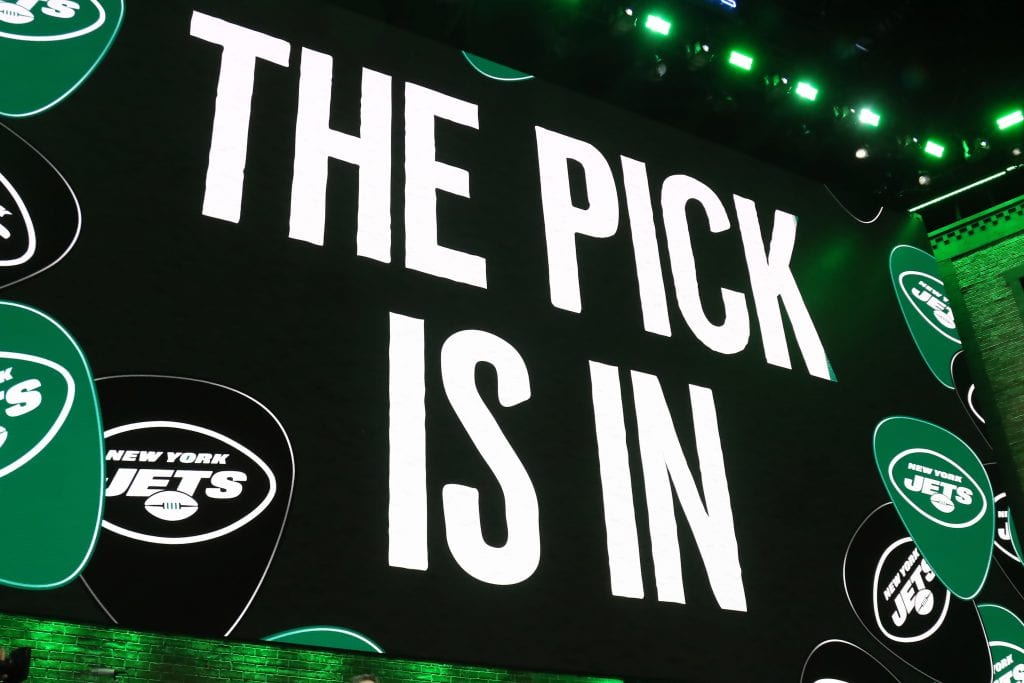
NASHVILLE, TN – APRIL 25: The video board shows that the New York Jets have turned in their pick during the first round of the 2019 NFL Draft on April 25, 2019, at the Draft Main Stage on Lower Broadway in downtown Nashville, TN. (Photo by Michael Wade/Icon Sportswire via Getty Images)
The Jets obviously have aspirations of becoming frequent end zone visitors. They moved up in the draft to find a franchise quarterback. Free agency currency has been dealt to a star running back and blocker to clear the way for him. But until the team can find the end zone on a regular basis, having reliable specialists are absolutely vital. Considering the fact that Robby Anderson (by far their most reliable receiver since 2015) sought bluer pastures in Carolina, regular six-point possessions are easier said than done.
The long-term long snapper spot was readily fulfilled last season. Thomas Hennessy has played four incident-free years thus far and is destined for four more through 2024. But there are several needs that must be fulfilled as the Jets’ latest rebuild continues.
Over the past two seasons (the first of hopefully many overseen by Sam Darnold), the Jets have kicked 63 field goals, a number tied for seventh in the NFL. The surplus was tolerable when Jason Myers was booting triples from all over the field (17-of-19 from at least 40 yards out), but the Marist alum has moved on to Seattle. Since then, four different kickers have dressed in a green uniform, the most recent of which is Sam Ficken.
Those we believe that special teams are meaningless to the Jets…who, granted, still have holes to fill…surely missed their opening weekend tilt against the Buffalo Bills. The Jets’ heartbreaking 17-16 loss was made all the more painful by a missed field goal and extra point from first-game participant Kaare Vedvik. Ficken surfaced shortly after, but was hardly reliable with a 70 percent success rate (19-of-27).
The Jets did bring in a new kicker shortly after the season’s end. Alas, it was Brett Maher, one of only two qualified names below Ficken for conversion rate (20-of-30, 67 percent). Simply put, the Jets need competition, barring a miraculous scoring outbreak next season.
It’s understandable why the Jets didn’t upgrade in free agency. The most reliable names (Mason Crosby, Ka’imi Fairbairn, Dan Bailey) re-signed with their prior squads. Greg Zuerlein was coming off a career-worst season, while Stephen Gostkowski and Ryan Succop were working off injuries.
The Jets are blessed with a deep draft in several of their need positions. Kicker is one of them.
2020’s kicker slot is highlighted by the bespectacled wonder that is Rodrigo Blankenship of Georgia. The former Bulldog may be more of an Athens staple than the hedges and Uga combined. Save for Georgia’s unfortunate collapse in the 2018 National Championship Game, Blankenship might’ve earned everything a kicker could achieve at the Football Bowl Subdivision level. He capped things off with the 2019 Lou Groza Award but his name also appears in the slots reserved for the kicker of the longest field goal in Rose Bowl history and the all-time leading leg scorer in SEC history. Blankenship also has an appearance in the 2019 ESPN Body Issue and a rap track to his name, certainly a unique accomplishment amongst his peers.
Also among the draft options is the perfectly named Jet Toner out of Stanford. Toner’s distance needs work, and he’s coming off a leg injury, but he completed all 101 of his extra points and went 14-of-15 in his last full season. Small-school option Tyler Bass (Georgia Southern) struggled in his senior season but impressed during the Senior Bowl preparation in Mobile. With the Jets afforded an eighth draft pick, particularly their final one in the sixth obtained from Kansas City through the Darron Lee transaction, they can afford to use capital on a kicker spot.
Somewhat murkier is the Jets’ dilemma at punter. It seems like an avoidable spot, but the fact remains that current free agent Lac Edwards led the league in punts with 87. That does come with a Luke Falk-sized asterisk (25 of Edwards’ boots alone came during Darnold’s three-game absence), but the Jets can’t afford to be negligent. If they fail to bring Edwards back, an SEC trio of Braden Mann (Texas A&M), Tommy Townsend (Florida), and Joseph Charlton (South Carolina) could fill in the gap.
The Jets can also fulfill their special needs earlier in the draft. After enjoying the antics of Andre Roberts’ first Pro Bowl season, their average kick return plummeted to 22nd in football after enjoying a third-place finish last season. While the team enjoyed some late traction in the punt return game with Vyncint Smith, it wouldn’t hurt to full multiple needs within the first two days. Virginia’s Joe Reed led the ACC in kick return average twice and also can work as a sizable slot receiver (6’0, 224 lbs.). Jalen Reagor and K.J. Hamler could each go in the second-round and can contribute in more ways that one.
Enough tired memes and jokes have been made at the specialists’ expense. Enough Jets fans are also, perhaps, still traumatized by the second-round selection of Mike Nugent during 2005’s proceedings (especially when Vincent Jackson and Frank Gore went not so long after).
But if the Jets want to end their endless cycle of misery, or at least start to put a dent into it, extra draft capital should go toward the third phase of football. The new Jets brass has already shown that they’re willing to do things differently, especially when it comes to the offensive line. Logic at least hints you can find an undrafted rookie in the scrap pile (i.e. Fairbairn to the Texans in 2016), but the Jets have played by the laws of football logic long enough.
These draft diamonds in the rough, practitioners of football’s third phase, could help provide the spark that burns the perception of “Same Old Jets” down.