New York Jets: Why everyone wins the Sam Darnold trade (for now)

It’s hard to assess a trade five months before a single down is played, but the New York Jets and Carolina Panthers came out looking good.

Despite Jerry Seinfeld’s best efforts, there’s probably is no such thing as a “mutual breakup”.

But the New York Jets and Sam Darnold might’ve come as close as one can, especially when it comes to severing the relationship between an NFL squad and its franchise quarterback.

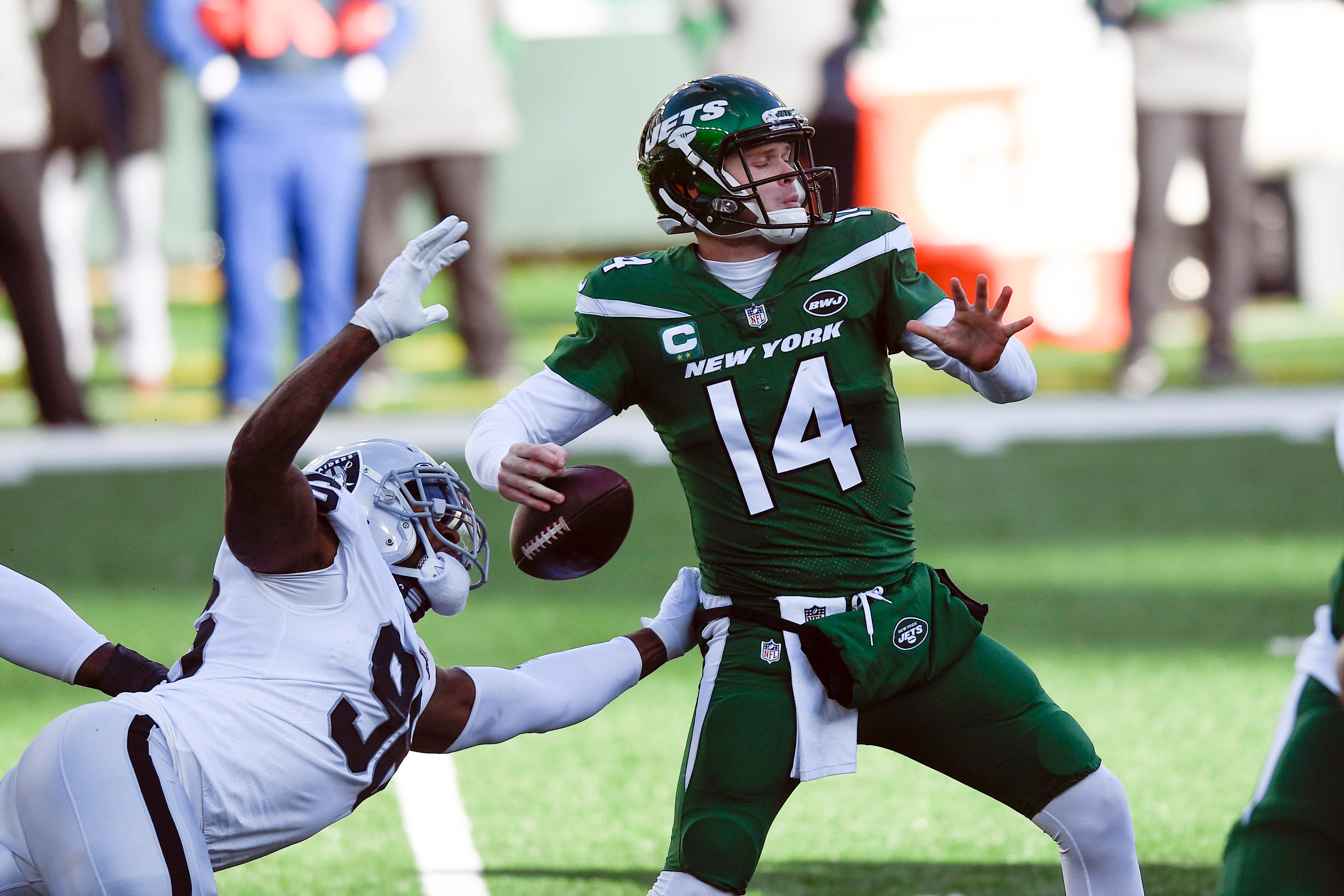
Darnold confirmed as much in his first statements as a Panther on Monday, a week after he was dealt from New York for a trio of draft picks. While Darnold ruefully stated that he throught he was destined to be the Jets’ quarterback for a long time, he’s ready to embrace a new opportunity in Charlotte.

“I imagined I was going to be the franchise quarterback of the New York Jets for a long time…once you realize that the team that drafted you is moving on, it stings a little bit,” Darnold said, per Carolina reporter Darin Gantt. “Getting that news that you’re going to be traded, of a team saying, ‘Hey, we didn’t want you,” for whatever reason, is hard. But right now, I feel great about it.”

How did each side find something to celebrate? ESM investigates…
zach wilson, new york jets
. Mandatory Credit: George Frey/Pool Photo-USA TODAY Sports

Grounded Controversy

Through social media schadenfreude, the Jets are a team whose simplest mistakes are turned into memes within minutes. That concept has hit a fever pitch during their decade-long playoff drought (an NFL-worst), but there may well be light at the end of their tunnel of rebuilding. Rare optimism can be found at One Jets Drive after the hire of Robert Saleh, whose arrival has spawned positive reviews both domestically and abroad.

But the good vibes bring forth a perilous responsibility: it must be surrounded by as little controversy as possible. Holding a quarterback competition would be an unwelcome distraction during. Once the games do get underway, it’s widely expected that fans will be back at MetLife Stadium. The last thing the Jets needed was spectators, no matter the capacity limit, screeching for Darnold’s backup every time he threw an incomplete pass.

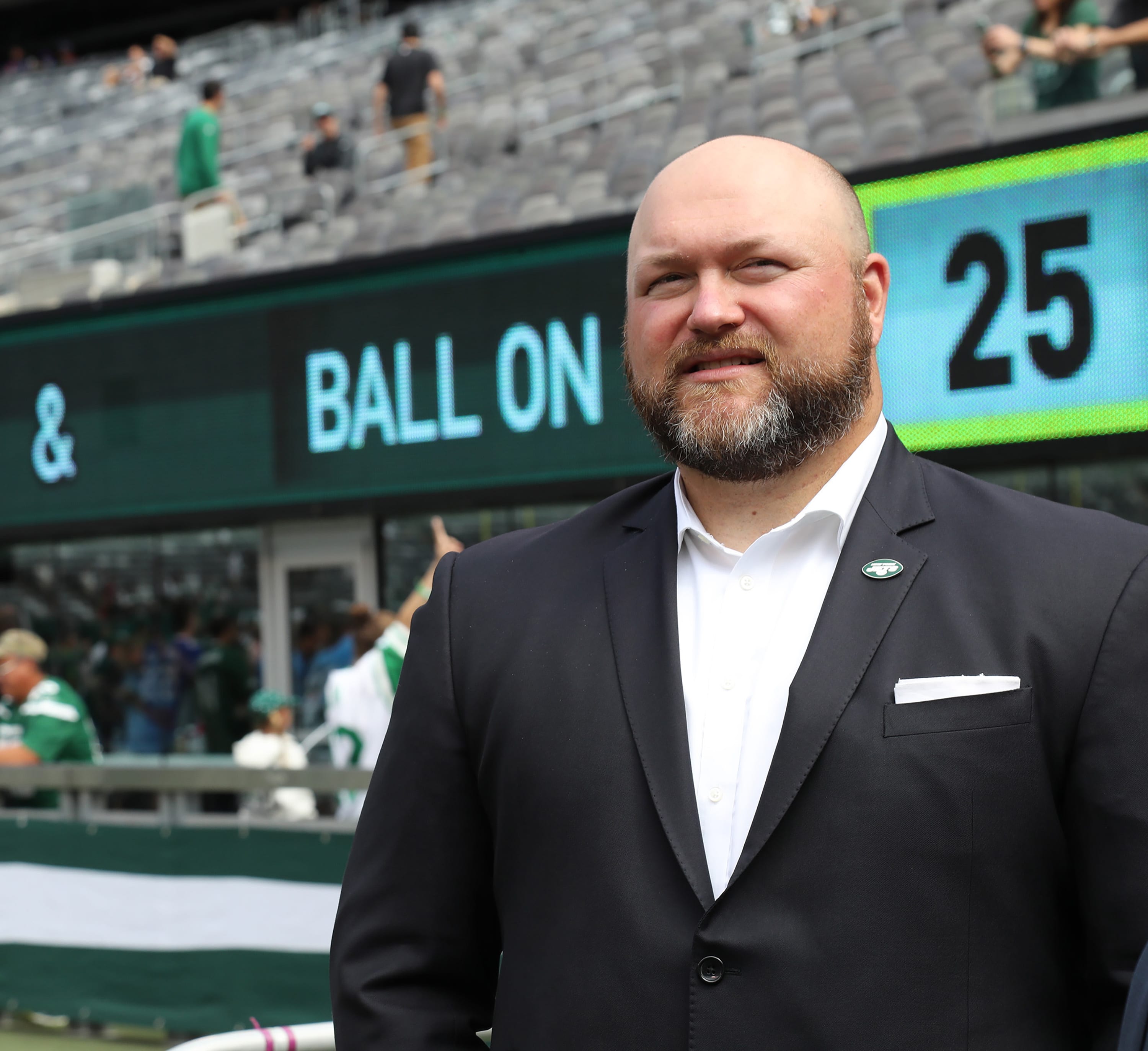
But, having traded Darnold, the Jets have a clear-cut plan. Their quarterback controversy will end no later than the evening of April 29, when they choose second in the 2021 NFL Draft in Cleveland. General manager Joe Douglas more or less confirmed as much when speaking after the deal was done.

“There was…a discussion about us taking a quarterback at pick number two and having Sam here for the season…ultimately, we felt that that wouldn’t be the best situation for Sam, the rookie quarterback, Coach Saleh and his staff, and the locker room,” Douglas said, per notes from the Jets. “We felt like this was the best decision for the entire organization moving forward, in hitting the reset button.”

Mandatory Credit: Vincent Carchietta-USA TODAY Sports

Darnold Gets Stability 

On paper, Carolina isn’t too far removed from the Jets in terms of where they are on the NFL barometer. They won only five games last season and are seeking stability under a first-time NFL head coach in Matt Rhule. But one look at the Carolina ledger shows that they provide a more stable offensive situation than Darnold ever had in New York.

Darnold’s burden is immediately lightened through a run game headlined by Christian McCaffrey rather than a disgruntled Le’Veon Bell and a tandem of projects. The biggest sign of Panther progress was perhaps shown through McCaffrey’s absence: despite enjoying only three games with the 2019 All-Pro in the backfield, Carolina remained competitive. All but three of their 11 losses came by one possession while Robby Anderson, Darnold’s favorite New York target in his first two seasons, tallied a career-best 1,096 yards despite relative turmoil at quarterback. Teddy Bridgewater was inconsistent in his first full-time starting gig since enduring a contact-free camp injury in 2015 and was relieved by XFL star P.J. Walker.

The coaching staff is also a welcome sight to any offensive player seeking his NFL fortune. Head coach Matt Rhule turned downtrodden college programs at Temple and Baylor into offensive blockbusters while offensive coordinator Joe Brady over saw the rise of Joe Burrow as the passing game coordinator during the LSU Tigers’ dominant national title run in 2019. Darnold took the time to appreciate the culture that Carolina is building during his opening statements.

“The culture that’s being set here is amazing,” Darnold said in Gantt’s report. “That’s probably the part that intrigues me the most about this.”
(Photo by Joe Robbins/Getty Images)

A Fine Addition to the New York Collection

While the immediate yield from the Darnold trade isn’t flashy…the Jets earned the 226th overall pick in the coming Cleveland selections…it’s pretty impressive on Douglas’ end that he was able to net a second-round pick (coming in 2022) for an injury-prone quarterback with a 13-25 ledger as a starter, even if the circumstances weren’t the greatest.

“With the premium picks, your first, second, third-round picks, those are the picture you’re looking to become starters on your team,” Douglas remarked through the Jets. “So, those ultimately end up being the picks that you spend the most time talking about.”

As a young Queens webslinger was told, however, with great power comes great responsibility. Quantity doesn’t automatically equal quality, and that axiom rings especially true in the NFL Draft. The Jets learned that lesson the hard way during the 2014 proceedings through John Idzik’s doomed dozen and it’s a nightmare that Douglas doesn’t take lightly.

“We have a lot of opportunity in front of us, 21 picks in the next two drafts, including 10 in the first three rounds,” Douglas said in Jets notes. “But with that opportunity, we know we have to make the most of it and hit on these picks.”

New York Jets, Joe Douglas
(Photo by Al Pereira/Getty Images)

Joe’s Jets

Douglas presents himself as a guy who’s not interested in looking for excuses. But he’d have a good few in the holster.

He joined the Jets under unusual circumstances, placed in charge weeks before training camp opened after Mike Maccagnan’s post-draft firing. His first years with the organization have been handicapped by decisions he had no jurisdiction over (namely the Adam Gase hire).

Now, Douglas’ signings are getting closer to becoming the majority after several Maccagnan/Gase staples were shipped elsewhere. He has a handpicked head coach in Saleh and he’s about to have a handpicked franchise quarterback.

It’s official: Douglas is the captain now. For better or worse, this was a step the Jets needed to move toward. There are no more excuses, there are no more “wait untils”. Douglas’ era can officially begin and he can thus be judged appropriately.

“I think you feel pressure every day you walk into the building,” Douglas said in Jets notes. “You want to do this job to the best of your ability. You want to take the information that you have at hand and make the best possible decisions that you can make.”

Jets fans and the football-loving public at large are about to find out if they’re truly the right moves to end the perpetual rebuild…a rebuild Douglas now officially owns.

Geoff Magliocchetti is on Twitter @GeoffJMags

One question will define Sam Darnold’s New York Jets tenure

As the Sam Darnold era ends, a lingering question will haunt New York Jets fans as he prepares to move to Charlotte.

With respect to the countless devotees of movies, books, television shows, etc., across the world, no one writes more fan fiction than football fans. Rather than “Once upon a time…”, football fables often begin with a question: “What if…?”.

The question is endlessly asked before, during, and after every NFL season. What if that star prospect falls? What if they went for it on fourth down? What if that quarterback retires?

What if the New York Jets hired someone…anyone…other than Adam Gase to oversee Sam Darnold’s developmental years as head coach?

It’s a question whose answers reside months, even years, away. Both Gase and Darnold are now distant memories in the New York archives, the former fired and the latter bound for Charlotte in a trade with the Carolina Panthers. The Jets only have numbers to show for it in the immediate aftermath. Dealing Darnold netted them the 226th overall pick in the coming draft, as well as a second and fourth-round choice in the spring of 2022.

(Photo by Emilee Chinn/Getty Images)

In the immediate aftermath, it’s easy to call the Jets’ Darnold deal with Carolina a win for both sides on paper. Darnold gains welcome stability in Carolina (reuniting with fellow ex-Jet Robby Anderson and working with All-Pro rusher Christian McCaffrey) while the Jets make some fine additions to their draft collection. But the Jets will forever look back on their Darnold with a sense of regret and what might’ve been. The chorus of “what if” echoes as the countdown to what’ll likely be the beginning of the Zach Wilson or Justin Fields era.

It starts with the hiring of Gase, a supposed offensive guru brought in to oversee Darnold’s vital post-rookie campaigns. Todd Bowles’ tenure had undoubtedly run its course, but its final stages were full of hope through Darnold’s final four games. It was a stretch that saw Darnold earn a come-from-behind victory in Buffalo (topping fellow 2018 draftee Josh Allen in their first meeting) and go head-to-head and blow-for-blow with Deshaun Watson and Aaron Rodgers in consecutive weeks. The latter tilt, a Festivus showdown with the Green Bay Packers, was an overtime thriller that saw Darnold earn career-bests in passer rating (128.4) and passing yardage (341).

When Bowles was let go, the Jets needed someone with a strong developmental mind, someone who could nurture Darnold’s potential and build on the promise shown over the final stretch. CEO/Chairman Christopher Johnson knew just how vital the search would be when he spoke after dismissing the current defensive coordinator of the defending champion Tampa Bay Buccaneers.

“I think the Jets are a really good spot for a coach to end up,” Johnson said at the time. “So I think that we have a competitive advantage there. But we’re not going to sit down and wait for people to come to us, we’re going to search hard and fast. We want to get this done.”

It got done through the arrival of Gase, fresh off three years of Miami mediocrity. From the get-go, there probably should’ve been something off about the new boss, one who never truly fostered a young quarterback. Peyton Manning put the best numbers of his career under Gase, but the most adamant football denier could probably oversee an offense with Peyton Manning and still average 21 points a game.

Gase helped get the Chicago Bears’ offense back on track as coordinator in 2015, but Jay Cutler, despite a career-best passer rating, was in his 11th season and headed toward his polarizing career’s final stanzas. Even if Gase’s work with Cutler counted for something, it was more or less undone when the pair reunited for a fruitless season in South Beach two years later. In terms of youth, Ryan Tannehill endured what seemed like an endless stream of “make-or-break” campaigns before being mercifully shipped to Tennessee after Gase’s Floridan ousting. By now, little more needs to be written about Tannehill’s success sans Gase.

Yet, the Jets insisted Gase was their man, sticking with him after a dreadful 0-4 start. After his infamous bout with mononucleosis…a happening only amplified by social media schadenfreude that amplifies the Jets’ simplest errors…Darnold helped right to ship to the tune of a 7-9 ledger. Further fleeting flashes of brilliance emerged, such as Darnold’s return from illness, a 338-yard, two-score showing in a triumph over Dallas, the Jets’ first win of the year. Further silliness came through Darnold’s failed Ghostbusters tenure, but to have him post a winning record (7-6) despite endless silliness surrounding him was a promising sign.

Mandatory Credit: Brian Fluharty-USA TODAY Sports

But seeds for a destructive 2020 season…for reasons far beyond limitations set up by the ongoing health crisis…were starting to take root. Anderson, Darnold’s favorite target during his opening years, absconded for Carolina after “(losing) his love of football“. Every week, it felt like Gase had to ensure the public that he wasn’t dealing with a full-on mutiny.

As the season moved on, the Jets continuously eschewed the notion of firing Gase in-season. Johnson even broke out the guru comparisons after a listless opening day loss in Buffalo by calling Gase “a brilliant offensive mind” after the Jets pulled off the statistical anomaly of earning under 300 yards in Orchard Park. The sub-300 tally, in fact, occurred 11 times during the 2020 campaign…a downright jaw-dropping occurrence in an NFL that worships offense.

All the while, the Jets gave up on several accomplished names before deciding Gase was expendable. A mini-fire sale ensued that saw accomplished defenders Steve McLendon, Avery Williamson, and Pierre Desir sent away. Le’Veon Bell, a constant co-combatant in Gase headlines, was outright released while the eyes of the nation were centered on a rare Tuesday night game.

Darnold sank further into oblivion, forced into situations that even the greatest, most established quarterbacks would have trouble salvaging. One couldn’t even argue that the Jets were showing promise in these losses. All but one of their first eight defeats came by multiple possessions, exacerbated by the struggle to gain yardage. Unlike their blue MetLife Stadium co-tenants (the Giants losing five of their first eight in single possession games), there was nothing to get excited for from a Jets perspective.

For the record, it’s not only the Gase hire that Darnold had to put up with. His rookie season was spent behind an offensive built through the negligence of the Mike Maccagnan era. When the 2020 season kicked off, Darnold had only a single receiver left from his rookie campaign (tight end Chris Herndon, who has struggled to maintain rookie momentum) and his offensive line had undergone yet another makeover. The fact such flashes of brilliance were achieved despite playing in the far reaches of the football netherworld perhaps says something about Darnold, who has a prime opportunity to put his career back on track in Charlotte.

It could’ve happened in New York. The offensive line still needs work, but the Jets upgraded their weaponry this offseason, bringing in capable targets (Corey Davis, Keelan Cole) that can compete with returnees (Jamison Crowder, Denzel Mims) for top receiving honors. A multi-faceted rushing talent like Tevin Coleman can take some of the pressure off of whoever the quarterback will be.

But the Jets are trying to pen their own redemption story. They don’t have the time to co-author someone else’s.

In short, the Gase era left the Jets no other choice. His firing brought in a new regime, one praised not by the hot take artists but by players themselves, both domestically and abroad. For Robert Saleh to fully implement his vision and the Jets holding the ever valuable second overall pick of the NFL draft…the original of aerial franchise saviors like Donovan McNabb and Roman Gabriel…Darnold simply had to go.

Still, that won’t stop the eternal discussions, the fabled chapters that Jets fans will write for months before a single down is played and in the years after that, both supporting what Darnold could’ve done and celebrating his release.

The question will still be asked…what if?

Geoff Magliocchetti is on Twitter @GeoffJMags

How does the Sam Darnold trade affect the New York Giants at 11?

new york giants, sam darnold, saquon barkley

The New York Giants currently sit with the 11th overall pick in the 2021 NFL draft, but it seems as if every team is moving around them. The new draft order is far different than it looked about a month ago, with the San Francisco 49ers trading with the Miami Dolphins all the way to the third selection. Miami jumped back to the 12th spot and then traded with the Philadelphia Eagles back up to the sixth selection.

The Giants have essentially been watching everything unfold beneath them, but how does the current outlook of the draft impact their potential selection in less than a month?

Current draft order leading up to the New York Giants:

1. Jacksonville Jaguars
2. New York Jets
3. San Francisco 49ers (from Miami Dolphins via Houston Texans)
4. Atlanta Falcons
5. Cincinnati Bengals
6. Miami Dolphins (from Philadelphia Eagles)
7. Detroit Lions
8. Carolina Panthers
9. Denver Broncos
10. Dallas Cowboys
11. New York Giants

On Monday afternoon, the New York Jets officially traded quarterback Sam Darnold to the Carolina Panthers in exchange for a sixth-round pick in 2021 and 2nd/4th rounder in 2022. While this wasn’t exactly the haul they anticipated, they did get some decent value back in the future for their former first-round selection.

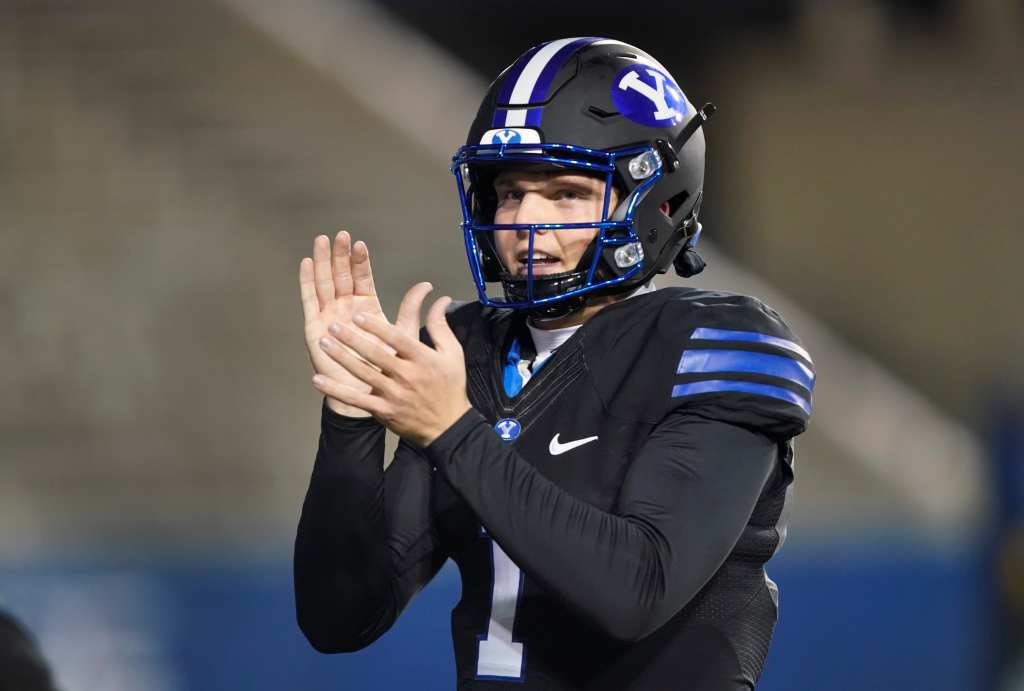
The Jets will now likely draft BYU quarterback Zach Wilson with the second overall pick in 2021, but what does that mean for the Giants as the Carolina Panthers no longer need a quarterback?

With Carolina in the eighth spot, the anticipation was that they could target a player like QB Trey Lance, but now they’re more likely to invest in a weapon or offensive lineman.

Many have mocked a star receiver or Northwestern OL Rashawn Slater to the Giants at 11, but the possibility of either falling dwindles with each passing trade. Nonetheless, there is a bevy of talent available, and with so many quarterbacks expected to come off the board in the top 10 picks, the Giants will have an opportunity to grab a premium talent or trade back for more capital.

As co-owner John Mara said recently, signing Kenny Golladay and Adoree Jackson allows the Giants to be a bit more flexible in the first round, taking the best player available or allocating toward a position of need. However, reaching on a pass rusher in a weak class would be a mistake, especially with players like Micah Parsons or even Jaylen Waddle on the board.

Nonetheless, the impact that Darnold has on the Giants’ draft pick is that Carolina could take a skill player; potentially one Big Blue desires. While it could hurt the Giants, there’s always the possibility they trade back and swap with a team like the New England Patriots who could target a quarterback.

Sayonara Sam: Darnold’s best plays with the New York Jets

The New York Jets have finally answered the question on many people’s minds: what are they going to do with Sam Darnold? For them, the answer was to trade him to the Carolina Panthers.

Darnold’s time in New York was riddled with losses, criticism and mono. However, it wasn’t all bad. There were some times of excitement, hope and celebration.

So, as a farewell, I highlighted some of Sam Darnold’s best plays as a New York Jet.

Behind-the-line scramble vs Buffalo

For the first play, we’re going all the way back to 2018. The Jets were 3-9 and the Bills were 4-8. The game had no playoff implications but it was a game against a division rival – so it mattered. Darnold and the offense needed a touchdown to tie the game and, well, this happened:

That play is still amazing today and shows some of Darnold’s unique abilities. The only problem is that these theatrics weren’t an all-the-time thing on the field.

Oh, and, by the way. Who caught that pass? Darnold’s new teammate Robby Anderson.

Cross-body throw vs San Francisco

Sam Darnold had arguably his best career throw this past season against the San Francisco 49ers. After breaking a sack, he rolled out left and threw across his body to Braxton Berrios for the touchdown.

Here’s the play:

If this play has started to bring out any emotions about Darnold being traded away, don’t fret. Zach Wilson can make that throw as well.

46-yard TD run vs Denver

The last play that’s going to be highlighted happened about two weeks after the previous one. Darnold once again showed his scrambling ability, but in a different way:

Jets fans and the NFL were all raving about this play because, well, he turned on the jets. This play showed that he can do more than run around behind the line and either throw a dart or an interception.

Despite Darnold showing in these three instances that he has talent and potential, the Jets only went on to win one of those three games. That’s the issue. You can have all the talent in the world, but if you don’t win, it doesn’t matter.

Fans and the organization are hoping the next chapter of Jets football brings along some wins. That next chapter begins on April 29 when the Jets are on the clock with the second overall pick.

BREAKING NEWS: New York Jets trade QB Sam Darnold to Carolina (Report)

Per ESPN’s Adam Schefter, the New York Jets are trading quarterback Sam Darnold to the Carolina Panthers for three picks.

According to a report from ESPN’s Adam Schefter, the New York Jets are trading quarterback Sam Darnold to the Carolina Panthers. In exchange, the Jets get three picks from Charlotte: two 2022 choices (second and fourth) as well as a sixth-round pick in the upcoming draft in April.

[UPDATE: 4:50 p.m. ET]: The Jets have confirmed the trade in a team statement.

“I want to publicly acknowledge the commitment, dedication, and professionalism Sam displayed while with the Jets. He is a tough-minded, talented football player whose NFL story has not been written yet,” Jets general manager Joe Douglas said in the team-issued declaration. “While all these things are true, this move is in the short and long-term best interests for both this team and him. We thank Sam for all of his work on behalf of this organization and wish him well as he continues his career.”

The 2021 pick sent over from Carolina will be the 227th overall pick (226th if accounting for the forfeited 77th choice from New England).

Thus ends Darnold’s tenure as the New York Jets’ franchise quarterback, a stretch that began as the third overall choice out of USC in the 2018 draft. Darnold was part of a highly publicized quarterback draft class that also included Baker Mayfield (1st overall), Josh Allen (7th), Josh Rosen (10th), and Lamar Jackson (32nd). While his New York career featured flashes of brilliance, he was never able to establish any consistency. His Jets career ends with a 13-25 record as a starter, going along with 8,097 yards and 45 touchdown passes, those marks both good for eighth in team history.

It was tough for Darnold to establish his mark as a Jets starter due to the numerous turnover in the Jets’ starting lineups. Only one receiver (tight end Chris Herndon) remained on the Jets’ roster from his rookie campaign. He was nonetheless able to display fleeting flashes of brilliance in green, his best showing being a December 2018 battle with Aaron Rodgers during his rookie season. Darnold earned personal bests in passer rating (128.4) and yardage (341) in a 44-38 overtime defeat at the hands of Green Bay. Another classic Darnold moment came in October 2019, when he returned from a bout with mononucleosis to tally 338 yards and two scores in a win over the Dallas Cowboys.

Darnold also had trouble staying healthy during his time with the Jets, failing to start a full season through injuries and illness.

Carolina should present a stable situation for Darnold, who reunites with Robby Anderson, his former favorite target in green. The Panthers also have a strong rushing situation (headlined by Christian McCaffrey) and strong offensive minds like head coach Matt Rhule and offensive coordinator Joe Brady. Darnold will likely compete for the starting job with Teddy Bridgewater, the Panthers’ incumbent starter who worked with him during the 2018 preseason.

With the trade of Darnold, the Jets will more than likely use the second overall choice in April’s draft on a quarterback, namely BYU’s Zach Wilson or Ohio State’s Justin Fields.

Geoff Magliocchetti is on Twitter @GeoffJMags

Four areas the New York Jets must still address in April

New York Jets, Joe Douglas

The New York Jets undoubtedly improved this offseason, but there are several areas of need to address as the calendar flips to April.

The New York Jets undoubtedly became a better team this offseason. Whether that’s a result of the Adam Gase era giving them nowhere to go but up or it leads to actual results on the field remains to be seen, but the Jets have laid down a solid foundation for the Robert Saleh era. Optimism reigns for an already star-crossed franchise coming off a two-win season through the signings of names like Tevin Coleman, Corey Davis, and Carl Lawson.

“There’s a lot of optimism, especially coming off a bad season, so I’m looking forward to working. I love the process,” Lawson said in video provided by the Jets. He compared the situation to franchise mode on the Madden NFL video game franchise. “I play Madden because I love building teams. I love franchise mode. Franchise mode hasn’t changed on Madden in like 15 years, but I’m never going to stop loving it because I get to build, I get to grow, I get to improve.”

Yet, as the calendar flips to April and the free agency frenzy mostly pacified, the Jets have several areas of need that have yet to be satisfied. Competing in the crowded AFC will probably be difficult with even the perfect offseason, but the Saleh era can get off to an optimally smooth start if the following areas are satisfied, preferably sooner rather than later…

New York Jets, Mekhi Becton

Offensive Line

Solving the offensive line issues was probably at the top of the Jets’ offseason to-do list, the necessity even outweighing the quarterback quandary. No matter who’s throwing the ball, he’s going to need protection.

Joe Douglas has shown he’s willing to make up for the blocking negligence of the Mike Maccagnan era. His drafting of Mekhi Becton was a strong start, but his free agency signings failed to pan out. Several are set to return for another season, but the Jets missed out on the big targets (Joe Thuney, Corey Linsley, Matt Feiler), adding only interior man Dan Feeney from the Los Angeles Chargers. Another addition, tight end Tyler Kroft, has gained positive reviews for his blocking, but nothing that should dramatically change the Jets’ protection affairs.

An interesting gambit for the Jets would be to draft top blocking prospect Penei Sewell with the second overall choice and letting Sam Darnold work behind a revamped line, but the Jets’ due diligence at incoming rookie passing class hints that they’re headed toward that direction. But at least one of their early picks, namely the 23rd and 34th overall selections, should be used on a blocker if only to raise the heat on some of the incumbents. Veteran help from abroad, like Kansas City’s Austin Reiter, should also be considered. Reiter, set to turn 30 in November, was the Chiefs’ starting center in each of the last two Super Bowls.

New York Jets, Bless Austin

Cornerback

After the spending frenzy in March, the Jets appear to have a plan in place when it comes to their safeties. Marcus Maye was granted the franchise tag, which basically serves as a $10 million “prove it” deal. On the strong side, the post-Jamal Adams era continues. Ashtyn Davis will get a de facto second rookie season after injuries marred his original and the Jets have brought in a strong mentor and veteran prescience in LaMarcus Joyner to help out. Elsewhere on defense, front seven newcomers Lawson and Jarrad Davis have experiences in the 4-3 scheme that Robert Saleh is reportedly hoping to implement.

But the cornerback depth is definitely concerning. Youngsters Bless Austin and Bryce Hall have shown flashes of brilliance in their infantile NFL careers, but they’ll probably need further development before fully embracing the starting roles. Newly signed Justin Hardee is listed as a corner but primarily works on special teams. The Jets also have a decision to make on one of their free agents, Brian Poole.

The 23rd pick, obtained from Seattle for Adams, can potentially be used on the top cornerbacks on the draft, namely Caleb Farley, Patrick Surtain, or Jaycee Horn.

New York Jets, Sam Darnold, James Morgan

Backup Quarterback

The Jets have not had a quarterback start every game in a season since Ryan Fitzpatrick went all 16 in 2015. If Darnold stays, the Jets should be ready for the unthinkable again, as he has yet to play a full NFL season. Should the rookie arrive, some see Darnold as a safety blanket. But if Zach Wilson or Justin Fields make their entrance, Darnold still shouldn’t stay. There doesn’t need to be a quarterback controversy and the USC alum isn’t at the “veteran mentor” stage.

When Darnold got hurt last season, the Philadelphia-bound Joe Flacco did a serviceable job in relief. But with the Super Bowl XLVII MVP donning a new shade of green, they need to be prepared in case of an emergency. The draft can’t be an option, as the Jets have far too many needs to fill with their surplus and the fourth-round choice of James Morgan in last year’s proceedings remains puzzling. If they want a safety net that can win games, Saleh and Mike LaFleur’s Bay Area comrade Nick Mullens could be an option, while veteran mentors are available through Alex Smith, Brian Hoyer, or Blake Bortles.

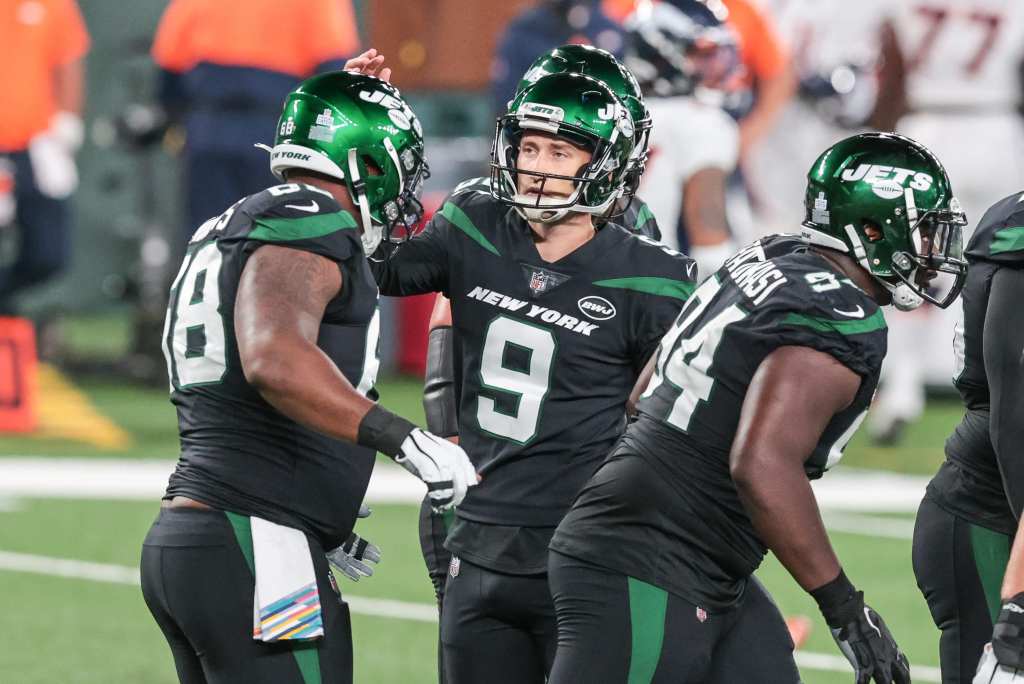
Oct 1, 2020; East Rutherford, New Jersey, USA; New York Jets kicker Sam Ficken (9) celebrates his field goal with teammates during the first half against the Denver Broncos at MetLife Stadium. Mandatory Credit: Vincent Carchietta-USA TODAY Sports

Kicker

Since Pro Bowler Jason Myers absconded to Seattle, the Jets have gone through six different kickers over the last two seasons. When you’re a team like the Jets, a team that struggles to get into the end zone, you need a reliable kicker to ensure visits to opposing territory end with at least some points. There appears to be a competition in place between two of those names (Sam Ficken and Chase McLaughlin), but the Jets need reliability and would be smart to showcase new talent.

The Jets haven’t used a draft pick on a kicker since Mike Nugent in the second round of the 2005 selections. There’s certainly no need to go that early this time around, but the selection of punter Braden Mann with their final pick last year shows the Jets won’t hesitate to address their special teams on draft weekend. Evan McPherson (Florida) and Jorge Borregales (Miami) are the top boots this time around.

Geoff Magliocchetti is on Twitter @GeoffJMags

New York Jets: Drafting Zach Wilson goes beyond talent

zach wilson, new york jets

Just a few days ago, the world saw BYU QB Zach Wilson produce one of the most memorable pro days in the past decade. Wilson caught the eye of so many that he’s viewed as a virtual lock to the New York Jets. Wilson’s performance may have booked him a ticket to MetLife for some, but others were less than enthused about his performance in shorts and drew comparisons to Sam Darnold’s past performances. The reality is that although Wilson is unproven, sometimes it’s better to take a shot at contention than aspire to toil in mediocrity. That shot is trading Sam Darnold and selecting Zach Wilson.

The case for trading Darnold goes beyond just the bad outweighing the good; since the day Darnold came out of USC, there has always been concern about his turnovers and decision making.

In two seasons as the quarterback for the Trojans, Darnold had 57 TDs to 22 INTs. Darnold also had a completion percentage of 64.9% in college, which is above average, but not a number that jumps off the page. For comparison, Zach Wilson had 56 TDs to 15 INTs. Not only that, but his completion percentage was over 3% greater than Darnold.

The eye-opening season that vaulted Wilson above Darnold in these categories was last season. After spending his offseason with John Beck, Wilson saw a jump from around a 64% completion percentage in his first two seasons to 73.5% last season. He also saw his interceptions drop from 9 in the season before to 3. Not to mention his pass attempts went up by over 25, his yards per attempt went up by nearly 4 yards and his touchdowns went up by an astronomical 22 touchdowns. Wilson refined his game and had a jump on par with that of Joe Burrow. Wilson’s decision-making is evidently better than Darnold’s was at this point, and there is an argument to be made Wilson has grossly exceeded where Darnold was when he came out of college.

The problem for Darnold is that his biggest issue was never talent, everyone knows he is talented. Darnold needed to see a jump in key categories like completion percentage and his touchdown to interception ratio, and it’s just not there. Darnold had a completion percentage of 59.8% throughout his three seasons to this point, along with a touchdown to interception ratio of 45 to 39. His touchdowns barely outweigh his interceptions, and his completion percentage ranked below nearly every quarterback who started a game last season. Darnold lacks confidence, and that stems from a lack of development. He doesn’t trust himself, and when he does, he tries to overcompensate with poor decisions.

It has been beaten to death how bad of a supporting cast he had, and that is true. I legitimately cannot think of a worse offensive line or wide receiver room than the Jets trotted out last season. Not to mention the utter incompetence of head coach. Darnold has not had help, and he has not seen any legitimate progression to this point. Sam Darnold is capable of making throws like Zach Wilson, and he has proven it, but Darnold has not developed, and with a new head coach, new offense, and a new future for the Jets, it may be best for parties to separate. It’s an unfortunate reality that, once again, a Jets quarterback has not worked out, but Darnold has not developed enough to earn the keys to the kingdom, and Wilson at least gives the Jets a chance to start fresh and the front office personnel a chance to take their guy.

New York Jets: Sam Darnold and Zach Wilson can’t mix

If the New York Jets quarterback quandary is truly down to Sam Darnold and Zach Wilson, there must be no stalemate.

There’s no telling exactly when the New York Jets started thinking of having someone other than Sam Darnold in their franchise quarterback role. The only facts behind the case are that the situation is active and will be resolved by the evening of April 29, when the team chooses second in the 2021 NFL Draft in Cleveland.

But what if the situation stretches beyond April, into the warmer months? The only way to do that would be to keep Sam Darnold and draft Zach Wilson…a situation the Jets must avoid at every cost.

No matter when this proverbial game of musical chairs began, some of the contestants have dropped out, opted to join other games, or both. One seat, that of the franchise quarterback role, remains, and it appears that two players circle it while the music plays: Darnold and Wilson.

As those other seats fill across the league, the incumbent Darnold remains a Jet with the team does their due diligence on his potential replacement. With Urban Meyer more or less eliminating any draft day surprises vis a vis Trevor Lawrence, draft day attention now turns to the Jets in the second slot. The consensus No.2 has become BYU quarterback Zach Wilson, who wowed many at his Provo-based pro day with Mahomes-like tosses. Among the awed was the Jets’ representative triumvirate of head coach Robert Saleh, offensive coordinator Mike LaFleur, and general manager Joe Douglas. The idea that Saleh and LaFleur’s former Bay Area comrades, equally perplexed over their own passing situation in San Francisco, traded to the third, not second, slot with Miami instead of the Jets served only to fuel the idea that Darnold’s green days were numbered.

If Wilson is truly on his way, a new debate is spawned: what to do with Darnold? One of the more fascinating “what if” situations on the modern NFL landscape is envisioning Darnold’s career if the Jets hired someone…heck, anyone…at head coach other than Adam Gase. The team has stocked up on affordable/bargain offensive weaponry this offseason that could provide Darnold some long-awaited professional stability.

But if Wilson is the way the Jets want to go…the Jets must cut ties with Darnold at all costs. The idea that this team can make it through a situation where two quarterbacks in their early 20s are on the same roster seems dubious at best. If Wilson’s Jets career begins, Darnold’s must end.

There’s no doubt that an incoming franchise thrower can benefit from having a veteran work alongside him, even through competition. That’s exactly how Darnold’s New York career began, after all, as he worked alongside Josh McCown for a season. But Darnold, set to turn 24 in June, isn’t exactly at the “veteran mentor” stage of his career. This is a quarterback who has displayed fleeting flashes of brilliance, enough for the casual observer to wonder if it’s a miracle in itself that he was able to briefly shine in the first place.

With the Jets cleaning their coaching house, there’s an opportunity to see Darnold work with a new staff. The idea of quarterback competition at camp could be interesting, especially if preseason games return this summer. Some might see Darnold as a reliable safety net if the unthinkable happens to the rookie, Wilson or otherwise. But when you’re trapped in a perpetual rebuild…one that just might see a light at the end of its tunnel…that’s not worth it. A Jets team divided amongst itself…especially at the quarterback position…cannot stand.

The Jets are in a position where they might finally be starting to right their ship. Whereas the hire of Gase was praised only by the hot take artists, players both domestic and abroad lauded the arrival of Saleh. It’d make sense to follow his vision as precisely as they can. At the same time, it means minimizing controversy, vital for a team whose smallest abnormalities are turned into memes because the mere concept of “LOL Jets” gets clicks.

There’s also no use in pulling Wilson’s leg, which the exact message that keeping Darnold sends. How can he ease into the franchise quarterback role when a young player who may be equally capable…the Jets still don’t know…is sitting behind him? It’s one thing to bring an experienced mentor whose full-time starting days are probably behind him (i.e. Alex Smith/Brian Hoyer) or a relative veteran who’s proven reliable in a pinch (i.e. Nick Mullens/Blake Bortles). But to continue to work with a young quarterback and push him back to a backup role creates a problem where there doesn’t need to be.

The situation works on both sides. Though the scenario appears to become more remote with each passing day, there’s still a chance that Darnold could stay. If that’s the case, it’d be silly to say Darnold’s the starter and have the second overall pick breathing down his neck. Fans are set to return to MetLife Stadium this fall and the last thing Darnold would need is a chant for Wilson’s insertion every time he throws an incompletion.

While Saleh has carved out a hopeful path, he inherits a mess from the depths of the football netherworld that, again, needs little exacerbation. The defensive-minded Saleh must settle the uncertain secondary situation in the post-Jamal Adams era, while he and his offensive assistants also have to figure out an offensive line picture that, the arrival of Dan Feeney notwithstanding, doesn’t look much different from last season’s. To worry about the quarterback situation is simply thinking about another problem the Jets can ill-afford.

New York football will have its share of problems beyond April 29. With a glimmer at the end of the tunnel of rebuilding, but countless other turns to tackle in it, this quarterback issue can’t go beyond that.

Geoff Magliocchetti is on Twitter @GeoffJMags 
New York Jets: Why Tevin Coleman is the most impactful pick-up yet

The New York Jets have made some intriguing moves this offseason, but none may be more vital than welcoming in Tevin Coleman.

The New York Jets look drastically different than they do from this time last year, but Robert Saleh made things a little more familiar on Wednesday.

Per Ian Rapoport of NFL Network, the Saleh and the Jets are finally tapping into the new head coach’s former potential from his former Bay Area stomping grounds by adding running back Tevin Coleman. The former Indiana Hoosier spent the past two seasons navigating his way through Saleh’s defenses in San Francisco and worked extensively with offensive coordinator Mike LaFleur, then the 49ers’ passing game coordinator.

After a slow start, the Jets have made several moves to propel themselves in a positive direction this offseason. Carl Lawson should help a slow pass rush while aerial weaponry has been added through Corey Davis and Keelan Cole. Further veteran defensive help has been provided through both Sheldon Rankins and Coleman’s fellow Wednesday signee Vinny Curry.

But, to build toward the vision that Saleh and LaFleur are building towards, the arrival of Coleman might be the biggest move yet.

ESM explains…

The Anti-Bell

After the Le’Veon Bell situation, it’s going to a long, long time before the Jets shell out big bucks for another running back. The offseason surplus might’ve given Joe Douglas and Co. some wiggle room in terms of extra spending, investing high numbers into a running back hasn’t paid off. Of the 10 highest-paid running backs in football last season, only two (Derrick Henry and Mark Ingram) appeared in January’s playoffs. The highest-paid back on the defending champion Tampa Bay Buccaneers was Ronald Jones, who was a sub-$2 million cap hit last season. By the time the Super Bowl trek started, he was sharing carries with in-season find Leonard Fournette.

Coleman’s coming off a year where was the 11th-highest-paid rusher in football. Going into the new year, he’ll be a mere $1.1 million cap hit in a deal where he’ll be eager to reprove his NFL worth. Meanwhile, the Jets get a ridiculously affordable back who has tasted success at the highest levels to headline their revamped rushing game. Coleman gets a chance to take on a new opportunity. On such an affordable deal, it comes at little, maybe even no, risk to the Jets.

Haven’t We Done This Before?

Defying the expectations of many offseason prognosticators, the Jets have opted not to load their roster with free agents from Robert Saleh and Mike LaFleur’s old Bay Area stomping grounds. But, if they were to add anyone from the most recent addition of the 49ers, Coleman was likely among their best options. For a team so desperate for offensive weaponry, adding a rusher that can put up numbers on the ground through the air is an absolute must.

When Coleman joined the 49ers, then-San Franciso run game coordinator (now offensive coordinator) Mike McDaniel referred to the rusher’s signing as “Christmas in March”. LaFleur, the Jets’ new offensive boss also stiationed in San Francisco at the time, concurred in that same report on the team’s website.

“He can run and he’s explosive, no doubt. The thing that really sticks out with Tevin is how fearless and physical this guy is. He is a man out there,” LaFleur said. “When you tell him to put his foot in the ground and go north and south, he’s going to do it times 10. It’s every single week. It’s every single down. You’re always getting the same guy. … When we need him to get us a yard, he’s going to get us a yard every single time.”

Coleman wound up getting some big yards in San Francisco’s journey to Super Bowl LIV. Anytime you’re in the same sentence as Jerry Rice is a celebratory cause, especially in a 49ers setting. Coleman joined such hallowed ground by becoming the first Niner since Rice to score four touchdowns in a single game since the legendary No. 80. He also put up 105 yards and two scores in the Divisional round triumph over Minnesota, becoming the first 49er to tally triple digits in a playoff game since Colin Kaepernick in 2014. It’s the type of playmaking the Jets desperately need in an anemic offense.

That Championship Feeling

Inconsequential as it may seem, the Jets could use some championship pedigree in their roster as they seek to get the rebuild back on track. That endeavor was seen on defense through Vinny Curry and continues with Coleman, who also partook in the Atlanta Faclons’ ill-fated visit to Super Bowl LI.

While each member of their returning rushing corps (La’mical Perine, Ty Johnson, the newly re-signed Josh Adams) had flashes of brilliance last season, they lack the experience to truly invoke confidence. Through Coleman, the group now has a championship mentor to work with, someone who has experienced the highs and lows of rushing starterhood.

Relief through Coleman also comes at the quarterback slot. Whether it’s Zach Wilson, Sam Darnold, or a third party that has yet to present himself, the quarterback can’t be a one-man show in New York. He’s going to need some help he can get to help the offense pick up the pieces after the Adam Gase era. While the Jets still have to make changes on their offensive line (Mekhi Becton notwithstanding), Coleman and the receivers added (Corey Davis/Keelan Cole) will certainly help, but Coleman’s arrival definitely gives the quarterback a sizable safety net. The need for aerial miracles could drastically lower.

Geoff Magliocchetti is on Twitter @GeoffJMags

How the NFL Draft shuffle affects the New York Jets

The New York Jets remained rooted in the second overall slot, but chaos erupted behind them on Friday. Where does that leave them?

Never mind the Super Bowl shuffle…the draft board boogie aired at full blast on Friday afternoon.

The Jacksonville Jaguars and New York Jets respectively remain in the top two slots, but the landscape behind looks drastically different. At the cost of two future firsts, the San Francisco 49ers will now choose in the third slot. The Miami Dolphins, recipients of those Bay Area picks, dealt the No. 12 they gained to Philadelphia, officially situating themselves at sixth overall. 

How does this affect the Jets, still the ongoing holders of the No. 2 choice? ESM investigates…

No Way, Darnold

Many assume that the 49ers, like the Jets before them in 2018, are trading up to the third pick to select a quarterback. Trevor Lawrence remains the consensus top choice to Duval, while many believe the Jets will take BYU passer Zach Wilson after team brass attended his pro day on Friday.

Despite being firmly entrenched in the rookie passer discussion, San Francisco has no imminent plans to trade Jimmy Garoppolo, per ESPN’s Adam Schefter. But this move more or less eliminates them from the Sam Darnold conversation. If the 49ers are apparently comfortable with a lingering quarterback controversy between Garopoolo and, say, Justin Fields, there’s no way they would add a third name to that list.

This week has been one of the roller-coaster variety for Darnold. Corey Davis mentioned that he was under the impression that Darnold would be his thrower come September in his first New York statements. But the New York prescience in Provo dictates that the Jets are still exploring other options. If the Jets are ready to officially close the book on Darold, likely only one potential destination remains: the Carolina Panthers. 

Tua Time

Miami owned the third pick through one of the earliest chapters of the downfall of the Houston Texans: the trade for Laremy Tunsil and Kenny Stills. After Friday, the Dolphins have essentially turned Tunsil (who fell to their grasp at 13th overall in 2018 after the bizarre social media hacking) into six first-round picks over the next three drafts.

But the cold truth is that draft quantity means nothing without quality, and major questions surround a high-profile choice in quarterback Tua Tagovailoa (No. 5 in 2020).

While many have pegged the Dolphins as a surprise playoff team this season after winning ten games, questions hovered around their quarterback position, especially after the Ryan Fitzpatrick safety net went to Washington. Trading out of the third slot essentially says they’re not looking for a quarterback. Even with the sixth choice, the best passers, including FCS stud Trey Lance, will probably be gone. With Atlanta rounding out the top four and possibly looking to prepare for the post-Matt Ryan era, we well could see quarterback taken with the first four picks.

From a New York standpoint, the upgrades to their front seven through Vinny Curry and Sheldon Rankins look even wiser right now. It’s possible they could use their latte first-round choice (the Seattle pick at No. 23) to further shore up their edge game, though cornerback options have also been analyzed.

Would the Jets be willing to trade too?

San Francisco elevator ride up the draft board ensures that they can get one of the three or four most-talked-about passing names in the draft. Could that inspire other teams to give the Jets a call in an attempt to find further passing stability?

Carolina’s passing conundrum is anything but solved in the eighth choice, their current depth chart topped by Teddy Bridgewater and P.J. Walker. Denver could be trying to put pressure on incumbent Drew Lock. Stifling the tough of such a deal is the fact that neither potential partner has much to offer in terms of future picks (the best in terms of a surplus amongst each of them is day three picks in 2021). Either way, this shift will possibly have other quarterback-hungry teams trying to work their way through, so Joe Douglas might have some extra calls to field as draft day in Cleveland approaches.

Geoff Magliocchetti is on Twitter @GeoffJMags