The New York Jets can’t ignore the (backup) quarterback problem much longer

Robert Saleh doesn’t seem too worried about it, but the New York Jets’ backup quarterback situation creates an eerie offensive aura.

Rejoice, New York and New Jersey, for it’s officially summer in the metropolitan area.

Don’t turn your calendar to June 21 just yet. It’s perfectly fine if you haven’t run to the ice cream truck for a Choco Taco. Summer in the city is often welcomed not by the beach, blockbusters, and burgers…but rather a New York Jets quarterback controversy.

Now, rest assured, Jets fans, you who have been granted legitimate hope in the form of Zach Wilson. The second overall pick of April’s draft is the latest (and, the Jets certainly hope, last for a while) name chosen to lead Gang Green into the 21st century. Time will tell if he lives up to his status as the long-awaited passing prophet absent since Joe Namath hung up his helmet adorned with a green oval, but there’s no doubt that he is the man the Jets envision starting in three, five, ten years from now.

This time around, however, the problem lies behind Wilson.

As New York commences their minicamp proceedings this week, three quarterbacks reside on the current passing ledgers. Wilson is far and away the top option, with James Morgan and Mike White sitting behind him. There’s not much in common between the three, with the glaring exception that they all have the same number of regular season passes in the National Football League: zero.

The goose egg is a startling contrast to the last few attempts the Jets have made in providing insurance, both mentally and physically, to their would-be backup quarterback. Todd Bowles’ tenure began with Ryan Fitzpatrick set to mentor Geno Smith before an infamous training camp altercation thrust the bearded Harvard alum into the starter’s role (and deeper into the hearts of the American football fan). After being used as a stopgap the year before, Josh McCown was re-signed with the purpose of being the Yoda to Sam Darnold’s Luke Skywalker. Super Bowl MVP Joe Flacco took over the role last season, though it was clear to the Jets that there was no saving Darnold from the Adam Gase era, leading to Wilson’s selection. Years beforehand, Mark Sanchez earned some of his final football hours thanks to the late-career efforts of fellow two-time AFC finalist Mark Brunell.
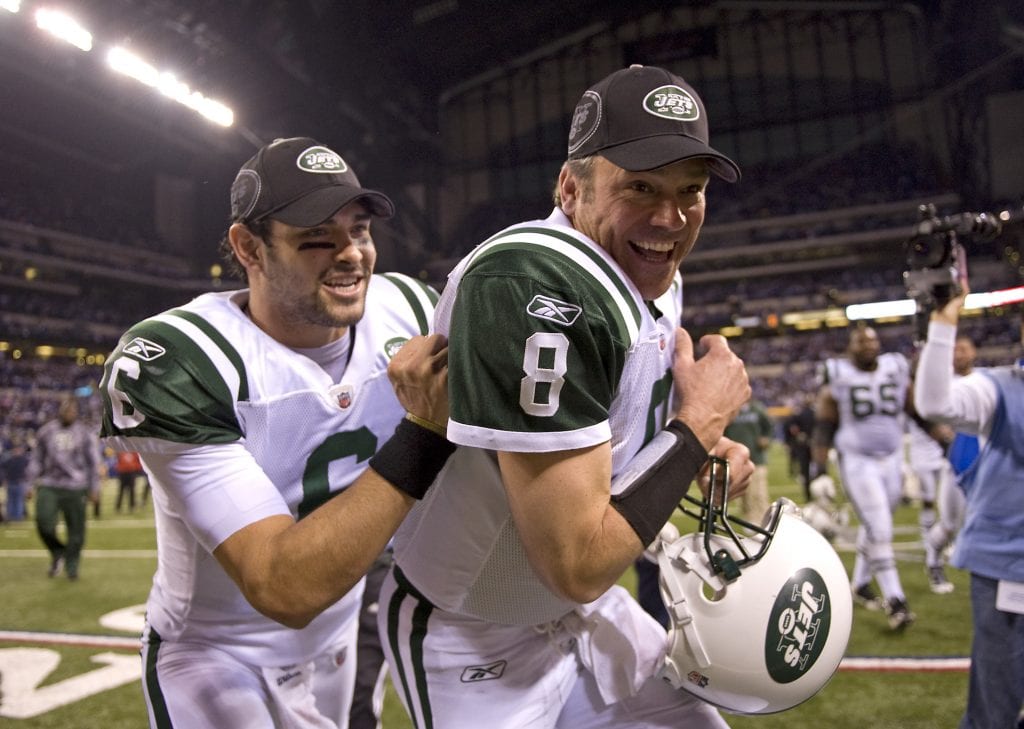
New York Jets, Mark Sanchez
NY Jets quarterback #6 Mark Sanchez runs off the field with Mark Brunell after the Jets win 17-16. The New York Jets defeated the Indianapolis Cols 17-16 in an AFC Wild-card game at Lucas Oil Stadium in Indianapolis, IN, January 8, 2011. ***** ALL NEW YORK NEWSPAPERS OUT —- ALL NEW YORK NEWSPAPERS OUT ***** (Photo by Anthony J. Causi/Icon SMI/Corbis/Icon Sportswire via Getty Images)Mar


Flacco switched his shades of green in the offseason, moving on to Philadelphia to mentor (and possibly compete with) another young hopeful, Jalen Hurts. For the three weeks between the Darnold trade and the draft’s opening night, Morgan and White were the only quarterbacks on the roster before Wilson heard his name called in Cleveland.

Yet, Jets coach Robert Saleh doesn’t sound overly enthused about bringing in a backup any time soon. Speaking after the Jets’ minicamp proceedings on Monday, Saleh seemed to hint that bringing one in at this point in time wouldn’t have much of a purpose at this point in time.

“If you just bring in a veteran who doesn’t know your scheme, he’s learning just like the rookie is,” Saleh said, per Brian Costello of the New York Post. “Aside from helping him with rehab…and study habits, which I think Zach and that entire quarterback room is already ahead of the curve on how they handle their bodies and study, I don’t know if there’s much value aside from being comfortable that if the crap hits the fan you have a veteran who has played football. It’s more of a comforting feeling rather than working your ass off to develop the quarterbacks who are already in the building.”

The role of the backup quarterback may well be the most underrated job in professional sports. Sometimes, the role proves to be bizarrely rewarding. Fitzpatrick, for example, has built a 17-year NFL career through quasi-Winston Wolf endeavors, solving starting quarterback problems in various locales. He’s spending the 2021 season in Washington, which is still buzzing from the antics of Taylor Heinicke, the Old Dominion legend who viral for playing respectably during the NFC Wild Card playoffs against Tampa Bay last winter. Charlie Whitehurst, he of a Christ-like physical appearance and nearly 400 pass attempts over 11 NFL seasons, earned a cult following as “Clipboard Jesus”.

In these modern NFL Sundays, dominated by the social media behemoth of Twitter, it doesn’t take much for overzealous fans, even facetious supporters looking for engagements, to start calling for the backup’s name. Once he’s in, the primary directive is simple: do not be the reason your team fails to prevail. For instance, Heinicke (26-of-44, 306 yards, 46 rushing yards, 2 total scores, 1 interception) was far from the primary reason that Washington fell to the eventual Super Bowl champions, and it convinced the Football Team to bring him back on a two-year deal. The same couldn’t be said about, say, 2019’s Pittsburgh Steelers, who failed to keep up the same offensive production with Mason Rudolph and Devlin Hodges after Ben Roethlisberger went down.

But when a rookie quarterback, an anointed franchise man, joins the fold, the backup takes on double duty: serving as a mentor or even holding down the fort while the freshman gets his NFL legs.

The latter concept is an endangered species. Kansas City’s gambit…remaining in immediate contention with effective incumbent Alex Smith before turning the reigns over to future champion Patrick Mahomes…probably bought it some time. The Los Angeles Chargers were set to roll with such a strategy before a medical emergency forced the chosen veteran, Tyrod Taylor, to vacate the starter’s role in favor of eventual Rookie of the Year Justin Herbert. Miami partially employed it, but never truly committed to Tua Tagovailoa last season. When thrust into a surprise playoff run, they turned to, who else, Fitzpatrick.

Right now, neither of the understudies on the Jets’ roster seems capable of fulfilling those roles. The fourth-round selection of Morgan was bizarre when it happened (especially when Gabriel Davis went to Buffalo three picks later) and was made even more puzzling when the Florida International alum couldn’t even earn a dressing during a meaningless two-win season. White, a fifth-round pick in Dallas back in 2018, at least has the benefit of a couple of preseasons under his belt, but those numbers (68.5 passer rating over eight contests) aren’t inspiring.
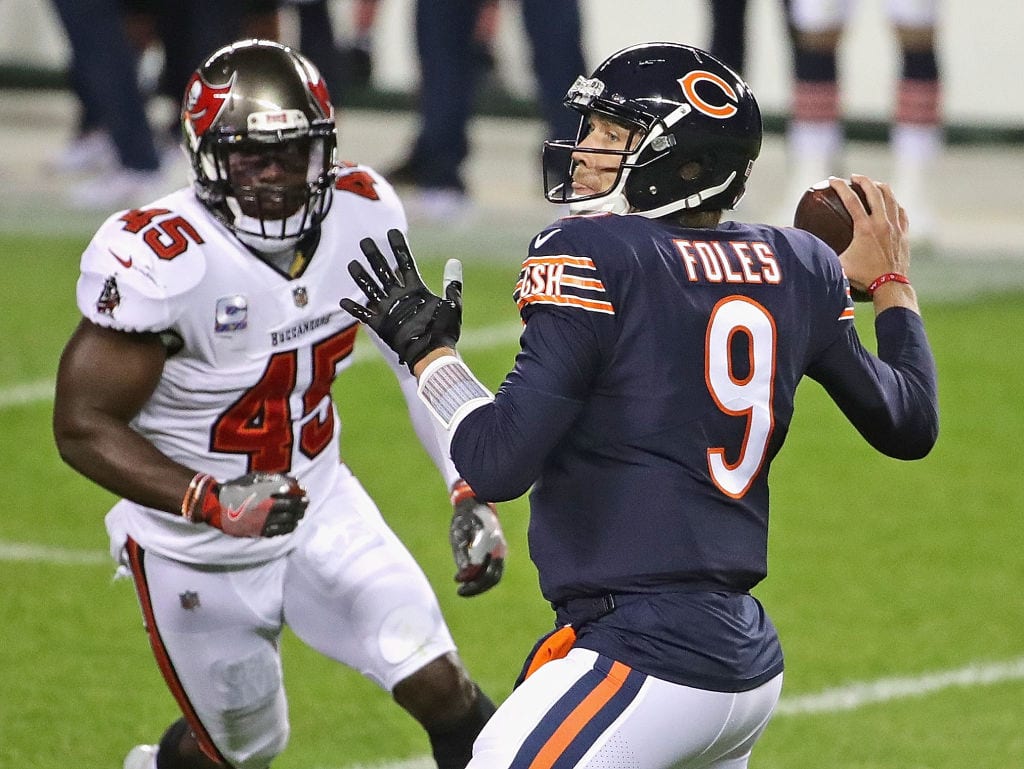
CHICAGO, ILLINOIS – OCTOBER 08: Nick Foles #9 of the Chicago Bears passes under pressure from Devin White #45 of the Tampa Bay Buccaneers at Soldier Field on October 08, 2020 in Chicago, Illinois. The Bears defeated the Bucs 20-19. (Photo by Jonathan Daniel/Getty Images)

The Jets have actually had ample opportunities to address the area this offseason, but have curiously passed on each one. Brian Hoyer, another thrower who has extended his career through sizable backup endeavors, was brought in for a workout but he chose to continue his third tenure in New England. Nick Mullens, a former pupil of the Jets’ new offensive coordinator Mike LaFleur back in San Francisco, seemed like another prime candidate before he joined Flacco and Hurts in Philadelphia. The free agent market is relatively shriveled at this point, with the best option perhaps being a trade with Chicago, inquiring about Nick Foles. Flacco’s fellow Super Bowl MVP is a popular entry in the backup quarterback Mount Rushmore who won the 52nd alongside current Jets general manager Joe Douglas, the latter then residing in the Eagles’ front office. He’s expendable in Chicago through the arrivals of veteran Andy Dalton and rookie Justin Fields.

Between Saleh’s words and the logistics and protocols involved with a new entry, it’s probably not wise to assume that Jets (who have a decent amount of extra draft picks to barter with) will be welcoming Foles to their minicamp proceedings this week. But they’d be better off trying to solve the situation sooner rather than later.

As the Darnold era quickly proved, the Jets can hope all they want that a certain prospect will pan out, but they need to have both guidance and insurance working with the rookie. Darnold would routinely mention that his best days came under the watch of McCown, years after Mark Sanchez built a strong relationship with Brunell. Otherwise relatively quiet on the football timeline, the early summer months can be a perfect time for Wilson to work with a mentor. By neglecting this area for so long, they’ve wasted some valuable time in Wilson’s development.

One can have the highest hopes and dreams for Wilson, and it’s abundantly clear that the Jets have such fantasies in store for him. However, when the prized rookie comes in and is somehow tied for the title of the most experienced man in the room…that’s a controversy.

Geoff Magliocchetti is on Twitter @GeoffJMags
How the Chiefs-Ravens trade could affect the New York Jets’ draft plans

Baltimore and Kansas City’s deal might give the New York Jets some extra clarity at the 23rd overall pick in Cleveland next weekend.

A deal between contenders could have ripple effects on a team that’s desperate to join them.

The Baltimore Ravens and Kansas City Chiefs swapped assets and names on Friday, six days before the first round of the 2021 NFL Draft will be staged in Cleveland (8 p.m. ET, ABC/ESPN/NFL Network). Pro Bowl-nominated blocker Orlando Brown Jr. will join the refurbished wall in front of Patrick Mahomes while four picks, including the 31st overall choice on Thursday, move on to Baltimore. Two Raven draft picks also come over with Brown, the first of which will be a second-rounder on Friday.

One can argue that a trade between a pair of playoff teams should have little effect on the New York Jets, who are ready for a potentially franchise-changing weekend. But New York will turn in three draft cards within the first 34 selections next Thursday and Friday. The Chiefs and Ravens’ gambit could set them up for what they plan to do with the latter pair.

The Jets’ first pick, second overall on Thursday, is more than likely accounted for: unless they plan on starting James Morgan or Mike White in September, they’re taking a quarterback. But debate rages on in what they’ll do with the 23rd overall choice, obtained from Seattle last offseason. The Ravens also own their regularly scheduled pick in the 27th slot, giving them two picks before the Jets pick again at No. 34, the second pick of the second round.

This de facto Baltimore sandwich…including the 31st pick from Kansas City traditionally bestowed to the Super Bowl runner-ups…only strengthens the case that the extra metropolitan first-rounder could behoove the Jets to address their offensive issues with each of their first two selections.

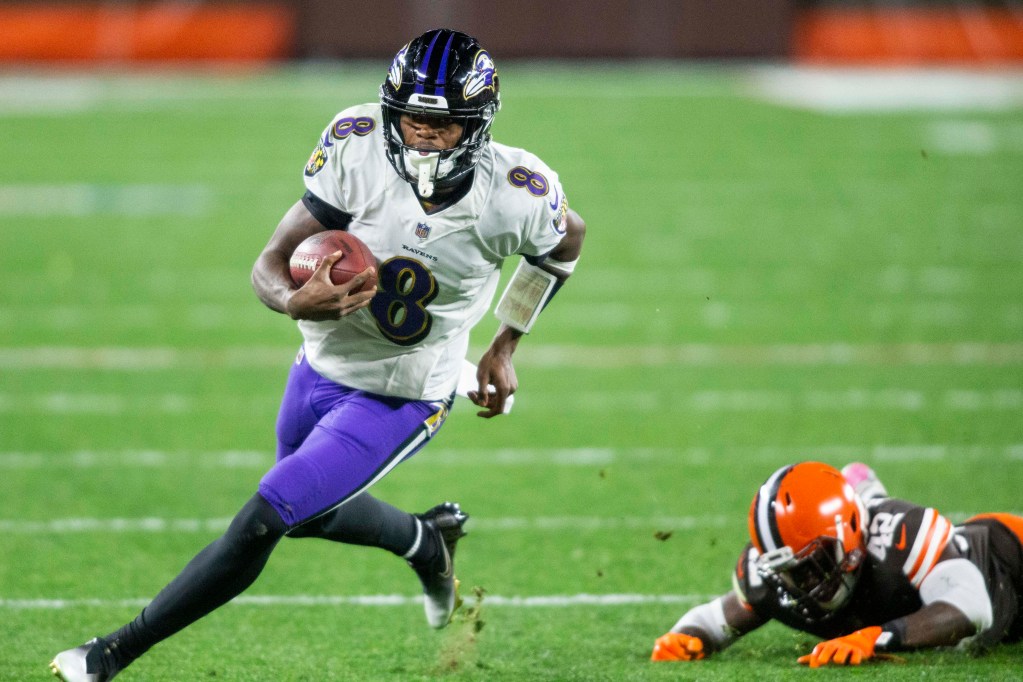
Baltimore is at an interesting point on its franchise timeline. They’ve earned at least 10 wins in each of the last three seasons and won a playoff game for the first time since 2014 in the Wild Card round in January. Barring a jaw-dropping transaction, they’re set with Lamar Jackson at quarterback for the foreseeable future. Their ground game enjoyed a significant jolt with rookie JK Dobbins working with Gus Edwards (1,528 yards, 15 touchdowns combined).

 Mandatory Credit: Scott Galvin-USA TODAY Sports

With Jackson’s great power comes even greater responsibility (wrong city, we’re aware). Jackson is capable of beating teams both through the air and on the ground (1,005 rushing yards). His mobile prowess, however, leaves him open to sacks and injuries. The trade of Brown, a blindside blocker, leaves a mediocre offensive line (16th in Pro Football Focus’ final 2020 rankings) in somewhat dire straights. Former All-Pro Ronnie Stanley is expected back, but he’s coming off a brutal ankle injury suffered in November.

Additionally, Baltimore may also look to surround Jackson with more weaponry. They’re set with the young pair of Dobbins and Edwards in the backfield but their receivers leave something to desired. Is there a No. 1 receiver in this bunch? Marquise “Hollywood” Brown has potential (58 receptions, 769 yards, 8 touchdowns) but even if the Ravens want to roll with him, major questions reside behind him. Second receiver Willie Snead left for Las Vegas, leaving behind the unproven Miles Boykin and Devin Duvernay. Veteran Sammy Watkins was welcomed in this offseason, but he’s not somebody who’s going to be the difference in wrangling away control of the AFC from Kansas City or Buffalo.

Thus, it’s very possible that the Ravens could be going offense with each of their first two picks. From a Jets standpoint, it’s thus less likely they can afford to wait until Friday to address a non-quarterback need. Had Kansas City kept Thursday’s penultimate pick, it was more likely to see them addressing their pass rush woes. It’s quite possible Baltimore could go offense with each of their Thursday couple. Several teams between 23rd and 34th (Pittsburgh, Green Bay) already appear to be leaning toward an offensive pick as well. Baltimore’s extended prescience should at least help narrow the Jets’ choices. Several defensive talents should still be around by the time Friday’s proceedings start, but some elite blockers (Tevin Jenkins, Alex Leatherwood, Christian Darrisaw, Landon Dickerson) and weapons (Travis Etienne, Rashod Bateman) could be gone with another offense-seeker injected into the fold.

New York Giants, Rashod Bateman
 Mandatory Credit: Jesse Johnson-USA TODAY Sports

Granted, the Jets are working so far from behind that there’s almost nowhere to go but up when it comes to day one of the draft. But while the Jets will likely have to address defensive woes sooner or later, they’re about to put a big investment in one of the non-Trevor Lawrence passing talents of a strong 2021 passing class. Whether it’s Zach Wilson, Justin Fields, Trey Lance, or an unknown party, they can’t lead the Jets’ resurrection on their own. They need help, namely on the offensive line after not doing too much to upgrade over the offseason.

Secondary and edge help will be around in the second round. Thursday should be a day dedicated to the new quarterback and getting him as comfortable as possible before the hard part begins. Giving him a more attractive offensive depth chart to look at before he makes his Florham Park entrance requires an offensive mindset in the earliest stages in Cleveland next week.

Geoff Magliocchetti is on Twitter @GeoffJMags
New York Jets: Three ways to avoid the failures of the Sam Darnold era

The New York Jets will welcome in yet another passing savior next week. How can they avoid the pratfalls of the prior era?

The New York Jets have answered the question of “what” when it comes to the second overall pick in next week’s NFL Draft (8 p.m. ET, ABC/ESPN/NFL Network). Through trading Sam Darnold, it’s all but assured that the Jets will be taking a quarterback, but the lingering quandary is “who”? Many expect it will be BYU passer Zach Wilson, but New York management continues to do its due diligence on non-Trevor Lawrence prospects like Justin Fields, Trey Lance, and Mac Jones.

For Jets fans, this process has become distressingly familiar. It’s been a long time since the team had any form of consistency in the franchise quarterback role, a spot plague by turnover on both the field and depth chart. The new century has been particularly cruel: would-be saviors found in the first two rounds have fizzled out, doomed to obscurity or inclusion on the yearly all-time bust lists that accompany draft weekend. Darnold was the latest unfortunate name added to that list through the trade to Carolina after three years of general inconsistency.

But it wouldn’t be fair to pin all of the Jets’ struggles of the past three seasons on Darnold. New York has made their share of mistakes that any quarterback would have trouble overcoming. How can they ensure a smoother transition for a new quarterback this time around? It won’t be easy, as the Jets’ problems won’t automatically be over once the newcomer takes over. ESM has three ways to avoid embarking on yet another passing search…

Build a Wall

Darnold was officially credited with a career-best 217 rushing yards last season. But if his scrambling was accounted for, he might’ve rivaled Derrick Henry’s final tally…OK, maybe Dalvin Cook, but still.

With D’Brickashaw Ferguson and Nick Mangold long gone, the Jets have spent the past few seasons paying dearly for the sins of the Mike Maccagnan era, where upgrading blocking was more of a suggestion than it was a requirement. Poor blocking can derail a young quarterback’s career before it ever truly begins. The most blatant case is the cautionary tale of David Carr, the first rookie chosen in Houston Texans history who was sacked an NFL record 76 times in his debut year. He (and the Texans as a whole, for that matter) was never able to get his NFL career back on track. Darnold fortunately never reached those dubious heights, but he was sacked 98 times in three seasons…and he missed ten games due to injury and illness.

To his credit, Joe Douglas has tried to make up for the neglect, even if the Jets’ 2020 renovations have left something to be desired. His first moves as general manager were to convince Ryan Kalil out of retirement and trade a draft pick to Baltimore for Alex Lewis. He brought in veterans like Connor McGovern, George Fant, and Greg Van Roten and passed on elite receiving talents to draft Mekhi Becton. Thus far, only Becton looks like a long-term piece. It’s great to see that Douglas recognizes the importance of blocking, but talent evaluation will be vital over the next few years.

Remember It’s a Team Game 

There is the occasional, once-or-twice-in-a-lifetime passing talent that is able to single-handedly change the game. Legends like Tom Brady and Peyton Manning have probably extended the careers of countless receivers. But putting the pressures of New York is too much to bestow on a rookie quarterback and it’s downright harsh to expect any newcomer to be an instant fix for a team that’s nursing a decade-long playoff drought.

We’re still not sure who’s going to line up under center for the Jets come September, but he’s going to be blessed with a relatively warm situation. The Jets brought in a proven multi-talented weapon in Tevin Coleman to headline a run game working with three younger projects. Big play talents Corey Davis and Keelan Cole were added to receiving corps that welcomes back Jamison Crowder and Denzel Mims.

Patience will nonetheless be the name of the game. Again, any quarterback short of de-aged Joe Namath isn’t going to thrust the Jets back into relevancy. There are simply too many holes that even next weekend’s draft won’t fully plug and too many established contenders in the AFC to get by. The newcomer’s first season should be about establishing a rapport with his new weapons and coaches. Any extra wins that happen to emerge (the Jets’ o/u is currently 6 at the William Hill sportsbook) can be considered extra credit.

Taking in Robert Saleh as a head coach was a good way to start things off. Sure, a defensive mastermind like Saleh seems unconventional when a team is trying to groom a long-sought-after franchise quarterback. But this time around, it’s not the hot-take artists that are praising the hire…it’s the players. Saleh’s arrival and promotion has earned positive reviews from players both domestically and abroad, a welcome change compared to the relative indifference from on-field participants that plagued Adam Gase’s arrival. Hometown players buying into what Saleh has to offers and outsiders expressing jealousy should help present an ideal emotional setting for a quarterback taking his first NFL steps.

Stay Awhile

No quarterback is an island. Even the most impactful quarterbacks in league history have a name, nor names, forever spoken in the same breath as their own. Brady had Julian Edelman and still has Rob Gronkowski. Manning had Marvin Harrison and Reggie Wayne. Namath fulfilled his legendary guarantee in Miami with the help of longtime rushing collaborator Matt Snell, not to mention future Hall of Fame electee Winston Hill on the offensive line.

Now consider what Darnold dealt with in modern New York: by the time Week 1 of the 2020 season rolled around…his third and final season in green…the 2018 draftee had no receivers leftover from his rookie year with the exception of tight end Chris Herndon (whose sophomore campaign was effectively wiped out by injuries and a suspension). The offensive line was likewise completely different from even one year prior. Darnold took his snaps from three different starting centers (Spencer Long, Jonotthan Harrison, and McGovern).

Simply put, all will seem relatively well once the new quarterback is on the roster. But once he’s secure, it will be all about building gridiron camaraderie with the rest of the roster. That doesn’t only apply to the offense either: building a strong defense can help keep the game manageable for a youngster while good special teams can help turn the field in his favor. Endless amounts of turnover will only lead to chaos for a young man that is already facing one of the most stressful jobs on the face of the Earth: NFL franchise quarterback. Darnold and the Jets learned that the hard way.

Geoff Magliocchetti is on Twitter @GeoffJMags

New York Jets: Sam Darnold and Zach Wilson can’t mix

If the New York Jets quarterback quandary is truly down to Sam Darnold and Zach Wilson, there must be no stalemate.

There’s no telling exactly when the New York Jets started thinking of having someone other than Sam Darnold in their franchise quarterback role. The only facts behind the case are that the situation is active and will be resolved by the evening of April 29, when the team chooses second in the 2021 NFL Draft in Cleveland.

But what if the situation stretches beyond April, into the warmer months? The only way to do that would be to keep Sam Darnold and draft Zach Wilson…a situation the Jets must avoid at every cost.

No matter when this proverbial game of musical chairs began, some of the contestants have dropped out, opted to join other games, or both. One seat, that of the franchise quarterback role, remains, and it appears that two players circle it while the music plays: Darnold and Wilson.

As those other seats fill across the league, the incumbent Darnold remains a Jet with the team does their due diligence on his potential replacement. With Urban Meyer more or less eliminating any draft day surprises vis a vis Trevor Lawrence, draft day attention now turns to the Jets in the second slot. The consensus No.2 has become BYU quarterback Zach Wilson, who wowed many at his Provo-based pro day with Mahomes-like tosses. Among the awed was the Jets’ representative triumvirate of head coach Robert Saleh, offensive coordinator Mike LaFleur, and general manager Joe Douglas. The idea that Saleh and LaFleur’s former Bay Area comrades, equally perplexed over their own passing situation in San Francisco, traded to the third, not second, slot with Miami instead of the Jets served only to fuel the idea that Darnold’s green days were numbered.

If Wilson is truly on his way, a new debate is spawned: what to do with Darnold? One of the more fascinating “what if” situations on the modern NFL landscape is envisioning Darnold’s career if the Jets hired someone…heck, anyone…at head coach other than Adam Gase. The team has stocked up on affordable/bargain offensive weaponry this offseason that could provide Darnold some long-awaited professional stability.

But if Wilson is the way the Jets want to go…the Jets must cut ties with Darnold at all costs. The idea that this team can make it through a situation where two quarterbacks in their early 20s are on the same roster seems dubious at best. If Wilson’s Jets career begins, Darnold’s must end.

There’s no doubt that an incoming franchise thrower can benefit from having a veteran work alongside him, even through competition. That’s exactly how Darnold’s New York career began, after all, as he worked alongside Josh McCown for a season. But Darnold, set to turn 24 in June, isn’t exactly at the “veteran mentor” stage of his career. This is a quarterback who has displayed fleeting flashes of brilliance, enough for the casual observer to wonder if it’s a miracle in itself that he was able to briefly shine in the first place.

With the Jets cleaning their coaching house, there’s an opportunity to see Darnold work with a new staff. The idea of quarterback competition at camp could be interesting, especially if preseason games return this summer. Some might see Darnold as a reliable safety net if the unthinkable happens to the rookie, Wilson or otherwise. But when you’re trapped in a perpetual rebuild…one that just might see a light at the end of its tunnel…that’s not worth it. A Jets team divided amongst itself…especially at the quarterback position…cannot stand.

The Jets are in a position where they might finally be starting to right their ship. Whereas the hire of Gase was praised only by the hot take artists, players both domestic and abroad lauded the arrival of Saleh. It’d make sense to follow his vision as precisely as they can. At the same time, it means minimizing controversy, vital for a team whose smallest abnormalities are turned into memes because the mere concept of “LOL Jets” gets clicks.

There’s also no use in pulling Wilson’s leg, which the exact message that keeping Darnold sends. How can he ease into the franchise quarterback role when a young player who may be equally capable…the Jets still don’t know…is sitting behind him? It’s one thing to bring an experienced mentor whose full-time starting days are probably behind him (i.e. Alex Smith/Brian Hoyer) or a relative veteran who’s proven reliable in a pinch (i.e. Nick Mullens/Blake Bortles). But to continue to work with a young quarterback and push him back to a backup role creates a problem where there doesn’t need to be.

The situation works on both sides. Though the scenario appears to become more remote with each passing day, there’s still a chance that Darnold could stay. If that’s the case, it’d be silly to say Darnold’s the starter and have the second overall pick breathing down his neck. Fans are set to return to MetLife Stadium this fall and the last thing Darnold would need is a chant for Wilson’s insertion every time he throws an incompletion.

While Saleh has carved out a hopeful path, he inherits a mess from the depths of the football netherworld that, again, needs little exacerbation. The defensive-minded Saleh must settle the uncertain secondary situation in the post-Jamal Adams era, while he and his offensive assistants also have to figure out an offensive line picture that, the arrival of Dan Feeney notwithstanding, doesn’t look much different from last season’s. To worry about the quarterback situation is simply thinking about another problem the Jets can ill-afford.

New York football will have its share of problems beyond April 29. With a glimmer at the end of the tunnel of rebuilding, but countless other turns to tackle in it, this quarterback issue can’t go beyond that.

Geoff Magliocchetti is on Twitter @GeoffJMags 
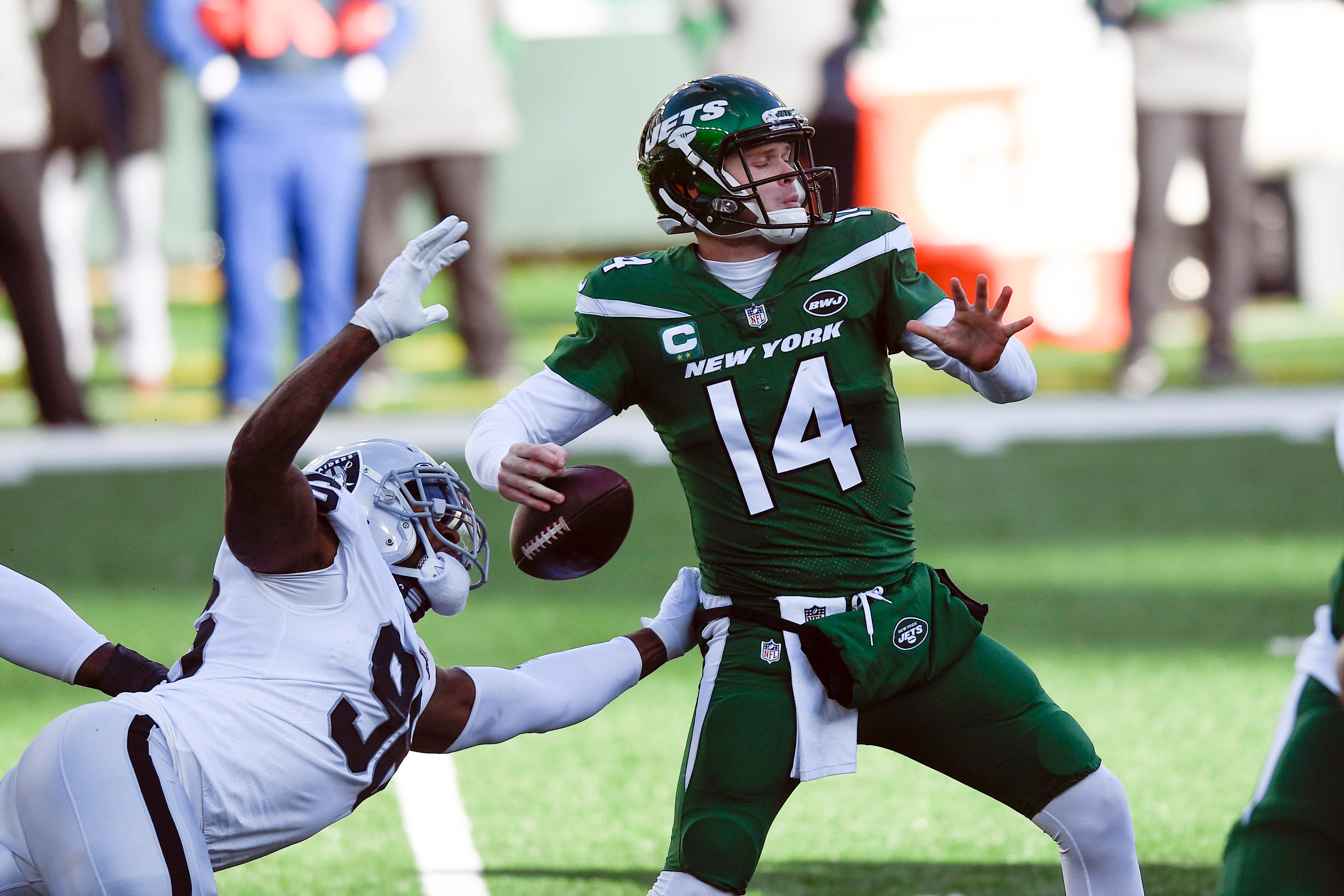
The New York Jets have a(nother) quarterback conundrum

Sam Darnold might be here to stay, but, even if the New York Jets are ready to roll with him, their passing questions still persist.

When one analyzes the offseason of a two-win team that’s welcoming in an almost-entirely new coaching regime, it’s hard to truly lament any losses from the prior group. Sure, departures Henry Anderson and Breshad Perriman provided occasional flashes of brilliance, but one look at the 2020 New York Jets would be enough to convince fans that change was coming and should’ve given them ample time to say their goodbyes.

But one of the most recent losses may sting the new edition in unexpected ways.

The Philadelphia Eagles announced on Tuesday that former Jets thrower Joe Flacco will don a new shade of green through a one-year deal. It is widely expected that the Super Bowl XLVII MVP will backup sophomore Jalen Hurts, or at least compete for the role against Nate Sudfeld and Khalil Tate.

On paper, the Flacco departure shouldn’t affect the Jets drastically. The Audubon, NJ native’s lasting metropolitan legacy was likely to appear on endless lists and attempts at Twitter procrastination when fans pejoratively reference a legend of the game’s time in unfamiliar colors (other Jets examples in this phenomenon would include Chris Johnson, Derrick Mason, and Ronnie Lott). Additionally, if incoming receiver Corey Davis is to be believed, Sam Darnold will be the Jets’ starting quarterback come September, eliminating any semblance of a New York quarterback controversy…for now.

Flacco’s departure, however, may be the Jets’ most impactful loss yet.

The importance of a backup quarterback can no longer be denied in the modern NFL. Injuries remain a part of the game and teams have become especially cautious when it comes to high-profile quarterbacks. In each of the last two seasons, for example, only 13 throwers started all 16 of their team’s games. We’ve witnessed backup throwers start…and win…playoff games. The most recent Wild Card Saturday saw John Wolford and Taylor Heinicke line up under center and the football world is only three years removed from watching Nick Foles shock the Patriots in the Super Bowl. Tennessee built a contending squad after a strong safety net, Ryan Tannehill, became their primary option.

Trivial as it seems, this area must be addressed. In New York, the Jets have not had a quarterback start every game in a season since Ryan Fitzpatrick went the whole way in 2015. Darnold has yet to start to a full season and the Jets are 0-10 in his absence, with those games being overseen by Flacco, Josh McCown, Trevor Siemian, and Luke Falk.

While Davis appears confident that Darnold is the Jets’ man for the future, his comments don’t clarify over whether he’ll be the official starting quarterback. National mock drafts continue to place a non-Trevor Lawrence thrower next to the Jets’ slot at No. 2. But it’s hard to imagine the Jets, already cursed with social media notoriety, creating controversy and conflict where there doesn’t have to be. They have enough issues, which include working with a new coaching staff. When there’s finally a light at the end of the tunnel of perpetual rebuilding, it needs to be approaching as cleanly as possible.

Thus, if Davis’ words are to be taken literally, it appears Darnold is the top man. But the backup situation must be addressed and undoubtedly moved up a few pegs on the team’s active offseason priority list (which already needs blocking, secondary, and kicking questions answered).

The current situation

If the Jets stick with Darnold and he’s lost to another medical absence, uncertainty looms in the bottom half of the depth chart. The primary understudy role would probably be a toss-up between James Morgan and Mike White…who have a combined zero NFL regular season passes between them.

The case of Morgan, a mid-major standout from Florida International, is particularly perplexing. His fourth-round drafting made little sense for a team that wound up filling the backup quarterback hole with Flacco shortly after draft weekend. Even as the Jets’ stakes quickly dwindled, to the point they had literally nothing to lose except the top draft pick, Morgan couldn’t even earn a mere activation. New York instead opted to use White, a fifth-round pick in Dallas in 2018, as Flacco’s backup while Darnold recovered. The situation becomes even more bizarre when one looks at the names passed (pun itentended) to add Morgan instead; among them were instant day three contributors like Gabriel Davis and DeeJay Dallas.

It’s hard to fully blame for the predicament. He hasn’t even had the luxury of throwing a down in Jets game jersey thanks to the cancellation of the 2020 preseason. Morgan could well prove himself worth of NFL time sooner or later, but the Jets must, at the very least, create a competition for the spot, especially if they’re keeping Darnold.

What the Jets need in a backup

  • Mentorship: What Darnold needs at this point in time of his NFL career is stability and guidance. The closest he’s looked to having his NFL act together came at the end of his rookie season, when he put up a 99.1 passer rating (64 percent completion rate, 6 touchdowns, 1 interception). Darnold credited the surge in production to “watching Josh (McCown)” while he was injured. Having a de facto coach who also wears a jersey could be big for Darnold as he enters the all-important fourth year on an NFL roster.


  • Experience: Abstaining from drafting another quarterback if Darnold is kept would limit potentially negative attention. But if the Jets want someone to keep them afloat if Darnold is lost once again, they would be much better trusting someone used to the weight of NFL starterhood rather than entrusting an emergency situation to a day three choice. Several ex-starters who would probably be better suited for backup duties remain on the free agent market, including Blaine Gabbert from the Super Bowl champions in Tampa Bay and San Francisco passer Nick Mullens, who has worked with incoming coaches Robert Saleh and Mike LaFleur.


  • That Championship Feeling: The Jets would be wise to seek someone whose has experienced the passing highs the NFL has had to offer. For example, Blake Bortles, most recently a member of the Los Angeles Rams, was starting in an AFC title game three seasons ago. Enough can’t be written about Alex Smith’s inspiring NFL journey. These throwers, amongst others, can provide the Jets some assurance and security in case the unthinkable happens to Darnold yet again, while providing him some off-the-field skills to learn as well.

Geoff Magliocchetti is on Twitter @GeoffJMags

New York Jets: Could Gardner Minshew be an answer at QB?

The New York Jets have already added one former Jacksonville Jaguar. Could another help them solidify a youthful revolt on offense?

Salvation for the two-win New York Jets could be earned through the one team that managed to finish worse: the 1-15 Jacksonville Jaguars.

The Jets have already added one North Floridian import in receiver Keelan Cole, a slot receiver that managed to earn a Duval-best 2,242 yards over the last four seasons despite relentless turnover at the quarterback position. Cole entered the league as an undrafted free agent in 2017 and has had seven different starters throw to him, including three alone last season.

Jacksonville has a prime opportunity to finally stop the carousel as the owners of the top pick of April’s NFL Draft. The consensus top choice is Clemson star Trevor Lawrence. The Jets are immediately behind them and are doing their due diligence on rookie throwers like Justin Fields and Zach Wilson, as Sam Darnold’s future remains a metropolitan talking point.

But could the Jets’ solution lie in further negotiations with the Jaguars?

The incumbent thrower in Jacksonville is Gardner Minshew, a sixth-round pick out of Washington State in the 2019 draft. Jacksonville has reportedly embarked on an endeavor to trade Minshew before Lawrence presumably dons teal and black on April 29. Minshew has produced some impressive numbers despite working in relative gridiron squalor in Jacksonville, posting 5,530 yards, 37 touchdowns, and only 11 interceptions over the last two seasons.

ESM has four reasons why the Jets should investigate…

He’s an upgrade

As the Jets continue to ponder the Darnold situation, many have risen in defense of the third overall pick from 2018, claiming his subpar numbers (79.1 passer rating, 28 touchdowns, 24 interceptions) over the last two seasons are the result of a toxic football environment brought upon by the Adam Gase era. However, Minshew has arguably had even worse surroundings in the wasteland of Jacksonville’s post-AFC title game visit in 2017.

With 23 games (21 starts) under his belt, Minshew nonetheless has best Darnold in touchdown passes, yardage, and passer rating despite partaking in two fewer games than the Jets’ incumbent. There’s time for Darnold to get his NFL act together, but if Minshew, who has proven he can produce in a professional setting, can help the Jets in the short-term and finally get some offensive momentum moving in the right direction, it’d help this hopeful chapter of the Jets’ perpetual rebuild get started on the right note.

He has a connection with a crucial newcomer

After a relatively slow start, the Jets have made a strong effort to upgrade their receiving weaponry. Reliable slot man Jamison Crowder appears to be on his way back with hopeful second round choice Denzel Mims. The newcomers have arrived from the AFC South. Corey Davis, fresh off a career-best season in Tennessee, joins the fold with Cole, the Jaguars’ most prolific receiver over the last four seasons.

Minshew bestowed some strong praise unto Colege heading into the 2020 season, comments that indicate that he would have no qualms working with him again.

“I love throwing to Cole and I’m excited to see what he’s going to be doing,” Minshew said per Demetrius Harvey of Big Cat Country. “He’s got really good hands, can play all three positions, he makes the tough catch, he’s been very consistent, he’s become better at this route running, he’s been able to get in and out a little better, so you see an improvement from last year to this year.”

The Jets backed themselves into a bit of a corner 

The Jets have undoubtedly upgraded this offseason, at least on paper. But their primary concern remains unsolved, one even bigger than the quarterback conundrum.

New York can resolve their quarterback situation one way or another. They can stick with Darnold, trade for a name like Minshew or Russell Wilson (the Deshaun Watson pursuit is likely on hold for obvious reasons), or wait until the draft. But no matter who the quarterback is, he’s going to need protection through a retooled offensive line. With the exception of adding the Los Angeles Chargers’ Dan Feeney…high in personality, low in analytical gradings…the Jets haven’t done anything to upgrade their much-maligned unit. Drafting Mekhi Becton was a good start last season, but general manager Joe Douglas’ free agency renovations haven’t panned out. Recurring target Joe Thuney is off to protect Patrick Mahomes in New England while Green Bay stud Corey Linsley is off to Feeney’s old stomping grounds.

Thus, the Jets find themselves in a bit of a conundrum. If they draft a quarterback, the poor first-year man will likely be running for his life or potentially see his confidence shattered behind a makeshift blocking unit. Thus, using the second choice on top blocking prospect Penei Sewell out of Oregon. Minshew would be a strong, if not temporary, solution while the Jets try to bolster the men in front of him.

Furthermore, taking on Minshew’s contract is a light load the Jets could handle while seeking out further options on the line. Over the next couple of seasons, Minshew’s combined cap hit is in the $2 million range.

He brings stability to a franchise in desperate need of it

Time will tell how Minshew’s NFL career plays out. As of now, he appears set to inherit Ryan Fitzpatrck’s throne in terms of being a serviceable fill-in option while accompanying such endeavors with a larger-than-life personality. At this point, he’s probably not a future franchise quarterback. But he can provide a sense of stability to a Jets team in desperate need of it, a security blanket, if only for a sense or two that the Jets desperately need.

The Jets are working on a playoff drought that’s nearly old enough to see a PG-13-rated movie without parental supervision. Ending that drought is a lot to ask for this year with still so many established contenders, no matter how much hope Robert Saleh brings to this team. But the Jets need to re-establish a sense of stability to their franchise at any cost possible. Thus, using Minshew as a stopgap option of sorts can help make the Jets a destination of sorts.

A comparable case came during the 2017 campaign in the form of Josh McCown. While far older and probably never reaching the statistical heights that Minshew has already traversed, McCown’s strong season on a Jets team some predicted would go winless helped them bring some stability to a team whose quarterback situation was in flux. The team had one less thing to worry about and was able to bide their time in finding a successor while being competitive in the meantime. McCown went 5-8 as a starter…featuring a win over the aforementioned AFC finalists from Jacksonville…but six of those eight defeats came by a single possession. Minshew can help the Jets build something further, helping get a new regime off in the right direction.

Geoff Magliocchetti is on Twitter @GeoffJMags

New York Jets to attend QB Trey Lance’s pro day (Report)

New York Jets general manager Joe Douglas is expected to be among those observing North Dakota State QB Trey Lance in Fargo.

The New York Jets will officially begin their rookie quarterback evaluation on Friday. General manager Joe Douglas is expected to be one of several decision-makers on hand at North Dakota State University’s pro day to view touted thrower Trey Lance. Proceedings can be viewed at 11 a.m. ET on NFL Network.

A report from Albert Breer of Sports Illustrated mentions that Douglas will be one of five general managers stationed in Fargo. Atlanta, Carolina, and Detroit are each sending both a coach and general manager while Washington is likewise repped by its GM Martin Mayhew.

Lance is expected to be one of the first passers selected in the first round of the NFL Draft come April. Though Lance has only a single full year of starter’s experience, he posted one of the most prolific ledgers in the history of the Bison’s storied football program. Lance was responsible for 36 touchdowns without throwing a single interception during their eighth Football Championship Subdivision title in program history. The Bison’s perfect 16-0 record hadn’t been achieved at the Division I level since 1894 (Yale).

For his efforts, Lance, then a redshirt freshman, earned the 2019 Walter Payton Award, annually bestowed to FCS’ most outstanding offensive player. Previous winners include Steve McNair, Tony Romo, Jimmy Garoppolo, and Cooper Kupp. Lance was the first freshman to ever be bestowed the award named after the Chicago Bears legend and Jackson State alum.

Lance is not partaking in the Bison’s ongoing season, which was moved to spring and continues on Saturday at the Fargodome against Illinois State (3:30 p.m. ET, ESPN+). But he did partake in a brief fall showcase against Central Arkansas, earning 292 total yards and four scores in a come-from-behind victory.

One of the most dominant programs in FCS history, NDSU’s pro offerings won’t be limited to Lance. Blocker Dillon Radunz earned positive reviews for his performance during Senior Bowl prep in Mobile while receiver-turned cornerback Marquise Bridges has likewise warranted a look. That group helped NDSU break its own record for the longest winning streak in FCS history (39), which was snapped on February 27 against Southern Illinois.

The last NDSU alum chosen by the Jets was running back Gordy Sprattler in the ninth round of the 1979 draft. Sprattler did not play a regular season down. They last chose a quarterback from an FCS/Division I-AA school in 1983 through first-rounder Ken O’Brien of California-Davis.

Geoff Magliocchetti is on Twitter @GeoffJMags   

New York Jets: New deals elsewhere make the case to draft

As a decision at quarterback looms, the New York Jets can take a lesson from Dak Prescott’s new contract and Tom Brady’s restructures.

Tom Brady has taught, or has at least attempted to teach, the New York Jets countless lessons over the past two decades. As Brady plans to extend his career even further, the Jets can probably stand to take one more as light begins to flicker at the end of their tunnel of rebuilding.

Just over a month after he helped bring the Vince Lombardi Trophy to Tampa Bay…and a seventh ring to his finger…Brady is already laying down the blueprints for another. According to a report from Josina Anderson, the thrower whose “GOAT” label is becoming less debatable with each passing day and the Buccaneers are restructuring the two-year, $50 million deal bestowed to him last spring.

The plan is to open up enough cap space to keep the other key contributors from the recently wrapped Super Bowl run. Shaquil Barrett, Lavonte David, and Leonard Fournette are among the champions set to hit the market, while receiver Charles Godwin was franchise tagged.

This wouldn’t be the first time that Brady, 44, would adjust his contract to prolong a potential dynasty. In 2014, negotiations with the New England Patriots netted $24 million in cap space that played a role in three additional Super Bowl visits (two wins).

As things currently stand, Brady is the 16th-highest-paid quarterback in football. It’s probably the one quarterback list where he doesn’t appear in the top ten.

“When he restructures his deal, he’s getting a big bundle of cash up-front. But it is helping us create cap room,” Patriots owner Bob Kraft said of a prior restructure in 2012, per Mike Reiss of ESPN. “We are in the business of quality depth management,” Kraft said. “It’s a physical game and you have injuries, and you need depth on your team.”

The Brady situation is a direct contrast to the ongoing passing situation in Dallas. Dak Prescott is now the second-highest paid quarterback in football at the end of a two-year game of chicken between him and Cowboys management. He’ll make $40 million in each of the next four seasons, a price tag bested only by Patrick Mahomes’ seemingly eternal deal in Kansas City.

It’s great to see a high-character, high-ceiling athlete like Prescott get a good deal, but it’s not the transaction that’s going to bring an elusive sixth Lombardi Trophy to the metroplex. With the signing of Prescott, the Cowboys bare sit above the cap, now working with less than $1 million of space. It could necessitate some painful cuts in the coming future…some say talented blocker Tyron Smith could be a part of that, for example.

Prescott’s deal should not be seen as greed on his part, but rather getting what’s necessary for the Cowboys to merely remain relevant. Some have grilled Prescott for a lack of postseason success, but it’s clear he has the skills to be a game-changing NFL quarterback. Dallas had a taste of life without Prescott when he was lost for the season with an ankle injury after five games. A cursed quarterback hydra of Andy Dalton, Ben DiNucci, and Garrett Gilbert mustered a 4-7 mark in Prescott’s absence. Through four seasons as a full-time starter, Prescott has yet to post a losing record with a star on his helmet.

What do these situations have to do with the Jets? They should avoid a similar predicament in all circumstances.

Unlike the Buccaneers and Cowboys, the Jets’ quarterback future is anything but settled. The only thing anyone knows about the situation is the unspoken guarantee that it will all be over no later than the evening of April 29, the first round of the NFL Draft. Just over a month of relative chaos, however, awaits on the horizon.

The Jets have enough stress with an NFL equivalent of a first-world problem: deciding what to do with the second overall pick. But it seems like every elite, disgruntled, veteran quarterback wants in on what Robert Saleh has to offer, as rumors have linked Deshaun Watson ($39 million in 2021) and Russell Wilson ($35 million) to a green future. Watson and Wilson respectively rank third and fourth in terms of the best-paid quarterbacks, but the Jets, blessed with a cap space number in the area of $70 million that’s been talked about endlessly in the NYC area, are one of the few teams that can perhaps afford to take on such a financial burden.

Tantalizing as such a union would be, however, the cases of Brady and Prescott dictate that the Jets would be best off starting fresh with a rookie contract.

New York Jets
(Photo by Michael Wade/Icon Sportswire via Getty Images)

There’s a sense of “when you have nothing, you have nothing to lose” with the Jets, which can allow them to play with a sense of reckless abandon under a first-time head coach seeking an identity. With so many holes to fill and so many established contenders in the AFC, ending their postseason drought still seems like a tall task. But progress must be made in this perpetual rebuild, particularly in the franchise quarterback role that’s felt vacant since Joe Namath left Shea Stadium for the final time.

For the Jets to do that, they need to fill as many holes as possible and settle as many of their affairs as they can…similar to what Brady’s doing in Tampa Bay. Save for the front four and one of the tackle slots…which appear set to be anchored by the talents of Quinnen Williams and Mekhi Becton respectively…the Jets face uncertainty at almost every spot on the depth chart. Thus, the Jets are not in a position to dedicate most of their offseason funds, no matter how expansive their surplus becomes, to a Prescott-like situation.

It’s better, at this point, to follow the Brady method and restructure around a quarterback that’s not among the highest-paid names in football. Even if they wanted to even extend Sam Darnold’s fifth-year option (currently valued at circa $18 million, per Over the Cap), that would be a better, more affordable trek on which to embark.

When you accumulate a 30-8 record against the Jets in your NFL career, you tend to teach the metropolitan area a lesson or two. With Brady taking on less to ensure his reign lasts even longer, finally heeding and emulating his example…even in mere roster management…can help finally end the perpetual rebuild.

Geoff Magliocchetti is on Twitter @GeoffJMags
New York Jets: The case for (and against) Alex Smith

The inspiring story of Alex Smith won’t continue in Washington. Should its next chapters be written with the New York Jets?

The roller-coaster story of Alex Smith has written its final burgundy chapter.

Per Ian Rapoport and Kim Jones of NFL Network, Smith will be released by the Washington Football Team and become a free agent. The former top overall pick returned to the NFL this season after suffering a devastating leg injury in 2018 and played a role in guiding Washington to the NFC East division title, though another injury prevented him from partaking in their subsequent playoff game against Tampa Bay. Per Rapoport, Smith, set to turn 37 in May, has no plans to retire.

It’s likely Smith won’t have much trouble finding a new destination. His release unto the market comes at a time where many teams are at a crossroads in their quarterback situation, both in the starter and reliable backup roles.

Should the New York Jets be in the running? ESM makes a case for, and against, the concept…

For: He’s a reliable, veteran backup

No matter what sort of legacy Smith leaves behind…and it’s going to be one that’s talked about for a long time…one can never deny his resiliency, strength, and competitiveness. Even before the harrowing injury, the NFL had thrown a lot at Smith. His early days in San Francisco were trapped in a perpetual rebuild and a revolving door of coaches. A teammate’s knee served as a roadblock to the Super Bowl before a concussion saw him lose his franchise quarterback job to Colin Kaepernick the following season. It felt like he found a place to flourish in Kansas City, but the same situation befell him: despite playing an effective, yet relatively boring, brand of football, he was supplanted by an electrifying youngster, Patrick Mahomes in this latter case. At the end of the day, however, Smith has built a length NFL career through resilience and perseverance, finding ways to make the game work for him.

Simply put, there might never be a better mentor in NFL history.

Whether it’s Sam Darnold, Deshaun Watson, or a rookie-to-be, the Jets’ quarterback can benefit from having the mind of Smith mentoring their young franchise man. Additionally, backup quarterback has been one of the most underrated positions in all of professional sports. The Jets had the right idea with the role last season, as Joe Flacco was relatively effective in four starts for Darnold. But the Jets have not won a game with a backup starting since Bryce Petty home an overtime decision in December 2016 against San Francisco. Even if Smith posted some subpar numbers while shaking the rust off in Washington last season (his 78.5 passer rating was his worst in over a decade), there would be far worse options in case of an emergency.

Against: Is this the end?

No matter what role Smith’s team wants him to fill, there will be lingering questions of not only his effectiveness at 37, but how durable he will be in that role. Judging a player for injuries is a concept that deserves a deeper conversation, but it’s an unfortunate reality in today’s NFL. It’s ultimately Smith’s decision to make…and there is every indication that he wants to continue his NFL career…but the bad medical luck he’s had over the past few seasons may be something teams would like to avoid.

One look at Smith’s contract history may cause potential suitors to wonder whether he’s worth the risk. He’s coming off a four-year, $94 million deal with Washington, and while the Jets have the fund through their much-discussed cap situation, but they’re a team with many, many holes to fill. They’re not in a position to splurge on a quarterback that likely has retirement on his scope.

For: Perhaps a stopgap? 

Back in December, we investigated whether a stopgap quarterback would be a good idea for the Jets. The concept has become increasingly popular over recent years. Smith became such an option in Washington once it became clear the Dwayne Haskins experiment wasn’t going to pan out. Elsewhere, the Colts had Phillip Rivers take over for a single season and it led to a playoff berth in the third year of the post-Andrew Luck era.

There are no indications that they’re going that route, but it’s something that could at least be discussed. For the record, it’s completely understandable and makes complete sense that the Jets would find their man for the present and future on their roster. If they temporarily fill in the gap for Smith, they can spend this season taking care of their other needs. Under such a system, a, say, revamped offensive line In the off-chance they were willing to go that route, Smith would be a strong candidate to roll with.

Against: Is he too accomplished?

The Jets are in a position where they’re trying to make their own comeback, one where they would probably prefer to start fresh, roll with younger, maybe even homegrown, talent. Adding a 37-year-old quarterback to the mix in a major role seems like the wrong way to steer a rebuild project, especially one planted with so much youth.

Additionally, the Jets don’t do so well when it comes to guys who have done famous things in another jersey. For this process to work, namely that of the maturation and grooming of a potential new franchise quarterback, they need to have as little distraction as possible. Bringing in one of the NFL’s most-talked-about stories wouldn’t benefit either party in that regard.

The Verdict

If the Jets were looking to go the stopgap option, Smith would, again, probably be among the best option. But there’s no indication that they’re willing to enter the single-year quarterback process, and will instead try to find their long-term man. Perhaps if they were the proverbial “one move away” from contending for a championship, but 2020 proved that they’re many transactions away from merely contending for one of the wild card slots, even with extra real estate.

The Jets are already in a position where, for better or worse, every move they make is viewed with an extra layer of notoriety. Through no fault of Smith’s his prescience in green would be a distraction. Between that and a potentially inflated price tag, the Jets would probably be better off looking elsewhere for their backup quarterback.

Geoff Magliocchetti is on Twitter @GeoffJMags

Buffalo Bills offseason preview 2021: Quarterbacks

The Buffalo Bills finally have an answer in their franchise quarterback role, but adjustments may be coming to their backup situation.

The Position: Quarterback
On the Roster: Josh Allen, Jake Fromm
Free Agents: Matt Barkley
Reserve/Future: Davis Webb

It took 24 years, 18 AFC East titles for the New England Patriots, and countless false prophets…but the Buffalo Bills have finally found the answer to Jim Kelly.

Any doubts about Josh Allen’s NFL future were more or less eliminated with a historic season that likely occupies its own chapter in the Buffalo record books. Allen’s 2020 evolution turned the Bills into bona fide championship contenders, ones that fell just a game short of the Super Bowl. It’s safe to say that the Bills envision Allen riding out the decade with a streaking buffalo on his helmet…and maybe partake in a little of the next one as well. In fact, it may not be too early to start thinking about an extension to ensure he stays in blue and red.

But if any franchise knows that NFL prosperity can be yanked away in the blink of an eye…it’s the Buffalo Bills.

No one in their right football mind is going to deny that Allen has a role to play in the future of not only Western New York but the national gridiron scene as a whole. But the Bills must think about the names behind Allen, just in case the medically unthinkable happens. Allen has started the last 42 Bills games under center, but he did miss four games during his rookie year (2018) with an elbow injury. During that time, Buffalo worked with the backup hydra of Nathan Peterman, Derek Anderson, and Matt Barkley, the latter securing the long-term backup job by earning the lone win in that bunch.

Obviously, Allen is the toast of The Queen City until further notice. But no one in the NFL has ever prepared for an injury, especially one of the season-ending variety that can sink Super Bowl runs entirely. Barkley has proven somewhat reliable when called upon (his 2020-21 ledger consisted of Week 17 mop-up duty in a blowout win over Miami), but the Bills might have plans for rookie Jake Fromm to assume the role. Chosen in the fifth round of last year’s draft, Fromm’s rookie season was an unusual situation where he was kept in relative isolation in case COVID-19-related protocols rendered Allen, Barkley, and practice squad arm Davis Webb inactive.

It may seem irrelevant in the grand scheme of things, but backup quarterback remains one of the most underrated positions in any of the four major sports. The wrong name behind Allen, likely one the Bills hope they never have to see in the weekly box score, could save or derail a championship effort the Bills have steadily built.

Free Agents-to-be

Matt Barkley

Barkley’s football career has never truly recovered since he fell to the fourth round of the 2013 draft and a six-game stint as a starter yielded little in Chicago. But he managed to create some stability in Buffalo after guiding the Bills to a one-sided win over the Jets during the aforementioned 2018 season, having been Allen’s backup ever since. Barkley’s given little reason for the Bills to move on, but it’s possible they could move on to a younger name like Fromm to serve as Allen’s understudy.

Will They Draft? 

Very, very, very unlikely. The Bills just used a draft pick on a quarterback in Fromm, and if they bring in another camp arm. It’ll likely be one of the veteran free agent variety. Longshot options on day three include Ian Book of Notre Dame and Dustin Crum out of Kent State.

Veteran Possibilities

Tyrod Taylor, LA Chargers

One of the most reliable pre-Allen options as Buffalo quarterback was Taylor, who helped the Bills end a playoff drought that nearly became old enough to enjoy a Labatt Blue legally. Since Allen’s takeover, Taylor has been the opening act for rookie sensations in Cleveland and Los Angeles. If Allen were to go down, Taylor would serve as a reliable replacement because he has likewise been a multi-threat; some of the records Allen broke this season, namely the quarterback rushing marks, previously belonged to Taylor.

Jacoby Brissett, Indianapolis 

It’s unfortunate that Brissett likely won’t get an opportunity to win his starting job back in Indianapolis, as he performed admirably when Andrew Luck abruptly retired in 2018. Brissett is another mobile threat who would help Buffalo quickly pick up the pieces if the unthinkable happened to Allen. Despite backing up Phillip Rivers this season, the Colts had Brissett come for quarterback sneak situations on crucial short-yardage situations (scoring three touchdowns last season).

Colt McCoy, NY Giants

If Barkley leaves and the Bills go looking for a more traditional veteran option to compete with Fromm, they could go with McCoy, who was relatively decent in two starts with the Giants, even helping the team earn a win in Seattle.

Outlook

Quarterback remains very low on the Bills’ offseason priority list. If they lose Barkley, it’s likely they’ll attempt to groom Fromm into the backup role, though a competition will ensue if they want someone with more experience behind Allen.

Geoff Magliocchetti is on Twitter @GeoffJMags