What does New York Jets’ rookie Ashtyn Davis bring to the defense?

New York Jets, Ashtyn Davis

The New York Jets selected a defensive back in the third round to the initial dismay of the fan base. The Jets faithful either wanted another receiver, an edge rusher, or a corner. Ashtyn Davis was listed as many as a safety, but that’s in the same way some listed Isaiah Simmons as a safety and some as a linebacker. Versatility is key, and that’s what Ashtyn Davis brings to the table.

Who Is Ashtyn Davis?

Ashtyn Davis began playing football in Santa Cruz, California, as a wide receiver. Davis has incredible athleticism, and he put that on display outside of the game. Davis was an electric hurdler for Cal and began in high school. He was a champion in 110-meter hurdles. On the field, his athleticism is one of his greatest assets.

Davis tracks balls like a center fielder. He’s got phenomenal sideline to sideline ability. He’s dynamic in the return game and on special teams as a whole. He’s a solid cover safety or potentially corner and a fun weapon for Gregg Williams. His athleticism allows him to be versatile. Wherever he can make an impact, he will. Davis has all the makings to be a great defensive back in this league.

How does he fit?

Heading into his rookie year, Davis doesn’t have a clear cut role. What’s more likely is he will be used in a multitude of ways. He can be trusted to come in wherever and make an impact. Davis will immediately be trusted to take over Rontez Miles’ role on special teams and as a backup safety. In the long haul, a good performance in 2020 could make him a franchise building block.

With Marcus Maye’s contract up along with Jamal’s in 2021, the Jets can’t afford both. Adams is the priority, but the Jets can’t tie up all that money to one spot. Despite being Jamal Adams’ running mate, Marcus Maye could still find his way out. Ashtyn Davis could be groomed to fill his shoes. With his incredible physical abilities and impressive on-field play, if Ashtyn Davis takes advantage of his opportunity, he could be an excellent pick for Joe Douglas.

NFL: Winners and Losers of the 2020 NFL Draft

The 2020 virtual NFL Draft is officially in the rearview mirror. With that, let’s take a look at three teams who helped themselves the most and three teams who helped themselves the least on draft night.

Winner: Baltimore Ravens

It seems as though the Ravens are just operating on a totally different level than the rest of the NFL. They have a stacked roster as is, and they still managed to fill their few remaining holes with great value picks. They didn’t make any head-scratching reaches or risky trades, they just let the draft come to them and took advantage of other teams mistakes.

With the selection of linebacker Patrick Queen in the first round, Baltimore got a steal and took care of a huge need. Queen was an instrumental part of LSU’s National Championship run and helps fill the void that was created once CJ Mosley left the last offseason. JK Dobbins in the second round was more of a luxury pick, but he provides them with an elite 1-2 duo who can take over for Mark Ingram in a couple of years as well.

Middle and late-round selections such as defensive tackle Justin Madubuike, receivers Devin Duvernay and James Proche, linebacker Malik Harrison and guard Ben Bredeson all provided great value and help the Ravens strengthen some of the weaker areas on their roster.

The Ravens were an elite team last year and have only gotten substantially better this offseason. That means the rest of the NFL should be very worried.

Loser: Green Bay Packers

The Green Bay Packers are coming off of a great year where they won 13 games and fell one game short of the Super Bowl. This offseason was supposed to be the perfect opportunity to tighten the loose ends on this roster and be in prime position to help get Aaron Rodgers his second Lombardi Trophy. Right? Well, apparently not.

In what was being widely considered as one of the richest and deepest wide receiver classes ever, it was thought to be a sure thing that the Packers would draft a wideout at some point to give Rodgers another viable option in the passing game next to Davante Adams. In the first round, rather than give Rodgers another weapon, they decide to trade up for his eventual replacement in Jordan Love. Now, Love is a fine prospect with some intriguing tools, but this was definitely a questionable move for Green Bay that sends a dangerous message. They basically told their franchise quarterback that he has at most 2 years left with the team, and they wasted a prime opportunity to enhance their championship window with him by adding an immediate impact player at a much-needed position.

Then, with a bunch of great receiving options still on the board in the second round, they decided to draft a running back in AJ Dillon. Dillon is solid, but he’s more of an old-school back who is entering an already strong running back room with Aaron Jones and Jamaal Williams. Another missed opportunity. Throughout the rest of the draft, the Packers failed to add a single wide receiver. That is mind-boggling considering it was such a glaring need, and it will surely come back to bite them. Green Bay had multiple chances to greatly improve their squad here and they just didn’t take advantage of them.

Winner: Dallas Cowboys

As a Giants fan, this really hurts to say, but the Cowboys had an outstanding draft. From top to bottom, Dallas filled needs left and right and stole prospects who had no business falling as far as they did. More times than I care to admit I kept finding myself uttering the words “how was he still available” to my phone or TV. They really knocked this draft out of the park.

Snagging CeeDee Lamb at pick number 17 was a huge steal, as the Cowboys added arguably the draft’s top receiver to an already elite stable of offensive weapons. Lamb, Amari Cooper, Michael Gallup, and Ezekiel Elliott in the backfield are going to make Dak Prescott the happiest man alive and give defensive coordinators nightmares.

Defensive back Trevon Diggs in the second round replaces Byron Jones and defensive tackle Neville Gallimore in the third was a tremendous value. Combine those with potential late-round gems in center Tyler Biadasz, who replaces recently-retired Travis Frederick, and EDGE Bradlee Anae, and this draft makes the Cowboys substantially better. I rarely ever take my hat off to Jerry Jones, but he did a very nice job here and the Cowboys are now legitimate Super Bowl contenders.

Loser: New England Patriots

It feels weird to put the Patriots in the loser category. Very weird. But, there’s a first for everything I guess.

The Patriots actually didn’t have that bad if a draft. They took some intriguing guys, like safety Kyle Dugger and outside linebacker Joshua Uche, who is a bit raw but can develop into impact players. That’s not why I’m calling them a loser. The reason is that they lost a pretty good quarterback by the name of Tom Brady, and they didn’t draft a single one in return. They had chances to snag developmental projects like Oklahoma’s Jalen Hurts, Washington’s Jacob Eason, or Georgia’s Jake Fromm, but they didn’t pull the trigger.

It’s certainly possible the Patriots might not have been sold on any of those guys, which is fine. They seem to be confident in 2019 4th-round pick Jarrett Stidham, and they can still add a veteran like Cam Newton or the recently released Andy Dalton. However, it seems odd that the Patriots didn’t at least bring in a late-round pick to add some competition for Stidham. Either way, the Patriots will look very different this season.

Winner: Cleveland Browns

The Cleveland Browns are coming off a very disappointing year. With sky-high expectations and a boatload of talent heading into the season, the 6-10 record they finished with did not match. However, new general manager Andrew Berry and head coach Kevin Stefanski have hit the ground running this offseason and had themselves a very nice draft.

They got arguably the best offensive tackle in a deep class in Jedrick Wills. There are questions as to whether or not he can play on the left side after only playing on the right in college, but with the amount of talent and pro-ready tools, he possesses he should be able to adjust rather quickly. He and free-agent signee Jack Conklin should form a dynamic pair at left and right tackle, which was far and away Cleveland’s biggest problem last season. Baker Mayfield’s life should be a bit easier now.

Having safety Grant Delpit fall to them in the second round was a stroke of luck, as he’s a top 20 talent who just needs to clean up some tackling issues. Defensive tackle Jordan Elliott and linebacker Jacob Phillips in the third, tight end Harrison Bryant in the fourth, and center Nick Harris in the fifth were all big value pick-ups who have tons of upside as well. This was an overall quality draft class for Cleveland, and now there’s really no excuse for them not to be much better this season and start living up to those big expectations.

Loser: Las Vegas Raiders

Ever since head coach Jon Gruden and general manager Mike Mayock took over the Raiders, they have certainly not been afraid to make bold moves with their draft picks. This draft was no different, as it was solid overall for the Raiders, but early on they had a few head-scratchers that definitely can be classified as reaches.

They made Henry Ruggs III the first receiver off the board when they took him 12th overall. That wasn’t so bad, as Ruggs is super talented with top-level speed and that big-play ability the Raiders desperately lacked. However, taking cornerback Damon Arnette at number 19 overall was confusing, especially with better options like Jeff Gladney and Jaylon Johnson still on the board. If they really wanted Arnette, they could’ve probably traded down and still gotten him as he had a second to third-round grade from most analysts.

Selecting versatile offensive weapon Lynn Bowden Jr. and receiver Brian Edwards back-to-back in the third round was also questionable. They reached for Bowden, who is most likely going to play receiver in the NFL, and I like Edwards but it seemed excessive to essentially make three of your first four picks wide receivers, especially since they had other needs. They had some good picks such as safety Tanner Muse, guard John Simpson, and cornerback Amik Robertson, but their picks on Days 1 and 2 drag their overall class down a peg.

Analyzing New York Giants Rookie OT Matt Peart’s Strengths and Weaknesses

New York Giants, Matt Peart

The New York Giants crushed the 2020 NFL Draft. After years of disappointing offensive line play, Dave Gettleman and the Giants made it a priority to invest in the trenches. New York spent the fourth overall pick on an offensive tackle, Andrew Thomas out of Georgia, then doubled down at the position in the third round, spending the ninety-ninth overall pick on Matt Peart out of UCONN.

Matt Peart is not expected to be a starter for the Giants in the 2020 NFL season, but he has the potential to be a starter down the road. Matt Peart was not a big-name prospect after playing for four years at UCONN. However, he was an excellent prospect and a great selection at the end of the third round.

Many fans might not know much about Matt Peart, being that he played offensive tackle for the University of Connecticut. So in this article, I will break down Peart’s top strengths and weaknesses for fans to familiarize themselves with the Giants’ potential right tackle of the future.

Strengths:

Excellent Footwork

Matt Peart has quick, agile feet. He gets out of his stance immediately with an excellent kick step. His angle sets are nearly always perfect, and he has more than enough lateral agility to stay in front of opposing speed rushers.

The most impressive skill that Matt Peart possesses is his ability to mirror defenders off the edge. He can quickly shuffle or pivot and stay in front of defenders the entire way around the pocket. Peart’s agility makes it really difficult for opposing edge rushers to get around him.

Rarely do Peart’s feet get flat and stop moving. They also infrequently get too close together or too wide. He has advanced footwork, and it is the biggest strength within his game. His baseline of technique gives him the ability to be at minimum an average offensive tackle in the NFL. But there are other factors to Matt Peart’s game that give him a much higher ceiling than that.

Great Bodytype and Athleticism

Matt Peart is a tall, lanky offensive tackle. He possesses insane 36 5/8” arms, which are “some of the longest the Combine has ever seen,” according to Pro Football Focus. Peart’s long arms give him incredible length when taking on opposing rushers.

Peart’s size, athleticism, and length, as Joe Judge and Dave Gettleman pointed out, give him plenty of upside and a “sizeable ceiling.” Peart also ran a 5.06 40 yard dash at 2020 NFL Combine. His impressive measurables and athletic testing had him standout amongst the offensive tackles projected past the second round.

Weaknesses:

Inconsistent Hand Placement

As proficient as Matt Peart’s feet are, his hands do leave a bit to be desired. Sometimes his hands get too far apart, leaving a huge strike zone on his chest for defenders to grab and control him or to bull-rush through.

There are aspects of Peart’s hand placement to like, however. He does get his hands up rather quickly to initiate the contact, and he does do a good job of clinching the defender’s jersey to easily control them. But Peart can only clinch and control defenders when his hands get inside of their chest, which is why the sometimes erratic and too-wide hand placement can create problems.

Needs To Add Strength

Matt Peart is not exactly a big mauler at offensive tackle. While he has enough strength to get the job done in Division I football, he needs to add strength to be competitive in the NFL. There were times where he was bull-rushed backward in college, causing the pocket to collapse on the quarterback. Sometimes that was the fault of poor hand placement, but other times it was caused by a lack of strength.

In the run game, Peart has good vision and the athleticism to get to the second level. But he does not always make an impact when initiating contact with the defenders on the line of scrimmage. Sometimes he engages in the block and gets no push off the line. Its a bit of a stalemate, and that is OK. But when you factor in the additional strength he will be facing in the pros; it can be concerning. Especially when you watch the film and notice that there are plays in which Peart is actually the one being walked backward while run-blocking, which is obviously the complete opposite of what is supposed to happen.

But Matt Peart is not a weakling. He managed to total 26 reps on the bench at the NFL Combine. That is an impressive number with such long arms. Matt Peart has strength, but adding a bit more power and muscle mass to fill out that large frame will only improve Peart’s game.

Recap

A four-year starter for UCONN, Matt Peart is stepping into the NFL with plenty of playing experience. He also competed amongst other talented pass-rushers at the 2020 Senior Bowl. Nevertheless, do not expect to see Peart on the field much in 2020. The Giants simply do not need to rush him out there. They have the necessary depth at the offensive tackle position to give Matt Peart time to sit and develop. But being that his technique is already great and he has the prototype body and athleticism to be an offensive tackle in the NFL, odds are Peart will progress well enough to earn that starting spot in a year or two. I truly believe that Matt Peart was a steal at ninety-nine overall and that he will be a long-term starter for the New York Giants.

This article is also accompanied by a YouTube video of a film breakdown on Matt Peart. You can check that out here.

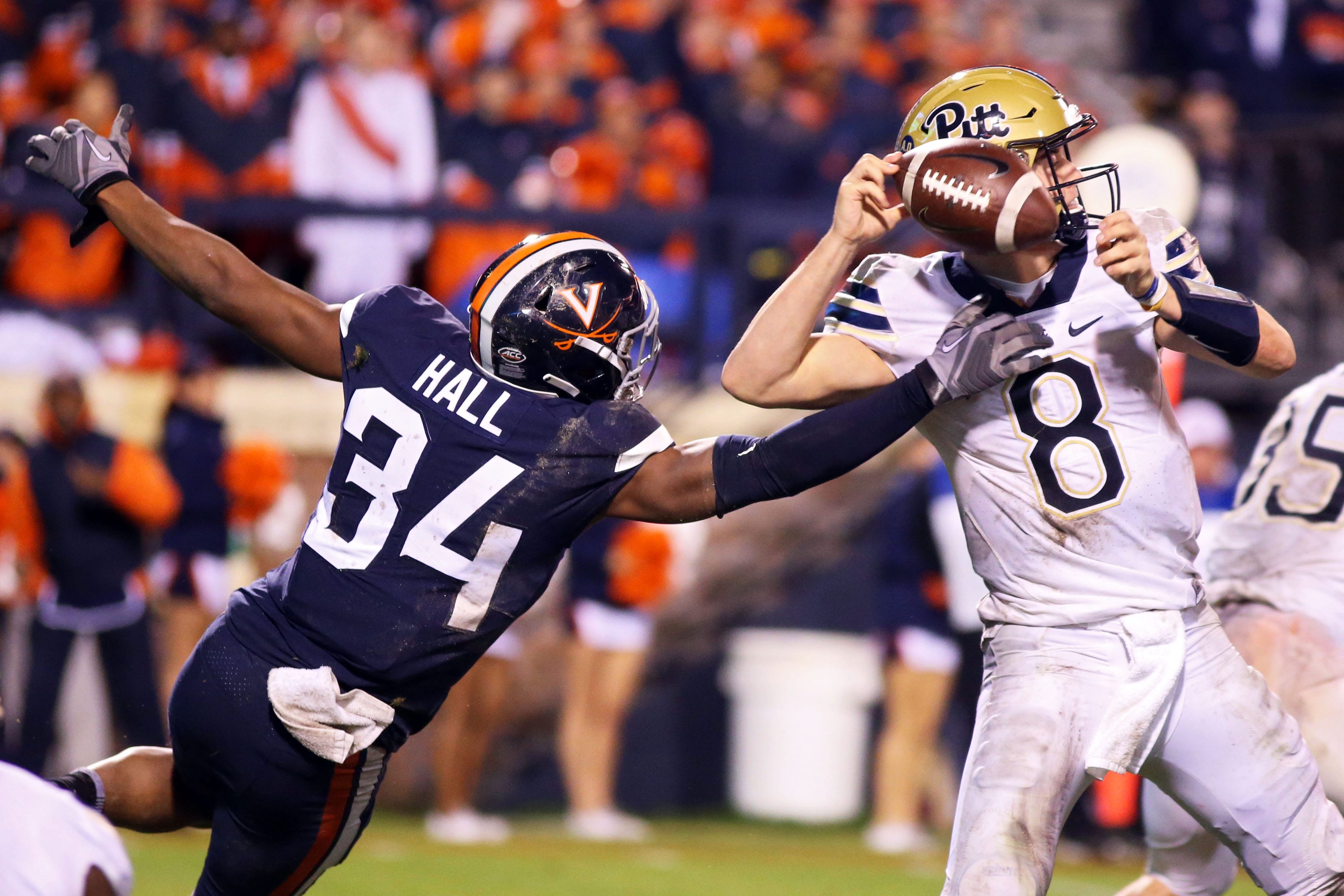
New York Jets Draft Pick Bryce Hall Shares Marriage Proposal on Instagram (Video)

After he was chosen by the New York Jets, Bryce Hall’s week got even better, as he shared a video of a successful proposal to his girlfriend.

No matter how your week is going, it’s going to very hard to stop how the past few days have gone for Bryce Hall.

The former Virginia cornerback was first chosen by the New York Jets last Saturday afternoon in the fifth round of the 2020 NFL Draft. Hall has now donned a ring before playing his first professional down.

On Instagram, Hall revealed that he proposed to his girlfriend, fellow Virginia Cavalier Anzel Viljoen. Like Hall, Viljoen partook in Virginia athletics, representing the school’s field hockey team as a back. She led the team with 26 points (7 goals, 12 assists) and helped them reach the semifinals of the 2019 NCAA Division I Field Hockey Championship in November. The New Zealand native also earned second-team All-ACC honors.

Hall shared his surprise proposal, which Viljoen accepted, on Instagram.

“She’s in it for the long Hall,” Hall declares in his caption “excited [sic] and ready to start this next phase of life with my best friend, lover, ride or die and answer to all of my prayers!!”

In the video, Hall is asked by an unseen party what convinced him that Viljoen was “the one”. He happily recalled Viljoen visiting him in the hospital after a broken ankle suffered in an October tilt against Miami ended his season.

“When she came to my hospital after I had broken my ankle, that’s when I was like, yeah this is the one, “It was 11:00 at night, everybody else went home and it was just me and her chatting it up. So I knew she was one to keep then.”

Hall’s engagement comes five days after he was the penultimate pick (158th overall) of the Jets’ 2020 draft proceedings. He put up 154 tackles and five interceptions during his four-year tenure in Charlottesville to go with 38 pass breakups. Of that latter tally, 21 came in 2018, which led the nation.

Geoff Magliocchetti is on Twitter @GeoffJMags

The New York Jets’ Last Draft Pick Might be Their Most Crucial (at least immediately)

The New York Jets’ sixth-round choice of Braden Mann raised some eyebrows, but the Texas A&M punter could be their biggest new contributor.

Ah, the punter. He’s football’s living, breathing white flag, a personified excuse to get a beverage refill or visit the restroom. His prescience, at least in his designated kicking duties, is a de facto admittance of failure to score, an admission of defeat that gives the other team the ball back.

Even a punter’s finest moments, at least when performing his designated duties of pinning the opponent deep can be erased. Few remember, for example, the New York Giants Steve Weatherford pinning the New England Patriots at their own six-yard-line after the opening drive of Super Bowl XLVI. When the Patriots were called for an intentional grounding penalty on the very next play, Weatherford became indirectly responsible for providing the Giants early momentum in the form of a safety. It set the pace for a 21-17 path to a fourth Super Bowl title, as the Giants built an early lead by scoring a touchdown shortly after. Whereas Weatherford’s part in a championship laid forgotten, it breaks the internet if a punter gets kicked in the fact on a return, as Spencer Lanning of the Browns found out the hardy way.

The New York Jets are certainly used to the concept of punting defeat. No one in the NFL has punted more over the last four seasons, as 339 drives have ended with a boot. By no coincidence, the Jets rank dead last both yardage and points scored over the same span. Their cumulative 21-43 record outranks only lowly Cleveland.

It’s no wonder why the Jets have spent the most recent transaction periods making headline news. They would spend their first top-three draft pick in over two decades on quarterback Sam Darnold in 2018. A $52.5 million payday awaited running back Le’Veon Bell, even after he sat out a whole year in Pittsburgh.

When it became clear that those two were mere athletes and not miracle workers, they brought in offensive linemen during the 2020 free agency process. Last week’s draft, rife with shifts via trade up and down the board, was equally heavy on offense. The team opted for further protection in the form of Louisville blocker Mekhi Becton (11th overall) before bolstering their receiving corps with Baylor’s Denzel Mims (59th). Using their next two picks defensively, the final day of the draft reverted to an offensive theme. Spell options for both Bell (Florida’s Lamical Perine) and Darnold (Florida International’s James Morgan) were chosen before another block in a logjam in the 120s. Secondary depth would in the fifth round through cornerback Bryce Hall.

Then, with their final pick in the sixth round, the 191st overall selection…the Jets took a punter.

Even at such a late stage, wedged between third-day interest enhancers like Zoom concerts from Luke Bryan and One Republic, the selection of Texas A&M’s Braden Mann raised eyebrows. Surely, the Jets could’ve used the pick further replenishing their needs? Interior blocking help in legacy fashion would go immediately after when Green Bay took Jon Runyan Jr. at No. 192. Robby Anderson’s departure left plenty of renovations in the receiver’s department…surely an option like First-Team All-AAC receiver James Proche would’ve sufficed? Options at furthering their pass rush and secondary were likewise available…so why Mann, the punter? Even the NFL’s historic ledgers weren’t so kind. Of the eleven punters with the highest averages in NFL history, four (including second-ranked Johnny Hekker) were undrafted.

The selections of Becton and Mims are the ones that already lasting long-term effects on the franchise’s well-being. But of the nine athletes added to the Jets’ roster during 2020’s virtual selections…Mann may be the one that can lead the team to the most immediate wins.

Regardless of your opinion of Darnold so far, there is no denying that the Jets are a team that struggles to reach the end zone on a consistent basis. Until that happens, a good punter is a must-have accessory in New York. The Jets got it right, or at least had the right idea, when it came to Mann.

Current free agent Lac Edwards, the overworked soul tasked with the excess booting, was serviceable (45.5 average) after joining the team as a seventh-round pick in 2016. But the Jets can’t afford serviceable efforts right now. It’s similar to when a team substitutes an acceptable quarterback for an extraordinary, dynamic talent in the interest of providing a spark. New York’s defense, while packed with talent, can’t afford to begin drives with their backs immediately pressed against the wall. Last season, the possessions of Jets opponents typically just past their own 31-yard-line (an average starting spot of 31.26, to be precise) Only Tampa Bay (31.70) was worse.

With no traction made in Edwards’ case to return, the Jets offered a future contract to former Pittsburgh preseason participant Ian Berryman. But with the offense’s struggles and defense’s desperation being the critical issues stifling the Jets’ efforts to achieve a mere winning record, a more reliable commodity was needed.

Should he fulfill his potential, Mann can at least provide levity toward those crucial issues.

One could argue that Mann might’ve been available after the draft, but that probably wouldn’t have been the case. Not only did another punter go in the seventh-round (Atlanta chose Syracuse’s Sterling Hofrichter), but Mann literally had a career for the ages in College Station. His historic junior season saw him become a literal field flipper, as his 51 yards per kick became an all-time NCAA record. Other shattered records included most punts of at least 60 yards (14) and the single-game punt average tally (60.8 in a September tilt against Alabama).

Mann’s trek to history led to the 2018 Ray Guy Award (bestowed to the nation’s top punter) and unanimous All-American honors (joining new Jets teammate Quinnen Williams in such an honor). It takes a lot for a season that featured a 47.1 punt average and all-SEC honors to appear as a slight disappointment…but that’s just how hard it was to live up to Mann’s 2018 antics.

To top it all off, those complaining about eschewing defensive depth for a punter had their prayers answered nonetheless. The Jets shipped their final pick of the afternoon, the 211th selection acquired from Kansas City over to Indianapolis in exchange for cornerback Quincy Wilson. Instead of a potentially expendable final pick, the Jets now have a veteran that can truly compete for a roster spot and one that will work alongside former Colts teammate Pierre Desir.

The Jets’ selection of a punter is not the one fans necessarily wanted, but one they needed. Mann can buy an offense struggling to gain traction some time as they work out their growing pains. While the Jets have undoubtedly improved, no one is expecting them to engage in a scoring shootout with their Week 1 opponent. Chemistry must be developed on the offensive line and Darnold must find a new favorite target.

Until that time comes, Mann is going to be the one putting both sides of the ball at ease. He can give a defense a favorable spot to work with and alleviate pressure from the offense to score on every single play while they get their act together. Perhaps a microcosm of the Jets’ draft as a whole, Mann (and, to a lesser extent, potential kick return candidate and third-round choice Ashtyn Davis) is the type of selection that can improve all three aspects of the game.

The Jets’ draft class is set to be long remembered for what Becton and Mims accomplish. But the early stages of Mann’s career could truly fuel the opening stages of what the tri-state area hopes is a lasting franchise turning point.

Geoff Magliocchetti is on Twitter @GeoffJMags

New York Giants New OL Lemieux Discusses His Versatility

The New York Giants spent four picks in the 2020 NFL Draft on the offensive line. New York secured two tackles, one fourth-overall, and one ninety-ninth-overall. They then found some depth at guard with Shane Lemieux out of Oregon in round five.

Shane Lemieux was a bit of a surprising pick. The tackle position was weak for the Giants but they went into the draft already pretty strong at the guard position. Kevin Zeitler and Will Hernandez are capable starters. But Shane Lemieux might be able to fill a different role.

Shane Lemieux Discusses His Versatility

This morning, beat writers were given the opportunity to interview Shane Lemieux via a conference call. He was asked about his potential role with the Giants in the near future and whether or not he can play the center position.

“I think I’m an offensive lineman,’’ Lemieux said when asked what position he plays (via the NY Post).

Shane Lemieux discussed his versatility, stating “versatility is the biggest factor in this game. Coaches want to be able to put you into multiple spots.’’ This is certainly true with the Giants as we have seen with the likes of Nick Gates. Gates has filled in at guard, tackle, and is now practicing to play center for the Giants in 2020.

The Giants will likely try Lemieux at center and see how it goes. Here is what Shane had to say when asked about potentially moving over to the center position:

“I feel like with center there’s a lot more responsibility on you to know the offense and to know more of the defense and to just be more sound with what’s going on around you,’’ Lemieux said. “And obviously you’ve got to snap the ball.’’ – Shane Lemieux via the NY Post

Below is a video of Shane Lemieux pre-draft practicing snapping as a center:

The Giants will have depth at the guard position in 2020. Lemieux is a talented interior offensive lineman who understands the importance of versatility and durability. He missed only one snap in his four-years as a starter at Oregon. The Giants will see how he performs at center but, regardless, Shane Lemieux will be available to fill in at whatever interior offensive line position they need him to.

Meet The New York Giants’ New & Improved 2020 Secondary

New York Giants, Darnay Holmes, Julian Love, Jabrill Peppers, DeAndre Baker, Xavier McKinney, Corey Ballentine

The New York Giants‘ secondary dealt with peaks and valleys in 2019. There were some big-plays mixed in with plenty of rookie mistakes and persistent struggles against top offenses. New York invested a lot of draft capital into its secondary in 2019 and doubled down this offseason.

The Giants made a big splash-signing at cornerback in free agency. They then followed that up by drafting a potential day-one starter at slot cornerback this past weekend. The New York Giants’ secondary is now loaded with young, versatile talents. The potential is there for the Giants to have one of the best young secondaries in the NFL in 2020.

The Versatile Safeties

Jabrill Peppers, Julian Love, and Xavier McKinney combine to create arguably the most versatile safety group in the NFL. Each of the players in this trio can line up in at least three different positions. Julian Love has played slot cornerback, deep free safety, and in-the-box strong safety. Jabrill Peppers is primarily an in-the-box strong safety but has also played linebacker and deep safety. In college, Xavier McKinney played over 200 snaps at three different positions; 323 snaps in the box, 227 in the slot, and 271 deep (PFF).

Thie trio of versatile safeties will allow Patrick Graham to be very creative with his defense. Having three different safeties that can each play three different positions efficiently will keep opposing offenses guessing. Typically there are only two safeties on the field at a time, but with this trio, Giants fans can expect to see plenty of three-safety looks.

Young, Talented Outside Cornerbacks

The Giants have invested heavily in their secondary over the past two years. They spent a first-round pick on DeAndre Baker last year. Baker struggled for much of his rookie season but seemed to show significant signs of improvement towards the end of the year. In 2020, DeAndre will start on the outside again and hopefully build on a promising finish to the 2019 season.

Starting opposite of Baker as the Giants’ primary cornerback will be newly signed free agent James Bradberry. Bradberry, coming from Carolina, is no stranger to following top-tier receiving talent. Bradberry shadowed the likes of Julio Jones, Mike Evans, and Michael Thomas twice a year as a member of the Panthers. He will instantly join the Giants’ secondary as the best coverage man and take on the most challenging tasks for the defense week to week.

DeAndre Baker and James Bradberry will man the outside cornerback positions. But who will play the slot/nickel cornerback position? There will be a competition to see who gets that starting role but expect to see a rotation in this position.

Nickel Cornerback Competition

Last year, the slot cornerback position was manned by Grant Haley and Corey Ballentine. Haley struggled immensely in coverage but demonstrated impressive open-field tackling. Ballentine, a sixth-round draft pick from 2019, was not ready to perform and struggled considerably. But he showed a lot of promise last preseason, so hopefully, Ballentine can take a step forward and improve in 2020.

The latest addition to the slot cornerback position is 2020 fourth-round pick, Darnay Holmes, out of UCLA. Holmes played on the outside in college, but his limited size will move him into the slot at the professional level. Holmes did try out nickel cornerback at the Senior Bowl this year, and he said he loved it. Analysts pointed out that he excelled in that new role in Mobile.

The Giants have plenty of depth at the slot cornerback position. But who will be the starter at the nickel? As I stated earlier, expect to see rotation. Since day one, Joe Judge has made it clear: players will play to their strengths. They will not be asked to do things at which they are not proficient. These three slot cornerbacks all have different skillsets that can be applied in various ways.

Maximizing Potential Through Rotations

For example, Grant Haley struggles in coverage but is a solid open-field tackler. This is why the Giants can use Haley in goal-line or short-yardage packages. Third-and-goal, fourth-and-two, Grant Haley can go in there and make a clutch tackle to keep the defense short of the line to gain.

On the flip side, in long-yardage situations and obvious passing-downs, Darnay Holmes’s speed and athleticism will come into play. He has the speed to keep up with quicker receivers going deep and the coverage ability to stick with slot receivers on deep-breaking routes.

The Giants’ two-year investment into the secondary is paying off. They have the versatility and flexibility to move their players around and put them in the best situations possible to make an impact. Giants fans should be ecstatic about the foundation that has been laid out for the future of the defense.

ESM’s Experts Grade the New York Jets’ Draft

New York Jets

ESM’s New York Jets experts look back on an eventful three days for Gang Green and pass their opening judgment.

Three days, nine picks, and seemingly infinite transactions later, the New York Jets’ 2020 draft proceedings are complete. 

How did they make out? ESM’s experts weigh in…

Geoff Magliocchetti: B

The concept of immediately grading drafts was tired and unfair before live sports were put on hiatus, but we’ve got nothing better to do, so here it goes…

It’s safe to say that, after Joe Douglas’ first draft at the helm, the Jets improved on all three sides of the ball. The draftings of Mekhi Becton and Denzel Mims are moves that are going to define the most hopeful era the Jets’ perpetual rebuild has seen in a long, long time. No long must their backfield saviors Sam Darnold and Le’Veon Bell conjure miracles to single-handedly win ball games. Defensively, the team strengthened their depth in both the pass rush (Jabari Zuniga) and the secondary (Bryce Hall). Even special teams enjoyed a must-needed boost. Third-round pick Ashtyn Davis can bolster a return game that sorely missed Andre Roberts (and later hypothetically fill in at safety if Jamal Adams or Marcus Maye depart) while Braden Mann is a great brand of insurance for an offense that struggles to reach the end zone consistently. Further strengthening their secondary depth with veteran Quincy Wilson was also a fine finishing touch.

The three-pick cluster on day three prevents this from being a perfect grade. Expected reliance on James Morgan to be Sam Darnold’s backup is iffy at best after last season’s understudy misadventures. Veteran backups/mentors for Darnold were there for the taking, so picking the young Morgan creates controversy where there is none. Additionally, while a spell option for Bell was necessary, it seemed a bit early to take Perine, especially with choices at need positions like guard Logan Stenberg or cornerback Reggie Robinson still on the board. They managed to salvage the session with another blocker, Charlotte’s Cameron Clark.

Dylan Price: B+

Build the Joe Douglas statue! Okay, not yet, but Joe Douglas had an excellent draft on paper. Douglas started the draft off with the high upside selection of the mountain of a man, Mekhi Becton. He followed that up with a savvy trade down to net an extra third-rounder and still grabbed Denzel Mims. Mims has high upside potential and could be a difference-maker immediately. Douglas grabbed Ashtyn Davis, the freak athlete from Cal. Davis could be the successor to Maye but will be a Swiss Army knife immediately.

La’Mical Perine, Cameron Clark, and Jabari Zuniga were two picks who can slot in as rotational players, but both have high upside. James Morgan was a questionable pick, but the Jets struggled to mount any offensive presence without Darnold. Morgan can at least be a developmental prospect at backup QB. Bryce Hall is a talented corner who may be their best steal because of a sketchy medical history. Braden Mann can be the punter for the long term future because he has a cannon for a leg. Joe Douglas had a B+ draft with significant upside.

Alex Wilson: A

The New York Jets did exactly what they needed to do in the 2020 NFL Draft: protect and support Sam Darnold. Having been sacked over 60 times over the past two seasons, Darnold needed to be prioritized and GM Joe Douglas did exactly that. Drafting Mekhi Becton instantly improves the line and opens up holes for Le’Veon Bell in the run game. If Darnold wasn’t satisfied with Becton in the first round, Douglas added a talented wideout in Denzel Mims in the second. A big, fast pass-catcher who can replicate Robby Anderson’s production and then some. If I were Darnold, I would be one happy camper.

Brendan Carpenter: B

Joe Douglas had a successful draft this past weekend. Taking Mekhi Becton at pick 11 gives them a mammoth of a lineman on the left side. He has some room to grow but could become a great tackle. The best move on Douglas’ part was trading down, though. Originally supposed to be at pick 48, he traded down to pick 59 and still got his receiver in Denzel Mims, someone Sam Darnold needed. Also, rather than picking a “possibility player” to end his night, he traded the pick for up-and-down veteran CB Quincy Wilson.


The New York Jets’ top draft picks are already a major part of team history

Mekhi Becton and Denzel Mims haven’t played a down with the New York Jets yet, but they’re set to play a major role on the team timeline.

Ah, the NFL Draft…host of the most inconsequential grade you’ll receive since your final semester of high school’s report card. At least back then, your bout of “Senioritis” would’ve featured activity that could be analyzed and calculated well enough to place a lettered grade upon it.

Even before live sports were put on hold, we have the sports-loving public have been fascinated by the concept of draft grades. These awards are bestowed months before the draftees will play a down, even weeks before they don the helmet of their choosers. That’s of no consequence to thoughtpieces across the nation, as prospects have their entire career decided for them in a blink of an eye (heck, this site is no exception). By this logic, Jalen Hurts should probably retire immediately.

But, in our world of endless, instant content demands, and draft grade pieces are certainly coming in more clutch than ever, whetting the appetite of we, the sports-loving people, famished of live content for tough but understandable reasons.

Of course, it’s hard to truly complain about immediate draft grades when high marks are attached to your team’s ledger. The jeers of Jets fans are a bigger part of draft lore than Mr. Irrelevant and hand-size comparisons combined. Even downsizing things to a virtual setting couldn’t silence the boobirds. But Joe Douglas’ first draft the general manager helm has earned positive reviews, particularly his choices at the top. Louisville blocker Mekhi Becton (chosen 11th overall) will provide protection for Sam Darnold and Le’Veon Bell. A surprise draft night tumbler, Baylor receiver Denzel Mims (picked 59th after a deal with Seattle) appears to be one of the biggest steals.

Time will tell if they, along with the rest of the sizable class, can live up to the rave reviews. But, for better or worse, Becton and Mims are already crucial landmarks on the Jets’ timeline.

It seems hypocritical, especially so after lampooning the concept of draft grades, to place such a judgment on this current crop of prospects, particularly the top two. Alas, it’s a weight placed on these top rookies by a demon that makes itself far too prevalent on draft day: forces beyond the rookies’ control.

The fates of these top picks have been written by the Jets’ latest fortunes. It is they who will be judged and relied upon to end the team’s postseason drought, which will reach a decade if they miss out this year.

Douglas’ opening stanzas have provided what feels like the most legitimate sense of hope in a long time. Jamal Adams’ future is uncertain, but, for now, he’s the face of the franchise. A duo of backfield saviors has emerged in Sam Darnold and Le’Veon Bell. To protect them, Douglas went on a shopping spree of offensive linemen, an area long neglected on his predecessor Mike Maccagnan’s watch.

Somehow, the ultimate judgment on what Douglas is trying to build is going to come down to how Becton and Mims perform.

Douglas’ free agency deals have come with a common theme: prove it. The Jets’ have inked 13 free agency contracts this season. Only one (Connor McGovern’s three-year, $27 million contract) features no potential out prior to 2022. Greg Van Roten and George Fant, for example, each got multi-year deals, but there are out clauses after the upcoming season.

Becton and Mims, however, are likely destined for four-year rookie deals. Not only will they have these lengthy contracts, but they’re both in a position to contribute immediately. Becton is going to be viewed as an anchor on the offensive line, especially if he’s set to shield Darnold’s blindside. Mims will be asked to contribute immediately with Robby Anderson gone.

A young New York resident was once told: with great power comes great responsibility. Such a resident was fictional, but the advice is all too real.

The depth of the receiver and blocking classes this season was potentially both a blessing and a curse for the Jets. They were able to get the men they wanted, but there’s major potential for second guessing. Did Mims fall for a reason? Will the Jets regret taking Becton instead of a receiver like Jerry Jeudy or CeeDee Lamb?

It’s these picks that can set the pace for the Darnold/Bell era. A Super Bowl is probably still out of reach in the immediate future, but these moves can build the team that makes the Jets attractive to championship talent. Hit these picks, and it’s the start of something big. Miss, and you’re right back where you started, albeit with all new faces filling the crucial positions.

Douglas went out this offseason and made plans for the team’s future. He, at least began, to make up for Maccagnan’s lost time on the line. With Anderson gone, he made the most out of a weak free agent class in Perriman once Amari Cooper re-upped with Dallas. But Becton and Mims, for better or worse, are going to be looked upon as the ultimate deciding factors. Some could even view them as finishing touches, depending on how optimistic the viewer is about the Jets’ either ending New England’s AFC East monopoly or nabbing the extra wild card spot.

It’s not entirely fair on either end. But that’s life in the NFL. The new semester has begun.

Geoff Magliocchetti is on Twitter @GeoffJMags

New York Jets: LIVE Undrafted Free Agent Tracker

New York Jets

The New York Jets’ roster continues to expand after the 255 names of the NFL Draft have been called through rookie free agency.

ESM updates the Jets’ undrafted free agency movements, as they continue to add players to their roster after Mr. Irrelevant’s name was called. ESM keeps things in order via a live tracker…

(LAST UPDATED: 4/26/20, 1:30 p.m. ET)

WR Lawerence Cager, Georgia: A less elusive Michael Pittman Jr., Cager has a Good catch radius and solid athleticism. (Zach Klein)

DB Shyheim Carter, Alabama: A former teammate of Quinnen Williams, Carter returned two interceptions back for touchdowns in 2018 and put up 100 tackles. (Yo Murphy)

DL Domenique Davis, UNC-Pembroke: The fourth member of the Division II Braves to join an NFL camp, Davis put up 40 tackles and three sacks. (Brandon Tester)

CB Javelin Guidry, Utah: Guidry is a freak athlete, having run a 4.29 at the Combine in the 40. (Sam Farnsworth)

OT Jared Hilbers, Washington: Hilbers started every game of the Huskies’ 2019 season at right tackle, earning second-team All-Pac-12 honors from Pro Football Focus. (Mike Vorel)

LB Bryce Huff, Memphis: Huff earned back-to-back second-team All-ACC honors, earning 16 sacks over the last two seasons. (Bryan Moss-Namcowicz)

CB Lamar Jackson, Nebraska: It might not be THAT Lamar Jackson, but this LJ of the defensive variety was named the Cornhuskers’ Defensive MVP. (Steven M. Sipple)

DT Sterling Johnson, Coastal Carolina: Johnson runs a 5.08 40 and he was pretty productive at CCU with 41 tackles, 10 TFLs, and 3.5 sacks last season. (Draft Diamonds)

Geoff Magliocchetti is on Twitter @GeoffJMags