The New York Jets had a late offseason surprise going into the weekend. How does it affect the team moving forward? ESM investigates.
With Independence Day weekend looming, the New York Jets had early fireworks to share.
Per a Friday report from Rich Cimini of ESPN, the Jets are set to sign Morgan Moses to a one-year deal. Moses, formerly of the Washington Football Team, was released due to salary cap reasons after seven seasons in the nation’s capital.
“Morgan is a fantastic player. He’s played at a very high level,” head coach Robert Saleh said recently, per Cimini. “We’re not going to shy away from adding good football players.”
What does it mean? ESM investigates…
Another Brick in the Wall
General manager Joe Douglas continues to make up for the offensive line negligence of the Mike Maccagnan era. While Douglas has earned rave reviews for the relative risk of picking Mekhi Becton at 11th overall and his willingness to use offseason capital on blocking, his veteran acquisitions haven’t exactly panned out. It’s great, for example, that he was able to convince Ryan Kalil to come out of retirement during his first weeks in office, but at some point, these moves have to start paying on-field dividends rather than ones of morale. Douglas has identified the problem. Now he needs the solution.
The 30-year-old Moses only boosts the Jets’ offensive potential as they continue to construct the wall in front of Zach Wilson and his young running backs. This veteran blocking signing, or at least the timing of it, has a different aura to it.
Unlike the aging Kalil or last year’s relatively unproven class developed out of necessity (George Fant, Connor McGovern, Greg Van Roten), Moses appears to still be working through his prime and is someone who serves as an automatic life of the blocking party. There are no Pro Bowl or All-Pro nominations to his name just yet, but Moses’ Pro Football Focus grade (80.6, including an 85.9 in rush protection) was sixth-best amongst right tackles.
Moses has also had little issue staying healthy (having started in every Washington game since 2015) and fulfills the championship feeling trait that the Jets have worked on this offseason (Corey Davis, Tevin Coleman, Sheldon Rankins). To that end, Moses was part of Washington’s unexpected division title effort.
George Fant Becomes a Depth Star
Fant was one of the more prominent arrivals of the Jets’ 2020 free agent class. But he figures to be the odd man out with a player of Moses’ caliber set to join the lineup.
At first glance, Fant could become a late cap casualty or draft capital fodder. The Jets, for example, would save $7.8 million if they trade the former Seattle Seahawk. But if the versatile Fant is a backup right tackle, the Jets are in a relatively decent spot. With experience in several blocking roles, Fant can serviceably step in in case of an emergency. If anyone knows about the value of having a deep squad, it’s Douglas, one of the architects behind the Philadelphia Eagles’ improbable Super Bowl run back in 2017 (which makes the lack of an experienced backup for Wilson all the more puzzling, but that’s another conversation).
Though Fant got off to a slow start, he gradually improved throughout the season. Fant likely endeared himself to new Jets management by expressing his anticipation of working in new coordinator Mike LaFleur’s system toward the end of minicamp proceedings. He’s particularly impressed by LaFleur’s tendencies to focus on outside-zone or wide formations.
“This system is really built for me,” Fant said in a report from team writer Ethan Greenberg. “This is the most excited I’ve been going into a season so far. Being in Seattle for all those years, we kind of ran something similar. But seeing the 49ers and how they were running a wide zone when I was in Seattle, I already kind of had an idea of what they were going to do. Very excited to work with them, get in this system and really show what I’m capable of.”
A Master and An Apprentice(s)
Once again, Douglas’ line renovations deserve some praise in the early going. Becton appears to a legitimate lasting force on the line while Douglas boldly traded up with Minnesota to take Alijah Vera-Tucker, sacrificing any day two capital beyond the second pick of the second round.
But, much like the incoming quarterback, it shouldn’t be fully on the shoulders of Becton and Vera-Tucker to completely clean up the Jets’ blocking woes, especially at such a young age. Having a veteran option like Moses in tow should provide some relief and give them a strong mentor to learn from. When Trent Williams left Washington for San Francisco, Moses became the elder statesman in burgundy blocking. Under Moses’ watch, Washington’s line finished sixth in the final PFF rankings, up from 29th in the preseason edition. Moses was even said to take Washington’s then-franchise quarterback Dwayne Haskins under his wing before the team moved on to eternal placeholder Ryan Fitzpatrick.
Between his experience, talent, and championship knowledge, Moses arrives at a perfect time from a Jets standpoint. Sure, his green makeover probably doesn’t turn the Jets into playoff contenders, but he’s something a Jets team desperately trying to end a perpetual rebuild desperately needed The hard part…fulfilling the potential brought about by this addition and proving Douglas correct…starts in training camp.
How much an impact will Moses have on the 2021 Jets? Continue the conversation on Twitter @GeoffJMags
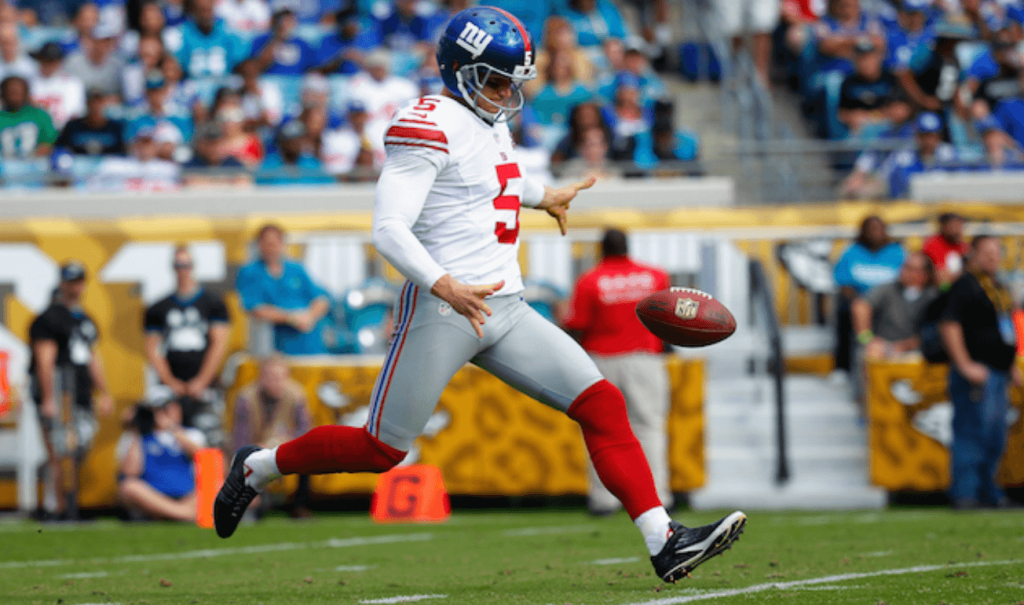
ESM sits down with former Giants/Jets punter Steve Weatherford, who has embarked on one of the most interesting career paths in NFL history.
When one thinks of the great Super Bowl heroes in New York Giants history, conventional conversation often skews toward Eli Manning, David Tyree, Justin Tuck, Chase Blackburn, and Mario Manningham.
Forgetting punter Steve Weatherford, however, would be foolhardy.
The Giants are preparing to celebrate the 10th anniversary of their most recent Super Bowl trek this season, a 21-17 triumph over the New England Patriots in Super Bowl XLVI. That upset victory began with the Giants gaining some early momentum through Weatherford’s leg. Forced to punt in New England territory, his 36-yard boot pinned the Patriots at their own six-yard-line. An ensuing intentional grounding penalty on the very next play led to a safety that gave the Giants a 2-0 lead before Manning found Victor Cruz for a touchdown when the Giants got the ball back after the unexpected double. That kick was one of three that Weatherford situated inside the New England 20-yard-line during the historic evening.
As Weatherford, now based in Texas, prepares to rejoin the rest of the 2011-12 Giants squad, the 38-year-old has had little, if any, trouble staying busy. The punter, who also spent three seasons with the New York Jets, has become a health and fitness guru, his feats of strength routinely on display on his Instagram account, and welcomed his sixth child earlier this spring. Before the Giants reunite at MetLife Stadium this year, Weatherford will make an early return to East Rutherford on June 28-29 through a motivational seminar entitled “Become the CEO of Your Life”. It will be a two-day event slated to be held at the Hilton Meadowlands centered on five power pillars that will boost listeners’ personal and business relationships. Tickets and can purchased here or by texting Weatherford at 949-763-5934
Upon his return, ESM sat down with Weatherford to talk past, present, and future…
Q: You’ve had one of the most interesting career paths in professional football history, going from specialist to fitness, health guru, and motivational speaker. What was the biggest factor in your shift from NFL punter to motivational coach/fitness expert?
A: If I had to boil it down to two things, I think it would be vision and disciplined focus. There were a lot of things that I was involved in that people were like, ‘Dude, why are you doing that?’. When I was in the NFL, I remember linebackers and positional players asking ‘dude, why are you working so hard, why are you so jacked?’, because I didn’t need to, to be a kicker. But I always had a vision for creating the strongest and the most flexible body that I could.
I didn’t work out just for football I worked out because I wanted to see what I was capable of doing. So from a vision standpoint, that allowed me to move that discipline and focus that it took to get into the NFL and be able to develop a skill and then be able to call upon that skill. I only played, think about it, seven plays a game. I think the NFL punter average is about 4.3 plays per game, so I was on the field for 28 seconds a game. To be able to discipline your focus, to be able to block out distractions, and being able to replicate a highly complex skill in adverse conditions when you have 250 pounds, athletic mutants running at you, it took a lot of mental and physical conditioning.
I would say the biggest factor would be vision, the fact that I had a vision of what I wanted to be or do, and still do. It’s the next version of myself that I want to become. I mean how much of a bummer would it be if I retired from the NFL at like 34 or 35 and those were like my best days? It’d be sort of depressing, retired at 35, and I just refused to accept that. I think that’s because I had vision, just constantly exposing myself to different people, or their different hobbies and different experiences and I think that will continue to allow people like you and me to continue to dream dreams and chase those dreams. Having vision is great but if you’re not disciplined and focused. It’s really easy to get distracted, and it’s really easy to be not disciplined.
Q: How did it feel to leave an impact on both of New York’s NFL franchises?
A: I’m from Terre Haute, Indiana. I certainly wasn’t supposed to play in New York, or win a Super Bowl, or play for the Jets, or play for the Giants. I feel like I’m playing with house money, but I definitely am not satisfied. I’m blissfully dissatisfied. I’m so happy with my life, but I want to experience more, I want more relationships, I want to learn more, I want to know, I want to grow more, I want to do things that people in my family haven’t done before, just because I decided I can.
Q: The NFL released their COVID and vaccination protocols for the 2021 season last week. As someone who knows a thing or two about athlete health and wellness, what are your thoughts on the policies?
A: To be fully honest with you, I saw a tweet and some Instagram posts about it, and that’s all the research that I’ve done so far. From what I gathered, the league is going to make the players who decide not to get the vaccination very difficult. ,
I know we’re not gonna get into politics, I don’t want to get into politics, but this is the National Football League. These guys are going to sweat all over each other. If people want to get the vaccinations for their reasons, get them. If people don’t want to get the vaccinations, then don’t get them. The people that got the vaccinations shouldn’t be worried about it, because you’re getting vaccinations. So what’s everybody worried about? Let’s play some football. That’s my opinion.
Q: What lessons can the 2021 Giants take from your championship squad back in 2011-12 as they seek back to get back to NFL relevancy?
A: I think it’s just synergy. If you look at our team from the 2011 roster, the one that won the 2012 Super Bowl, there were probably 10 other teams that were more talented than we were on paper.
But I believe it was two things: I believe it was our ability to achieve chemistry, but more important than being able to achieve chemistry, It was the timing in which we achieved the chemistry. We didn’t play our best football until we got into the playoffs, and we barely got into the playoffs. When we got into the playoffs, we went into, we went into Green Bay, we beat them. We went into Candlestick Park, we beat (San Francisco). We beat the Falcons at home. No one was really giving us much of a shot with any of those teams, but that’s because they hadn’t seen us play the level of football that we’re playing at that exact moment.
I almost felt like every day we woke up during the 2012 playoff run, we felt like we were the best version of the team that we had seen up until that point, and we just continued to get better, and to get better, and to get better. We played our best games when it mattered the most against Tom Brady and we did things that people didn’t think that we could do. It was because we got everything out of every person on the roster, and we did it at the right time.
Q: The 2011-12 team will be celebrating its 10th anniversary later this year. What’s the No. 1 memory you’ll take from the championship journey?
A: Training camp. There’s something special about collective suffering, and not just through world championship football games. Anytime that you go through a really difficult time with a group of people, be it boot camp in the military, or you know these firefighters or your law enforcement, Marines, that’s when you build the closest relationships. So my favorite memories were doing the stuff that we hated doing.
We actually have our 10-year Super Bowl reunion coming up. We’re going to be honored before the first game of the regular season this year. It’ll be cool to see a lot of those guys because after that season was over, some people went to free agency, went to other teams and it was the last time that I saw them. You still see them on social media and stuff, but it was the last time that I got to see a lot of those relationships in person. So it’s exciting to know that all those guys are gonna fly back ten years later.
Q: Your punt after the Giants’ first possession set up a safety that allowed you to take an early 2-0 lead. What do you remember about the kick?
A: I didn’t know it at the time, but Chris Collinsworth, who was doing the game for NBC, said at halftime that we would’ve given the MVP to the punter, Steve Weatherford. I was glad they didn’t have a TV on in the locker room the way that they normally do, because if I heard that, I would’ve had to change my pants! It was a pretty radical experience to have like the best game of your life in the biggest game of your life, especially against somebody like Tom Brady.
We knew that we needed every inch that we got. So every time the punt team went out there for the four punts that we had, (New England) wound up starting at the six-yard line, the four-yard line, and the eight-yard line. That really drastically changes how Bill Belichick’s going to call plays. You’ve got to rearrange game plans to give Tom a little bit more room, especially knowing that the first drive became a safety on the very first play.
Special teams played a big part of doing what we did in 46. I’m not just saying that because of my punts, all of the units did amazing. The whole reason we were in the Super Bowl was that Lawrence Tynes hit a field in the fourth quarter of the NFC Championship Game and then overtime. It took every single guy on our team to do what we did.
Q: How can special teams assist a developing offense like the one we’re seeing with the New York Jets right now?
A: I remember when I was in my first year with the Jets. That was Mark Sanchez, his first year as a rookie quarterback and I remember Rex Ryan literally pulling him aside with me after practice one day. (Ryan) said ‘listen, Mark, we don’t need you, and we don’t need Steve to win the game. Our defense is the best defense, the National Football League has ever seen. I want you to possess the football and get us first downs, you don’t have to do anything more than what you’re doing right now. When you can’t, we’re going to use Steve and pin them deep inside of the 20, and we’re gonna let our defense do what they do’.
I think that was relieving for Mark, not because it was like, oh, Steve is gonna bail you out, I don’t want listeners to hear it that way. It was more along the lines of Rex saying, ‘listen, punting’s not a bad thing, because our defense doesn’t give them points. If we can just possess the ball and get a touchdown every once in a while, we’re going to win games’. That’s literally what we did and Mark Sanchez was able to take us to the AFC Championship Game as a rookie and as a second-year quarterback in a really, really difficult division.
Q: We celebrated Father’s Day this past weekend, as the timing couldn’t have been better for you to welcome your sixth child. How has fatherhood changed your outlook on life?
A: There’s no need for being a dad, just like there’s no handbook for being an entrepreneur. We only have our experience of our fathers to recollect and look back on how we want to be a father. We have an opportunity to father six times over. It’s really forced me to uplevel my ability to create structure, to create order. It’s kind of like what we talked about earlier, we talked about vision, we talked about discipline to focus. We all have a vision of being great fathers, great providers, great businessmen, great employees. But to be able to put some structure, and some order in almost kind of like implementing the playbook.
When I was in training camp, Tom Coughlin gave us a playbook with the rules and regulations of the team to have expectations and had our agenda. We were responsible to know all of that. He said if you execute this and you get to get to know this well, you have a chance to be a champion and the chance to be a New York Giant. There’s no handbook for being a father and that’s one of the reasons that it’s so difficult because we only have our own experience of it. One of the things that I’m into right now, right after I retired from the NFL, I got into entrepreneurship, I started a fitness company, a supplement company, and was able to gain some success. But that one thing that I was missing, the one major mistake that I made was I didn’t have a coach anymore so I didn’t have anybody to give me my agenda for the day, tell me what time to go to bed, what time to wake up.
I had a disciplined focus, but I didn’t have structure in order, and so I didn’t have a business mentor I didn’t have somebody to tell me. You’re doing too much, go be with your family, etc. All I knew was harder I work the more successful I’m going to be.
Q: What does the future hold for the Weatherford family? There are certainly NFL teams that would love to have you aboard as a special teams and/or strength coach. Would you ever consider a return?
A: I really really love what I’m doing right now, working with entrepreneurs. The last thing I can envision myself doing is being a coach and the reason for that is that their structure, their order, the amount of time that that would require of me to invest into their mission could never supersede the mission that I have with my six kids.
As for the future, we’re actually about to launch our YouTube channel, My wife and I. We’re going to launch I guess you would call it a reality TV show, and it’s going to be focused on our faith, family, fitness business, and it’s pretty much calling me and my family around everything that we’ve got going on. We’ll be able to build a pretty nice community of people that support us on social media, so we’re going to take our show on the road to YouTube, and be able to have a platform to be able to share our lives. It’s called The Steve Weatherford Show: High Performance Tactics to a High Performance Life. So, for anybody that’s reading this, if you enjoyed our conversation and you want to hear more, you can come to this event, subscribe to our podcast because it’s personal development, it’s leadership it’s mind, discipline, it’s helping you create and live the life that God created for you to live.
The New York Jets have been contemplating the idea of signing former Washington offensive tackle Morgan Moses to a one-year contract. Well, on Friday, they finalized the deal to bring Moses to New York, having started 97 games in his career for Washington.
The Jets, who have Mekhi Becton, George Fant, and rookie Alijah Vera-Tucker capable of playing offensive tackle, now have added competition from a solid veteran.
The #Jets have signed former #WFT starting Tackle Morgan Moses to a 1-year deal, per @Sam4TR
Moses started 97 games in his career for Washington, should be a quality addition to the #Jets at this point of the off-season.
In 2020, Moses played the majority of his snaps at right tackle, featuring at left tackle in Weeks 11 and 12. He’s capable of playing on both sides but was far better in pass blocking when featuring on the right side of the OL. He allowed five total sacks, 14 QB hits, and 22 hurries.
Overall, Moses has been a consistent option for Washington for the past seven seasons. At 6’6″ and 335 pounds, rookie quarterback Zach Wilson now has himself a consistent OT on the right side who can provide support due to injury and will likely push Fant for the starting job.
Moses is coming off a five-year, $38.5 million deal, so the Jets signing him to a one-year contract should land in the $5-8 million range for the 2021 campaign. Fortunately, Moses hasn’t missed a game in six seasons, showcasing his reliability, and was mainly cut due to financial reasons and not performance-based factors.
The New York Jets don’t have a clear-cut starting running back, but rookie Michael Carter out of UNC already has the advantage to be the opening day option for Zach Wilson in the backfield. Last year in 2020, Carter posted 1,245 yards and nine rushing touchdowns, including 267 receiving yards and two receiving touchdowns.
As one of the most productive running backs in the country, nobody anticipated Carter falling to the 4th round. Jets management waited patiently for Carter to fall as they sat with their eyes glued to the screen as every team passed him by.
Having sweated the entire third round in hopes Carter would be available, general manager Joe Douglas stated they would have had a serious discussion taking him in the 3rd, but thankfully, he fell right into their laps and is already penciled in as a potential starter come Week 1.
Projected running back room for the Jets:
RB1: Michael Carter
RB2: Tevin Coleman
RB3: Ty Johnson
RB4: La’Mical Perine
RB5: Josh Adams
Carter has already gained the majority of first-team reps during OTA‘s, but the anticipation is that Robert Saleh will execute a rotation of running backs this upcoming year, especially with the signing of Tevin Coleman.
A committee-based approach would help Carter find his sea-legs at the NFL level, easing him into a more physical and athletic league. Heading into the draft, Carter’s strengths included solid agility, vision of the field, and protecting the football efficiently. The UNC product hasn’t fumbled in two years, and most of his negatives include diagnosing running lanes and a lack of top-end speed.
Breakaway speed for running backs is more of a luxury than a necessity, as finding running lanes and picking up first downs is more beneficial than blowing the top off of defenses at the second level. Plenty of backs with average speed produce above-average play. Some examples include Joe Mixon, Nick Chubb, Aaron Jones, Chris Carson, etc.
Ultimately, if Carter can improve his vision and ability to hit holes with confidence, the Jets could have themselves a steal in the mid-rounds. He is a player to have a close eye on during training camp, gauging his snap count with the starters.
One of the priorities for the New York Jets this off-season was bolstering their offensive line, as they went out and utilized draft capital and free-agent money to upgrade the unit. They brought in Dan Feeney, who’s started 57 games in four seasons of play, and has experience at LG and C, and drafted Alijah Vera-Tucker out of USC to fill an interior position.
Vera-Tucker has experience playing at OT and OG, providing the Jets with versatility they didn’t have before on the OL. Having failed to make a significant splash in free agency, they walked away with one of the best drafts in the NFL, as the USC product was considered a top 10 player in the entire class. Considering they traded up to pick 14 to ensure they snagged the versatile offensive lineman, it gives you an idea of how much they valued his services.
“He played three years for us at an elite level and really didn’t give up a sack his junior year (at LG) in that entire year,” Helton said. “He has tremendous athleticism in all your run schemes. He’s a guy who can get out in space, can run outside zone, power on inside zone and be able to really get out in space on the second level and be able to connect with defenders and be able to lock on them and show those great feet that he has. You’re really getting a talented a player that I think can really fit into what the Jets want to do.”
When you have a player being compared to Quenton Nelson, your eyes must widen. With a combination of athleticism and technique, Tucker is ready to make an impact on day one. In addition, he has the flexibility to help supplement injuries, which could end up being an undervalued factor. Considering Mekhi Becton has been dealing with planters fasciitis and other issues, there is the potential that Alijah could end up starting some games on the outside, which he has significant experience doing.
However, the Jets envision him filling the left guard spot next to Becton, solidifying a duo for years to come that can protect their rookie quarterback, Zach Wilson.
At this point in time, the Jets have made significant changes across the board, but their offense has experienced a shift that not many other teams have experienced around the league. They have the personnel to take a dramatic step forward and 2021 — it all depends on the scheme/coaching moving forward.
As the New York Jets bide time before training camp, ESM looks at some veteran faces that could be poised for a breakout.
As we’ve officially reached a rare dead period on the NFL calendar, ESM presents Top 10 Tuesday, a weekly list series that will center on the past, present, and future of the Jets in a sortable format.
We’ll begin this series by looking at ten veteran players that could rise to the occasion come up big for the Jets as they embark on a new gridiron journey…
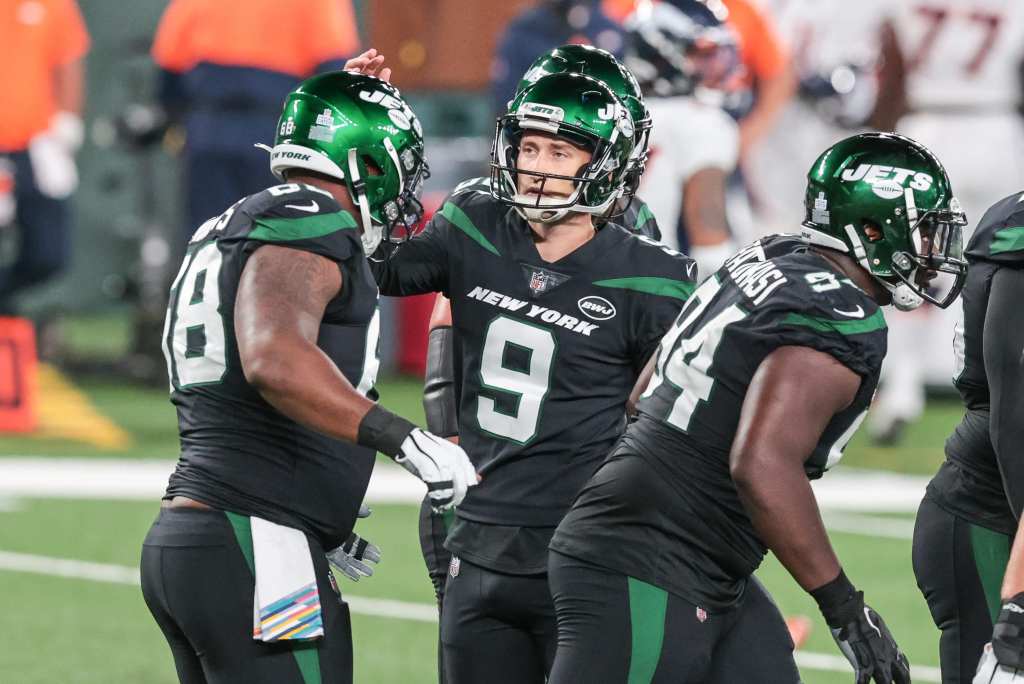
Oct 1, 2020; East Rutherford, New Jersey, USA; New York Jets kicker Sam Ficken (9) celebrates his field goal with teammates during the first half against the Denver Broncos at MetLife Stadium. Mandatory Credit: Vincent Carchietta-USA TODAY Sports
10. K Sam Ficken
Since Pro Bowler Jason Myers absconded for Seattle, the Jets have been through six different kickers. That’d be unacceptable in pretty much every football realm, but such instability is unacceptable for a team with a developing offense. Confidence can be built if points can be scored in as many drives that invade opponents’ territory as possible.
Ficken, set to enter his third season in green, seemed like he was on his way toward ending the constant turnover. He converted each of his first nine field goal attempts (five alone during a Thursday night tilt against Denver) but he lost the spark after missing several games with a groin injury. This time around, Ficken will compete with undrafted free agent Chris Naggar to get his job back. He can become a vital silver lining in the Jets’ expected growing pains if he’s able to capitalize on a career-best 86 percent success rate from three.
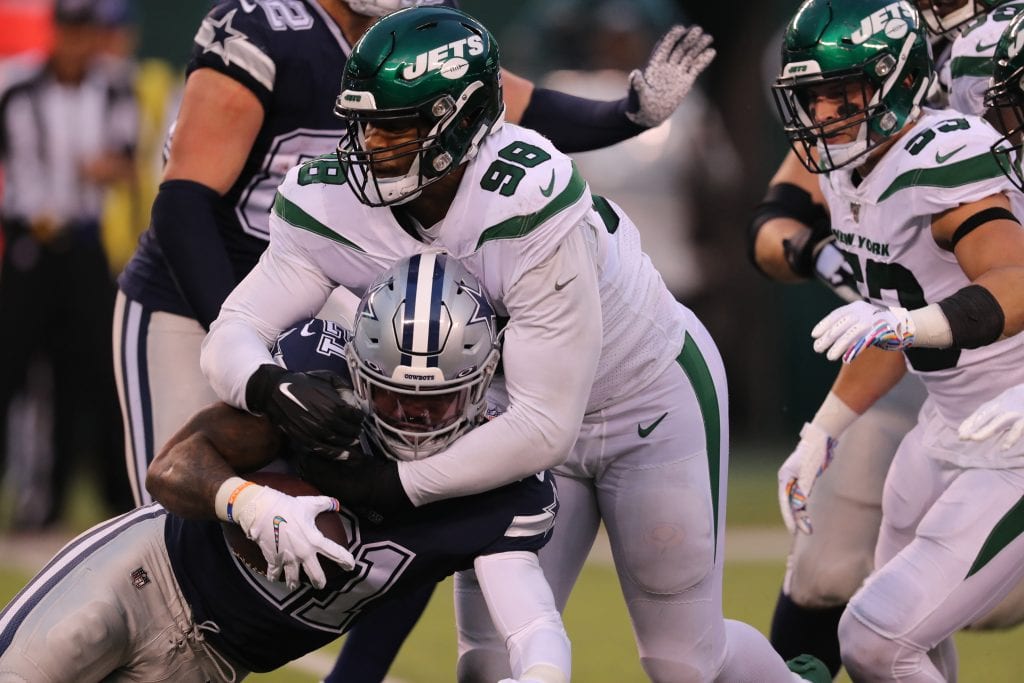
EAST RUTHERFORD, NEW JERSEY – OCTOBER 13: Defensive Lineman Kyle Phillips #98 of the New York Jets makes a stop call against the Dallas Cowboys in the second half at MetLife Stadium on October 13, 2019 in East Rutherford, New Jersey. (Photo by Al Pereira/Getty Images)
9. DL Kyle Phillips
The versatile Phillips, entering the league as an undrafted free agent out of Tennessee, was one of the more pleasant surprises of the 2019 season. Veteran injuries forced him into starting duties, but he made the most of his opportunity with 39 tackles and 1.5 sacks. Phillips was a consistent backfield invader in his rookie season, as his seven tackles for a loss were tied for fourth-best on the team and his quarterback pressures (6) were good for third amongst his fellow linemen.
Alas, an ankle injury prevented Phillips from building on the momentum from his rookie season. To make matters worse from a personal standpoint, the Jets spent the offseason bolstering their front seven with established veteran names that could leave Phillips in an awkward spot. He’ll certainly return with a vengeance in 2021 and will keep things interesting in the second halves of preseason games.
Perhaps no one in the NFL has increased their profile better than Feeney this offseason. The former Los Angeles Charger has gone viral for his goal celebrations at New York Islander playoff games, becoming the literal face of the Jets’ support for their blue and orange comrades on Long Island.
The surge in popularity has had many asking exactly what the Jets get in Feeney, who was mostly used as a depth option in Los Angeles. His experience at center could prove vital: Sam Darnold went through three different primary centers in three years and the Jets would love to establish some starting lineup stability for incoming franchise man Zach Wilson right from the start.
7. TE/FB Trevon Wesco
With Tyler Kroft arriving as an established goal-line option and strong potential behind undrafted free agent Kenny Yeboah (not to mention the return of starter Chris Herndon), the third-year, fourth-round pick faces an uphill battle to make an impact as a tight end. But he can make an offensive difference through the resurrection of the archaic fullback spot.
As we discussed last week, the days of Richie Anderson and Tony Richardson may be gone, but the Jets appear set to resume the Wesco experiment at fullback after injuries prematurely shut down the project last season. Offensive coordinator Mike LaFleur previously reaped the benefits of Kyle Juszczyk’s prescience in San Francisco and believes that Wesco’s bulkier size could allow him to do things that even the All-Pro fullback wasn’t capable of.
“(Wesco) is a bigger body, he’s longer,” LaFleur explained last week, per notes from the Jets. “He’s going to be able to play a little bit more inline, so we can use him in multiple ways, whether it be 21 or your typical 12 personnel formations.”
One has to wonder if it’s now or never for Cashman, who enters his third NFL season in an unusual spot. The fifth-round pick from 2019 filled in serviceable when C.J. Mosley got hurt two years back, but injuries of his own have limited him to only 11 games in his career so far.
It’s always tough to condemn a player for getting hurt in the NFL. After all, football is a violent game and injuries happen. When they do, players should take all the time they need to heal up properly. But the NFL has proven time and time again that it’s willing to make business decisions that aren’t anything personal. Cashman appears to be a good fit in Robert Saleh and Jeff Ulbrich’s defensive landscape, so it would be a shame to see his NFL career end before it truly begins.
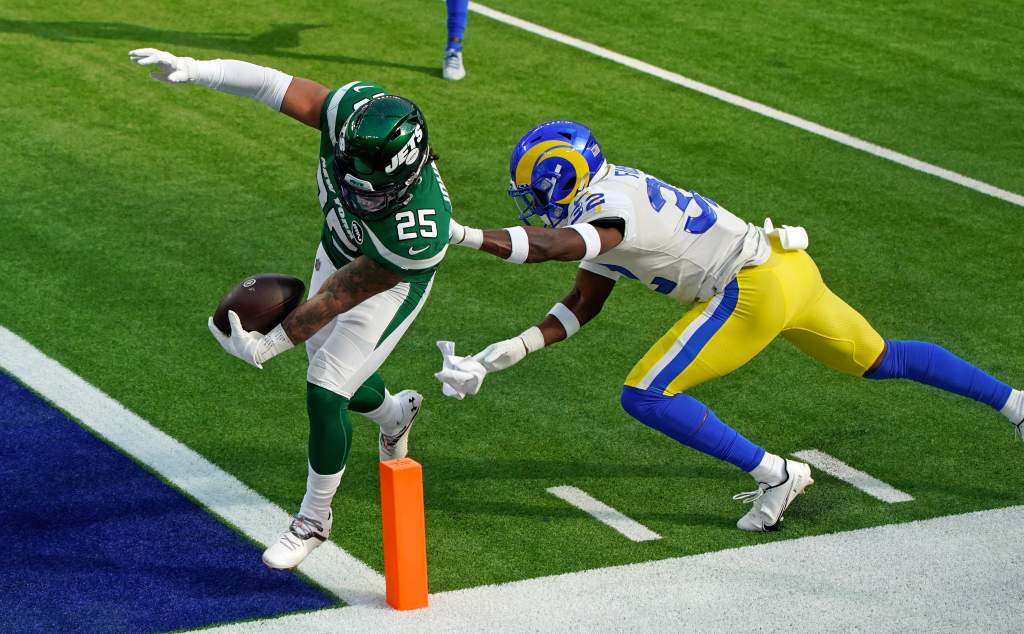
Dec 20, 2020; Inglewood, California, USA; New York Jets running back Ty Johnson (25) scores a touchdown as Los Angeles Rams strong safety Jordan Fuller (32) defends the play during the first half at SoFi Stadium. Mandatory Credit: Kirby Lee-USA TODAY Sports
5. RB Ty Johnson
It’s a bit of a shame that Johnson’s mini-breakout was masked by the malarkey of Adam Gase’s final days at the helm. For example, Johnson made Jets history in a December tilt against the Raiders by earning the first triple-digit yardage game for the Jets in over two full calendar years. Not only did the Jets waste the historic tally through Gregg Williams’ ill-advised final blitz, but Johnson earned only 13 carries over the next three games (as opposed to 22 in the Las Vegas debacle).
Johnson has a decent chance to shine in the Jets’ new-look, minimalist approach at running back. The present focus has turned to newcomers Michael Carter and Tevin Coleman, but don’t let Johnson’s status as a holdover from the Gase era fool you: he’s capable of making an impact at moment’s notice. His speed and experience in lining up in the slot could also pay big dividends in LaFleur’s system, giving him a bit of an edge over the more north/south-inclined La’Mical Perine.
With so many new receivers on their way in, it’s somewhat easy to forget about Berrios, one of the leading receivers from last year’s woebegone two-win squad. He faces a bit of a battle to make the roster, but the former Patriot got his season off to a great start in minicamp, emerging as one of the most pleasant surprises. It was enough to earn special props from Wilson.
“Braxton is a smart guy, that’s one of his best attributes,” Wilson said at the end of minicamp, per notes from the Jets. “He’s a slippery player, he gets in there and runs some great routes. He’s quick, but I think the best attribute is just knowing what’s going on. He’s got a great feel for the defense, he’s got great hands. He’s just been in those spots to make plays. We’ve got a lot of good playmakers and Braxton is doing a great job.”
Berrios might also be able to make an impact on special teams. During the 2019 season, he was one of two returners (min. 20 attempts) to average over 10 yards on punts.
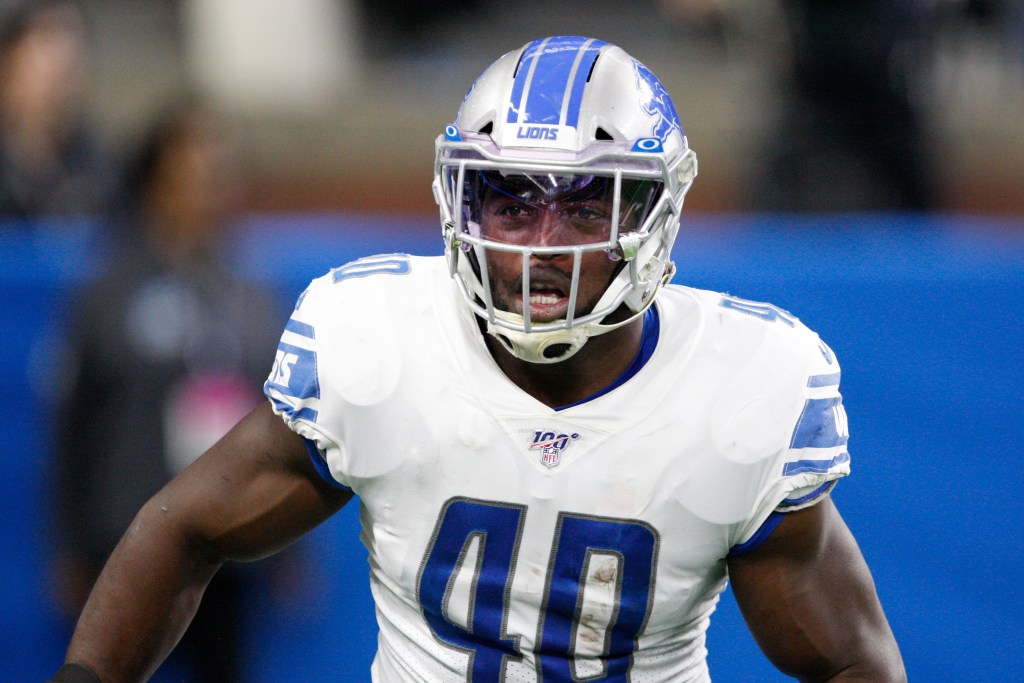
Nov 17, 2019; Detroit, MI, USA; Detroit Lions middle linebacker Jarrad Davis (40) runs off the field after recovering a fumble during the first quarter against the Dallas Cowboys at Ford Field. Mandatory Credit: Raj Mehta-USA TODAY Sports
3. LB Jarrad Davis
Coming off a brutal two-win season, it was going to be hard for the Jets to convince the truly elite free agents to join their cause. Their consolation prizes include Davis, a former first-round pick that previously repped Detroit.
Davis’ career got off to a decent start, as he earned All-Rookie team honors while working in defensive coordinator Teryl Austin’s 4-3 system. However, Austin was let go with the rest of Jim Caldwell’s staff at the end of the 2017 season despite guiding the Lions to three winning seasons in their four campaigns. Detroit football hasn’t been the same since and Davis was an unfortunate part of the decline. He failed to adapt to Matt Patricia and Paul Pasqualoni’s set-ups and the Lions declined his fifth-year option prior to the 2020 season. Davis thus joined the Jets on a one-year, $5.5 million deal this offseason.
Davis’ finest performances have come in the 4-3 set that Saleh and Ulbrich are set to implement. He earned his first-round status through working with Geoff Collins at the University of Florida and worked well with Austin early on in Detroit. That knowledge can not only help him break out on a personal level but can also help him take on the role of a teacher of the 4-3 set.
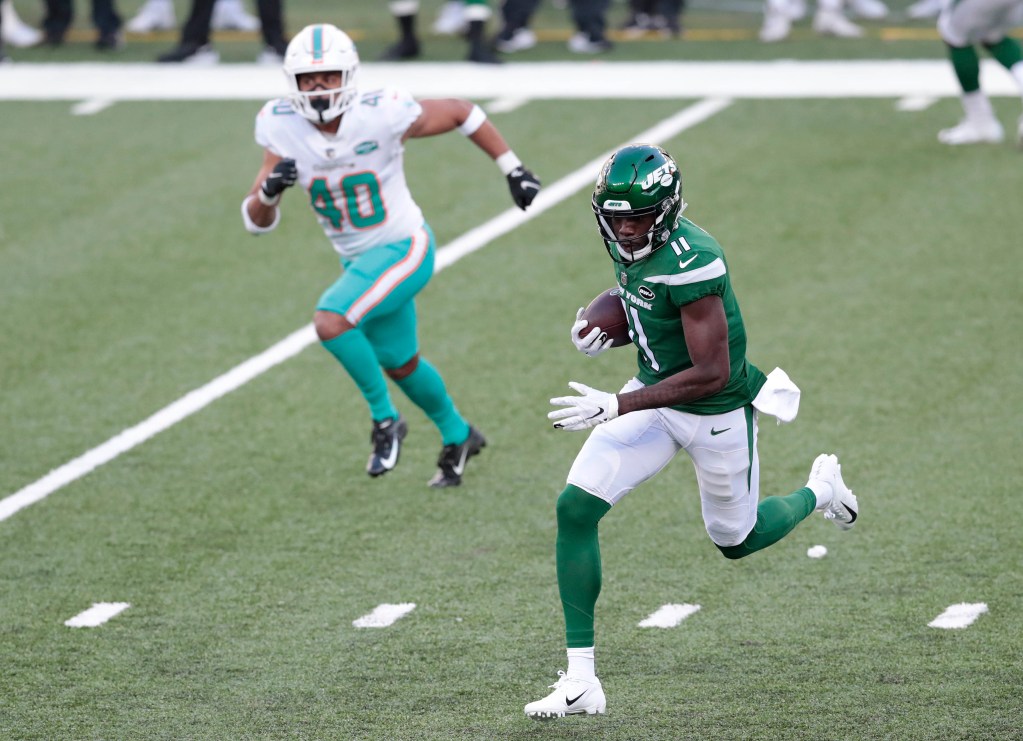
Nov 29, 2020; East Rutherford, New Jersey, USA; New York Jets wide receiver Denzel Mims (11) runs the ball ahead of Miami Dolphins defensive back Nik Needham (40) during the second half at MetLife Stadium. Mandatory Credit: Vincent Carchietta-USA TODAY Sports
2. WR Denzel Mims
One thing that’s really unfortunate about Mims’ situation is that he will forever be connected to a fellow member of the green draft class of 2020. When the Jets drafted Mekhi Becton with the 11th overall pick…Joe Douglas’ first at the helm of general manager…it came at the price of passing on considerable receiving talents (i.e. Henry Ruggs, Jerry Jeudy, CeeDee Lamb, eventual Rookie of the Year Jerry Jeudy). But those concerns were supposedly alleviated when the Jets when Douglas and Co. were able to snag Mims out of Baylor in the early stages of the second round.
Becton’s early promise has somewhat masked the fact that Mims hasn’t been on the field much in the early going. It has mostly been a case of bad luck, as he dealt with injuries at the earliest stages of 2020 prep and was never really able to get into the swing of things. This time around, Mims missed voluntary workouts due to a (non-COVID-19) illness, causing him to lose valuable reps with Wilson. The spotlight has thus turned to another second-round pick, that of Elijah Moore.
But Jets brass and outside observers still appear to believe in Mims, who serves as a valuable big-play target. Former NFL receiver and current NFL Network analyst Nate Burleson listed Mims as one of his five receivers poised for a breakout, while LaFleur compared Mims to Brooklyn Nets star Kevin Durant.
“It looks like he has a wingspan like Kevin Durant. He’s got tons of range as long as that ball is anywhere around him. If the ball is anywhere in the vicinity, you expect them to get it,” LaFleur said in May, per Max Goodman of SI.com. “He’s eager, he’s a really cool dude to work with. But he’s just gonna have to get out there…it’s just going to be reps and just going and understanding the speed of the game.”
1. LB Carl Lawson
As the Jets seek to re-energize their pass rush…which becomes vital with a presumed pair of matchups against Josh Allen and Tua Tagovailoa in the foreseeable future…one of their biggest acquisitions was Lawson out of Cincinnati. Yet, hard-to-please fans and analysts expressed disappointment with his relatively low sack numbers. Lawson tallied 11.5 over the last two seasons, a drastic declined from the 8.5 he put up in his rookie year.
However, don’t let the relatively pedestrian numbers fool you: Lawson has been an agent of chaos in opposing backfields. According to ESPN’s Seth Walder, advanced stats indicated that Lawson was one of eleven defenders that “created” at least 10 sacks last season, even if he himself didn’t obtain it. In more conventional stats, Lawson also put up 32 overall quarterback pressures, good for second in the league behind only TJ Watt.
Ulbrich noted Lawson’s dedication to the game in some of his first statements as the Jets’ defensive boss.
“(He’s) obsessed with the game,” Ulbrich said of Lawson, per Ryan Dunleavy of the New York Post. “He wants to become the most technical pass-rusher in the league.”
Lawson admitted in Dunleavy’s report that he does want his sack numbers to return to the levels he knows he’s capable of. He believes the Jets’ bolstered interior defense, led by 2020 breakout man Quinnen Williams, can help him get there.
“I have the mindset that no matter who is around me I should win my 1-on-1,” the signer of a three-year, $45 million told Dunleavy. “That’s a great thing to have, great interior players, but the way I think of it is to produce no matter what the situation because what if everybody got hurt? Could I use that as my excuse for (fewer) sacks? No.”
What other Top 10’s do you want to see? Let Geoff know on Twitter @GeoffJMags
The New York Jets’ rushing room officially moved on from the Le’Veon Bell era, opting for a more minimalist future.
Following the conclusion of minicamp activities, the NFL offseason is officially over. The next time the New York Jets convene in Florham Park, they’ll be getting ready for preseason and regular season action for the 2021 campaign.
With the offseason in the rearview mirror, ESM looks back on the green offseason that was, position-by-position. Our lookback continues with the running backs…
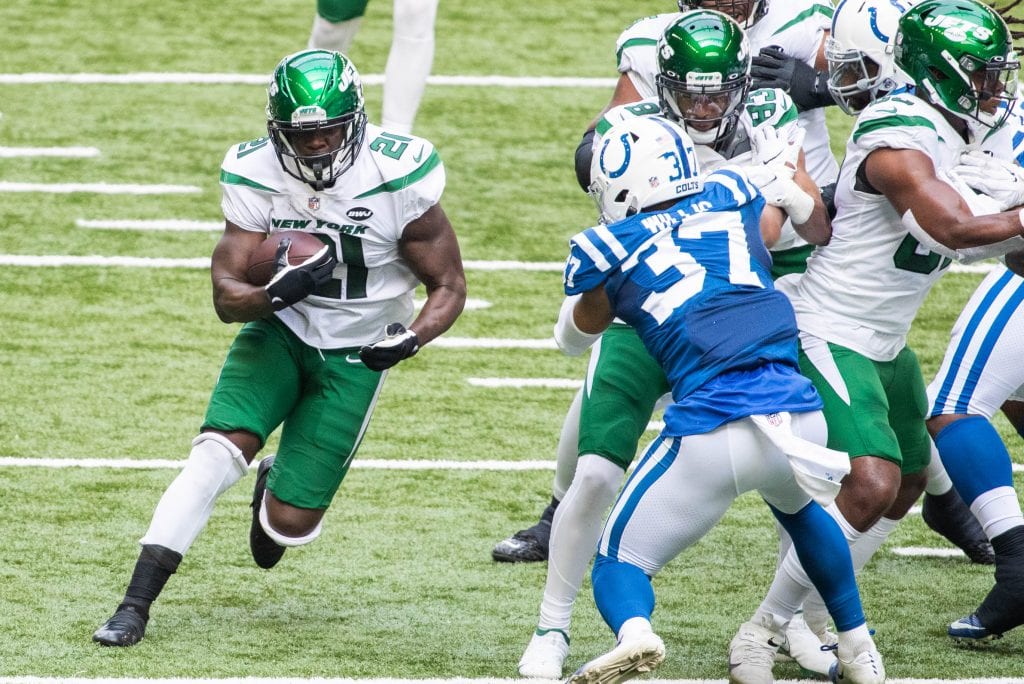
Sep 27, 2020; Indianapolis, Indiana, USA; New York Jets running back Frank Gore (21) runs the ball in the first half against the Indianapolis Colts at Lucas Oil Stadium. Mandatory Credit: Trevor Ruszkowski-USA TODAY Sports
How It Started
The 2021 game plan for the Jets’ run game technically began on October 13, when they released Bell after 17 uneventful contests, or at least it should’ve. With the Jets at 0-5 and armed with three young rushing projects (La’Mical Perine, Ty Johnson, Josh Adams), a macabre silver lining loomed: the playoffs were fathoms away from reach but the Jets had 11 opportunities of consequence-free, game day football that could be used as blank canvases, research and development for an uncertain future. They were de facto preseason games granted after the cancellation of the summer exhibitions. Jobs and/or New York longevity could’ve been won or lost.
Instead, Adam Gase opted to give Frank Gore, likely Canton-bound as is, a de facto retirement tour.
The 37-year-old Gore wound carrying the ball 187 times…40 more carries than Perine, Johnson, and Adam combined. Gore did manage did join Emmitt Smith and Walter Payton in the 16,000-yard club but his performance did nothing to keep him out of the future “NFL Legends in Wrong Jerseys” compilations.
Part of the reason for the focus on Gore was ridiculously poor luck on Perine’s end. In addition to Gase’s negligence, the fourth-round pick from 2020’s virtual draft also dealt with an ankle injury (sustained after running for 33 yards and a touchdown on eight carries in November against the Chargers) and even placement on the COVID-19 list during the final week of the season. Perine never really got into a rookie-year rhythm as a result of the instability, earning only 232 yards on 64 carries.
To their credit, Johnson and Adams capitalized on whatever opportunities they were offered. The pair averaged nearly five yards a carry (uniting for 411 yards on 83 attempts) with their magnum opus against Las Vegas in December overshadowed by Gregg Williams’ ill-fated final blitz. Lost in the chaos was the Jets’ most lucrative rushing performance in recent memory (178 yards between the two). Johnson even managed to earn the Jets’ first triple-digit yardage game in over two calendar years. Even with Johnson and Adams maintaining the workload well, Gase’s gift to Gore forced them into a small sample size conundrum, one where the Jets couldn’t be truly sure that any part of their young trio was primary rusher material.
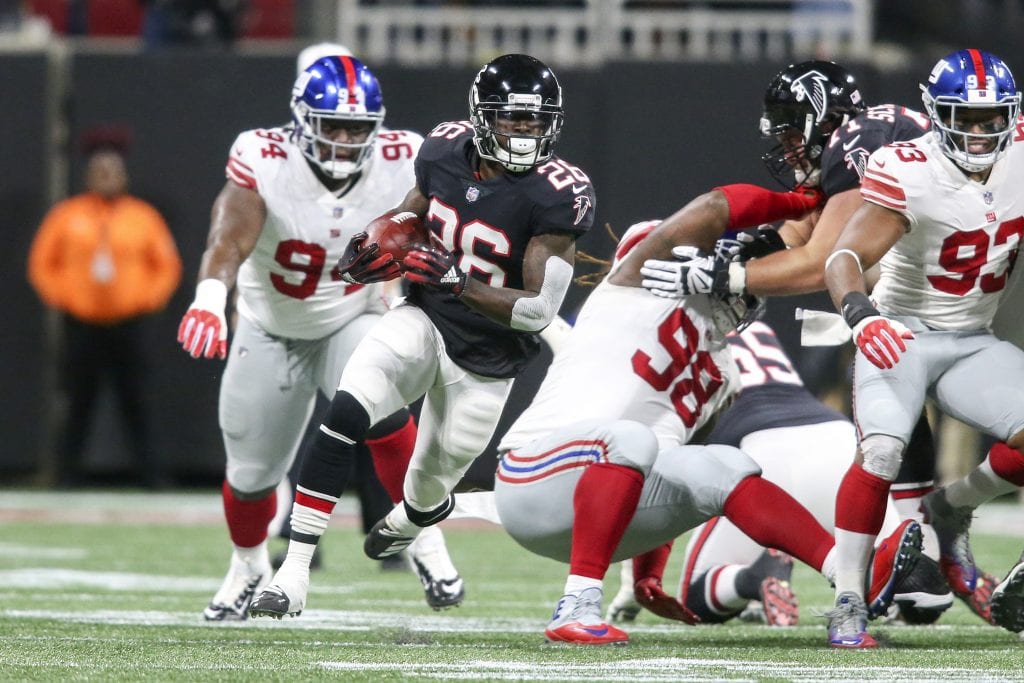
Oct 22, 2018; Atlanta, GA, USA; Atlanta Falcons running back Tevin Coleman (26) runs the ball against the New York Giants in the first quarter at Mercedes-Benz Stadium. Mandatory Credit: Brett Davis-USA TODAY Sports
How It’s Going
With the free agent Gore unretained, the Jets have opted for a relatively minimalist approach at running back for the immediate future, and rightfully so. Granting Bell a $52.5 million deal in an era where Super Bowl champions have won with frugal run games was one of the final mistakes of the Mike Maccagnan era, so it’s probably going to be a long time before the Jets spend big on a rusher again.
The incoming backs reflect that inconspicuousness. Tevin Coleman was brought in on a single-year deal worth $2 million, while the Jets used their first day three pick to take Michael Carter out of North Carolina.
Coleman is an interesting case. While the redemption-seeking Jets can’t afford to co-author big-budget/high-profile comeback stories…which made the decisions of trading Sam Darnold and passing on Julio Jones look all the wiser…Coleman is a player with big game knowledge and talent that slips under the radar. He’s a rare Jet with Super Bowl experience (partaking in the game’s 51st and 54th editions with Atlanta and San Francisco respectively) and knows the vision LaFleur will look to implement after their collaborations in the Bay Area.
On a personal level, the multi-talented Coleman can prove to both the Jets and the rest of the NFL that he has recovered from knee and shoulder injuries on a New York team that has very little to lose this season. At 28, Coleman perhaps has one more long-term deal in him, so it might be now or never.
Meanwhile, Carter arrived through the 107th slot on the NFL Draft board, though Joe Douglas reportedly would’ve been happy to take him in the third round (the Jets’ third-round choice had been traded to Minnesota to pick Alijah Vera-Tucker). Carter was one of the most pleasant surprises in minicamp and could well be at the top of the depth come September.
That leaves the aforementioned trio of returning young projects, at least one of whom is unlikely to be retained. The battle should be one of the most interesting debates of training camp and the Jets seem rather intrigued as well. One of their first moves this offseason was to retain Adams on a one-year deal ($1.18 million).
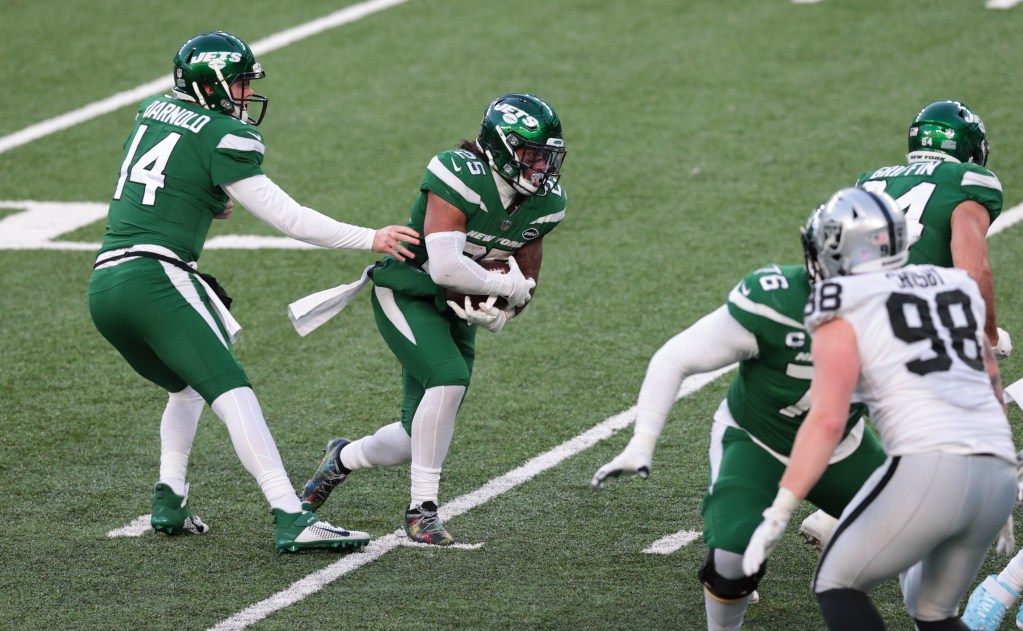
Dec 6, 2020; East Rutherford, NJ, USA; New York Jets quarterback Sam Darnold (14) hands off to running back Ty Johnson (25) against the Las Vegas Raiders in the second half of an NFL game at MetLife Stadium. Mandatory Credit: Vincent Carchietta-USA TODAY Sports
Are They Better Off?
The Jets’ minimalist rushing attack works in the modern NFL. Since 2010, only two top-ten rushers (Marshawn Lynch in Seattle and LeGarrette Blount in New England) have earned a Super Bowl ring at the end of their lucrative season. After drastically overpaying Bell (2019’s third-highest paid rusher behind only David Johnson and Todd Gurley), New York curbed their rushing budget. On paper, it looks like the move has paid off. Coleman’s championship experience and familiarity with LaFleur’s system can only help, while many view Carter as a day three steal.
That only leaves the puzzling situation regarding the returnees. At first glance, the odd man out appears to be Perine, whose north/south style of rushing conflicts with what LaFleur has preferred in the past. The sad part of the matter is that the Jets could’ve had some clarity on the group now, but the failure to take advantage remains one of the more underrated stains of the Gase era.
But there’s no use crying about the past at this point. The present has produced some solid finds in the rushing bargain bin that could well pave the way to an offensively upbeat New York future.
Final Offseason Grade: B+
What do you think of the Jets’ new rushing outlook? Continue the conversation on Twitter @GeoffJMags
ESM looks back on a fateful offseason for the New York Jets, starting with the big changes at quarterback.
Following the conclusion of minicamp activities, the NFL offseason is officially over. The next time the New York Jets convene in Florham Park, they’ll be getting ready for preseason and regular season action for the 2021 campaign.
With the offseason in the rearview mirror, ESM looks back on the green offseason that was, position-by-position. We start off at the quarterback spot…
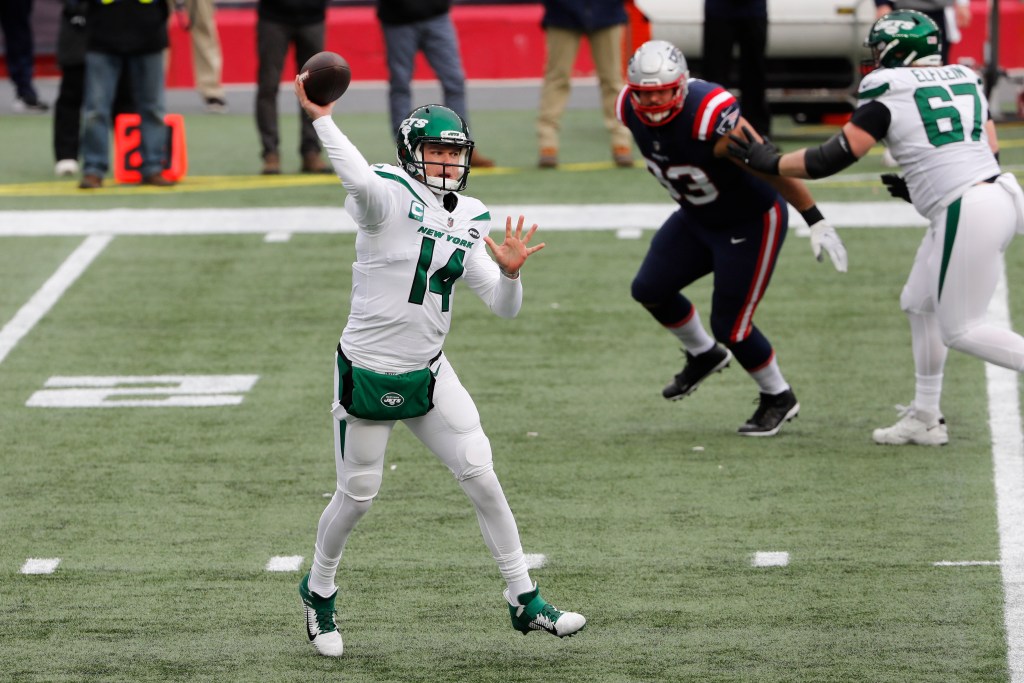
Jan 3, 2021; Foxborough, Massachusetts, USA; New York Jets quarterback Sam Darnold (14) throws on the run against the New England Patriots during the first half at Gillette Stadium. Mandatory Credit: Winslow Townson-USA TODAY Sports
How It Started
The Jets’ offseason centered around a puzzling conundrum: the NFL future of Sam Darnold. Conventional stats (as well as the fact they held the second overall pick in the draft) more or less implored the Jets to move on: Darnold ranked 40th in competition rate (59.8) and 41st in passer rating (78.5) amongst 42 quarterbacks (min. 500 attempts). Yet, there was a tantalizing case to prolong his New York career, a major temptation to answer a question Jets fans have asked and continued to ask…what would Darnold look like in a system that wasn’t overseen by Adam Gase?
For all the offensive malarkey the Jets had gone through in the Gase era, Darnold has still provided momentary flashes of brilliance that eeked through the endless layers of green gridiron gloom. Some felt that Darnold had the necessary skills to survive in the NFL, he just needed the proper support staff. There was only so much Darnold could’ve done while working in a Gase system and his top options being first-round washouts (Breshad Perriman) and current lacrosse stars pulled out of New England’s antique pile (Chris Hogan). In March, the Jets added Corey Davis and Keelan Cole, a pair of consistently reliable talents looking to make a bigger impact. Had Darnold been kept aroud for the eventual drafting of Elijah Moore, it would’ve been the most talented receiver class Darnold ever had to work with.
Darnold’s support problems were not limited to his receiving arsenal. The crucial developmental stages of his NFL career were staged in the midst of constant rumors surrounding Le’Veon Bell, who was a discount version in everything but his price tag ($52.5 million). That big contract and several other factors (i.e. general negligence) delayed any plans to bolster the offensive line. Darnold, after all, went through three different primary centers over his first three NFL seasons. To their credit, the Jets seemed to finally be seeing the light in the late stages of Darnold’s tenure, passing on elite receiving talent to draft Louisville blocker Mekhi Becton and later trade up with Minnesota for Alijah Vera-Tucker.
As for the backup quarterback spot, the Jets had the right idea when it came to Joe Flacco. The cheap deal signed late in the offseason (one-year, $1.5 million) and Flacco’s own words made it clear that he wasn’t meant to be any long-term backup solution. It was a contract that gave Darnold a year under Flacco’s watch while the one-time Super Bowl MVP (who truly sought a new area to take over the QB1 role) had a chance to prove to new suitors that he could still be a serviceable NFL option after enduring a neck injury during his previous stop in Denver.
How It’s Going
Ultimately, the Jets sent Darnold south, trading him to the Carolina Panthers in exchange for three draft picks, one of which was a second-round choice to be used next season. Even before Darnold was shipped off to Charlotte, the Jets spent the offseason in the thick of the quarterback discussion. Not only were they present at all major rookie quarterback showcases, but they were said to be in the thick of the Deshaun Watson sweepstakes before assault allegations ended that conversation.
Those factors all but assured that the Jets were going to use their premier pick on a non-Trevor Lawrence quarterback, eventually revealed to be Zach Wilson when the league converged on Cleveland in April. With the selection of Wilson out of BYU, general manager Joe Douglas has officially etched his signature onto his New York mosaic. He now has his own head coach (Robert Saleh) and quarterback running the show after working with the used parts of the Mike Maccagnan era’s final days.
As expected, Flacco moved during the offseason, joining a curious passing situation in Philadelphia that has been implied to give him a chance to compete for the starter’s spot. Despite several serviceable backup candidates emerging (i.e. Brian Hoyer, Nick Mullens), the Jets curiously opted to stick with their current backup situation of James Morgan and Mike White.
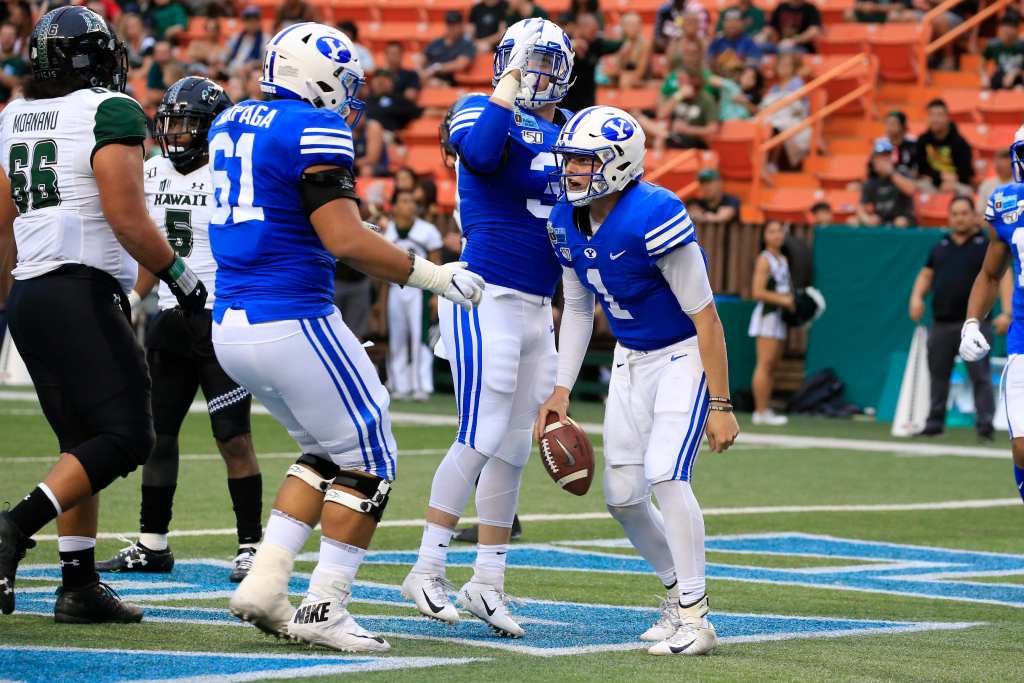
Dec 24, 2019; Honolulu, Hawaii, USA; Brigham Young Cougars quarterback Zach Wilson (1) celebrates with teammates after running in a touchdown against the Hawaii Warriors in the second half of the Hawaii Bowl at Aloha Stadium. Mandatory Credit: Marco Garcia-USA TODAY Sports
Are They Better Off?
One could have, and probably still can, make the case for Darnold staying in New York. The temptation to see him with a new support staff could’ve allowed the Jets to either use the second overall pick on one of their many other areas of need or even trade it to further reinforce those positions.
Ultimately, though, trading the Darnold was the best move for all parties. There’s no use in comparing Darnold and Wilson right now, especially when the latter has yet to throw an NFL pass (Lord knows the post-Week 1 discourse following the Jets and Panthers’ meeting in Charlotte will be arduous enough). But wondering whether Darnold’s issue was simply a coaching thing was a question the Jets couldn’t afford to answer anymore, especially when holding a draft choice that allowed them the pick of the non-Lawrence litter in Cleveland.
For Darnold, this move works on a personal level as well. He can now try to reclaim the narrative on his NFL career in relative obscurity in Carolina, a stark contrast to the constant tabloid attention in New York and the meme makers that pounce on the slightest green controversy on the internet (let’s face it, if the “I’m seeing ghosts” thing happened anywhere else, it’d be forgotten in a week). Time will tell if Wilson is the long-sought answer under center after decades of false prophets, but the Jets at least deserve some props for knowing when to cut ties and go back to the drawing board.
The Jets’ backup situation remains rather curious, however. As it stands, the Jets’ trio of quarterbacks has zero NFL regular season passes between them. New York is obviously pinning its future hopes and dreams on Wilson’s development. Holding minicamp with Wilson as the primary man more or less guarantees that the Jets aren’t practicing the “Kansas City model” a la Alex Smith/Patrick Mahomes.
But that shouldn’t mean that Wilson immediately must become the most experienced quarterback in the room. Even if one claims that adding a veteran to mentor the rookie (Chicago’s Nick Foles, perhaps?) is a passing cliche at this point, the Jets should at least bring on some insurance in case of an emergency. The team was 0-10 in the three-year Darnold era when backup quarterbacks had to step in. There’s no evidence that White or Morgan (who didn’t even dress for a game in his rookie year) are capable of breaking that trend if the unthinkable happened to Wilson. The playoffs remain a tall ask, but that doesn’t mean the Jets should punt on 2021 contests.
The Jets were right to kick off a new era of football, efficiently hitting the fast-forward button in their franchise timeline. But that doesn’t mean he should have to do this alone, especially in his own position room.
Final Offseason Grade: C+
Did the Jets make the right move in drafting Wilson? Or should they have stuck with Sam? Continue the conversation on Twitter @GeoffJMags
The New York Jets seemingly had a fantastic draft and free agency class, but there is one unit they didn’t bolster sufficiently this off-season. Last year, one of the weaker points on defense for Gang Green was the secondary, and after the departure of Jamal Adams, the unit only got worse. The Jets ranked 28th in passing yards allowed per game, giving up 275.6 on average. They desperately need more support at cornerback after cutting Pierre Desir after just one season with the team.
However, there is one free agent on the market that could make perfect sense for the Jets, especially with the hiring of Robert Salah from the San Francisco 49ers.
Currently, on the roster, the Jets have a plethora of inexperienced options which don’t represent immediate starters or impact players.
-Bless Austin
-Bryce Hall
-Justin Hardee
-Isaiah Dunn
-Corey Ballentine
Only one of these players has played more than two seasons in the NFL and an entire 16 game campaign. Justin Hardee, who the Jets signed as a free agent from the New Orleans Saints, has never started a game in the NFL but has played in 56 over four seasons. He has two passes defended to his name, so expecting him to be a starting-level player would be optimistic.
The player on the market who could make the most sense for Gang Green is Richard Sherman, who is coming off a three-year, $27.15 million deal. At 33 years old, there’s no question that Sherman is getting up there in age, but as an intelligent corner who is one of the best defensive backs in the last decade, he could offer them plenty of value as a veteran in the locker room.
Sherman recently played for Salah and his defense, featuring in just five games last year, but did partake in 15 regular-season games and three playoff contests in 2019. During his 2019 season, he recorded a 90.5 overall coverage grade, allowing 373 yards and one touchdown the entire season. As a historically lock-down man coverage corner, Sherman clearly has a bit of gas left in his tank, but after missing the majority of the 2020 campaign, the Jets might be able to snag him up on a cheaper deal.
Considering the connection between Sherman and Salah, this would be an easy signing to make for the Jets, inserting an immediate starter into the secondary who can help the young players gain their sea legs in the NFL.
Signing Sherman to a one or two-year deal in the $7 million range would make sense, given the lesser contracts signed this off-season. The Jets currently have about $32 million available and cap space, giving them plenty of money to work with prior to the start of the 2021 season.
Some of the more potent offenses in the NFL still feature a fullback. The New York Jets appear to be turning to Wesco to try it again.
Though hope reigns through newcomers, the New York Jets are in no position to turn down any method of boosting their offensive momentum…even if the potential approaches are considered archaic by NFL standards.
The fullback is an endangered species in the modern league, as the days of Mike Alstott and Daryl Johnston have gone the way of the Oilers and the tuck rule. Causes of the countdown to potential extinction have never been truly isolated, though the rise of single-back sets and empty backfields in the shotgun has more or less convinced teams that offensive resources are better spent on receivers and blockers.
But there’s no denying that the fullback still has a role in today’s game and can play an active role in a good team’s success. Several successful squads, including Super Bowl participants, still have a specifically listed fullback on their roster.
That made it a tad more surprising that the Jets didn’t make a stronger push for Kyle Juszczyk, the Bay Area staple that stands as the NFL’s premier fullback. It probably would’ve taken a lot for the Jets to lure Juszczyk over. Juszczyk’s five-year, $27 million contract was one of the first deals announced at the commencement of the movement period, done even before the legal tampering period got underway. But considering the Jets brought several former San Francisco 49er bosses (including Juszczyk’s old offensive coordinator Mike LaFleur), it was still somewhat surprising not to see a larger New York case made.
Even so, the Jets can use all the protection and weaponry they can get, especially with yet another franchise quarterback, Zach Wilson, on the path to his NFL debut. A fullback can provide both, even in its unsung status, though it has been a while since they fully utilized the position. The closest thing the Jets have had to consistent glory days were earned with a fullback in tow. Richie Anderson was a metropolitan essential for a decade while Tony Richardson ended his accomplished NFL career with the Jets’ AFC finalist squads in 2009-10.
Richie Anderson's epic touchdown in the #Jets' 41-0 spanking of Peyton Manning and the Colts in the 2002 playoffs.
New York’s offensive bosses appear to have taken the hint.
“You like to have a fullback. You like to be in those traditional 21-personnel formations. It just keeps the defense balanced a little bit more,” LaFleur said at the end of this week’s minicamp activities, per notes from the Jets. “You can go lead their way so you can control the angles, particularly in the run game and obviously all the play passes that come off of it. (Juszczyk) was the traditional fullback, there’s no doubt, and he’s obviously performed at a high level, maybe one of the best ever, who knows. He’s certainly gotten paid like the best ever, and I love Juice, so he deserves all of it.”
But there’s no use crying about the past. Excuses, after all, don’t exactly have a place in head coach Robert Saleh’s quickly-adapted “all gas, no brake” mantra, nor does looking back at the past. After all, the Jets mostly avoided getting the San Francisco band back together. A major exception was made through running back Tevin Coleman, but the only other Santa Clara holdovers (receiver Matt Cole and running back Austin Walter) face uphill battles to make the roster.
Even if on-field personnel from San Francisco won’t be making the journies to Florham Park and East Rutherford, LaFleur and the new offensive staff won’t hesitate to employ similar looks in their new surroundings.
If LaFleur’s final statements of training camp are any indication, expect the Trevon Wesco experiment to continue behind Wilson. Modern fullback endeavors have often substituted a bred fullback for a tight end, offensive lineman, or even linebacker to play the role. It appears that the Jets plan to utilize the 267-pound Wesco to establish the role again.
Surprisingly, LaFleur has worked with Wesco before, even though their paths never crossed in San Francisco. The 49ers’ staff served as the coaches for the South squad in the 2019 Senior Bowl, where Wesco represented West Virginia. He was used as a fullback throughout the afternoon, earning three receptions in a 34-24 defeat to the North. Three months later, the Jets made him the 121st overall pick in the 2019 NFL Draft.
“We played him a little bit at fullback and got to know him,” LaFleur recalled. “He was really the same guy there as he is here in terms of his personality. He’s a very confident dude, he loves being out there and yes, he is our fullback right now.”
Wesco is no stranger to the fullback experiment, as the Jets have tried to work him into the role over the past two seasons. The fourth-round selection burst onto the scene with a memorable showing in a rare regular season contest against the Giants. A fullback dive to Wesco on a one-yard fourth down produced a first down and kept an eventual Jets scoring drive going. He’d later go on to recover a backfield fumble the following week in Washington. Wesco likewise earned two reception in more traditional tight end duties, each of which went for first downs.
Former #WVU Mountaineer, Trevon Wesco, with a big gain for the #Jets !
Last season’s fieldwork didn’t go so well. Wesco got only a single carry, an unsuccessful third-and-one carry deep in Arizona Cardinal territory. The project was more or less shut down when Wesco suffered an ankle injury in practice, but it’s clear that LaFleur wants to reestablish it. It could wind up being the way that Wesco plays his way onto the Jets’ Week 1 roster. Doing so as a tight end is a less certain endeavor with former Buffalo Bill Tyler Kroft added to the proceedings.
Wesco was downright euphoric when discussing his duties as a fullback with team reporter Randy Lange last season.
“I like it,” the former Mountaineer said. “You’ve got to be a man to be back there, that’s how I look at it. Not a lot of people want to run five yards, full speed, collision.”
August’s training camp, as well as a trio of exhibition games, should help the Jets further establish the offensive identity they’re pursuing. LaFleur admits that Wesco probably isn’t going to be the next Juszczyk…then again, that might not even exist…but he sees him as a prime spark that can ignite the Jets’ offensive fire.
The Jets, according to LaFleur, don’t need another Kyle Juszczyk. He says that Wesco’s size (over 25 pounds heavier than “Juice”) could in fact allow LaFleur and his staff to accomplish things he wasn’t able to in San Francisco.
“Is he going to do all the same stuff that (Juszczyk) could do? Probably not. Is he going to do some stuff that (Juszczyk) couldn’t do? Absolutely,” LaFleur said. “He’s a bigger body, he’s longer. He’s going to be able to play a little bit more inline, so we can use him in multiple ways, whether it be 21 or your typical 12 personnel formations. So, he’s embracing it.
“The fullback, kind of like our tight end, which obviously Wesco is a tight end, has a lot of moving parts and you’ve got to be able to process what’s going on post-snap and change direction, do all that kind of stuff. It’s going to be a challenge but he’s a guy that has done a really good job at it and it’ll be really cool when we put on the pads and get into training camp and preseason.”
Should the Jets continue to use Wesco as a fullback? Continue the conversation on Twitter @GeoffJMags