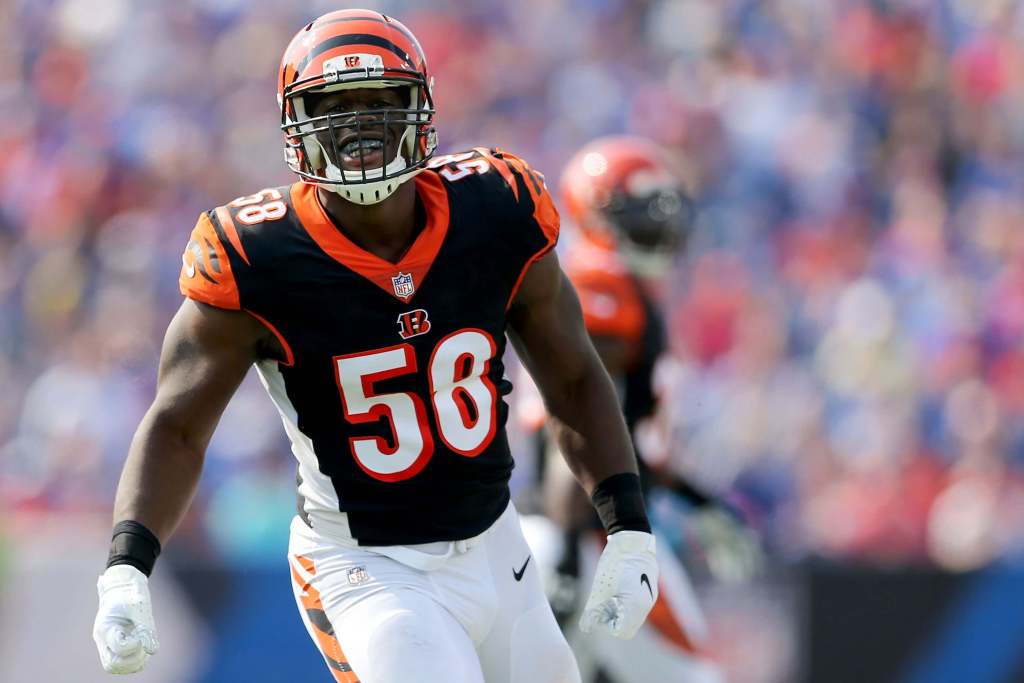
New York Jets: A training camp battle at every position (Offense)

As the New York Jets inch closer to training camp, ESM looks at the offensive roster battles to watch at every position.

Competition has always been a staple at summer camp. But if you’re headed to Florham Park, leave the archery materials at home.

The New York Jets are eight days away from descending upon One Jets Drive for their training camp activities. Once camp commences, they’ll have several positional struggles to solve before Week 1 kicks off in Carolina. ESM takes a look at each spot on the depth chart, sizing up a major battle that should be solved over camp practices and the coming trio of preseason games.

Our primer begins on offense…
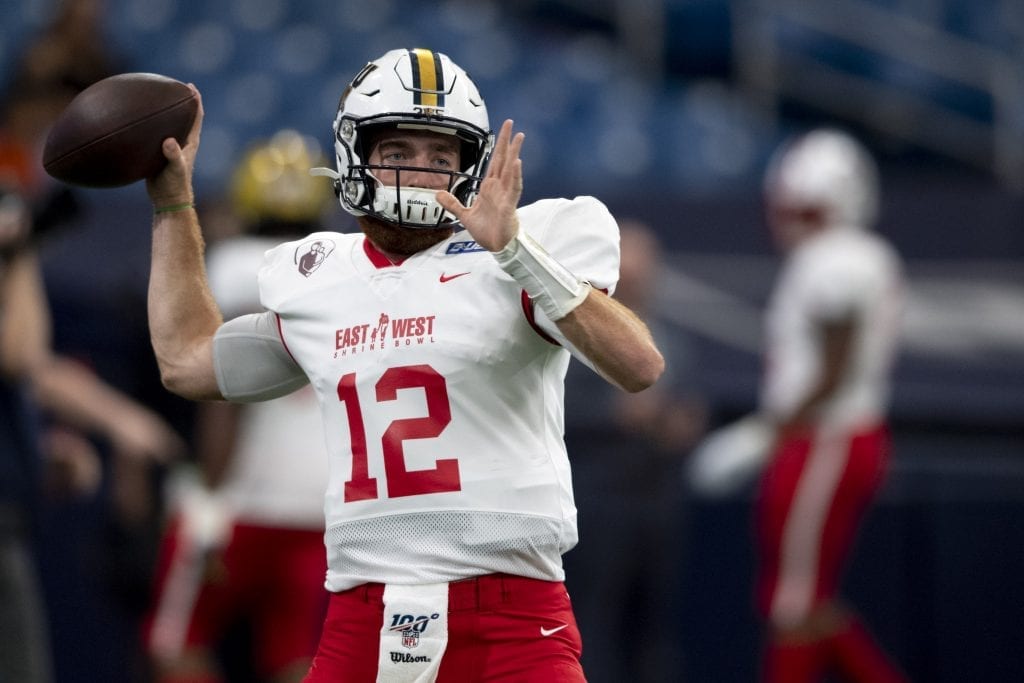
 Mandatory Credit: Douglas DeFelice-USA TODAY Sports

Backup QB: James Morgan vs. Mike White

Barring an epic disaster, the Jets will go into Week 1 with second overall pick Zach Wilson as their quarterback. Sitting the star rookie behind a veteran for a year has become a lost art in the modern NFL, even if Kansas City’s Alex Smith-to-Patrick Mahomes transition kept the concept alive for a few more years.

The Jets, though, are apparently planning to go in the completely opposite direction: no one in their quarterback cabinet has thrown a pass in an NFL regular season game. Immediately thrusting Wilson into the starter’s role is one thing, but backing him up with two veteran questions marks is another entirely. But head coach Robert Saleh apparently doesn’t see an issue.

“If you just bring in a veteran who doesn’t know anything about your scheme, he’s learning just like the rookie is,” Saleh told Max Goodman of Sports Illustrated. “There’s a match that has to happen. There’s a scheme familiarity that has to happen.”

That, of course, begs the question why the Jets didn’t go after someone like fellow former 49ers Nick Mullens, but it’s probably redundant at this point. Until further notice, the backup job comes to Morgan and White.

Morgan probably has the inside edge, if only due to his status as a Joe Douglas draft pick. Chosen in the fourth round of 2020’s virtual draft, the Florida International hasn’t even worn a game jersey yet due to the cancellation of last summer’s preseason. White entered the NFL as a fifth-round pick of the Cowboys in 2018 and has been on and off the Jets’ practice squad over the last three years. By going with someone inexperienced, it’s clear the Jets aren’t going with the “mentor” route for their backup quarterback. The winner will be judged on late summer showings and their performance in preseason games could be particularly intriguing.
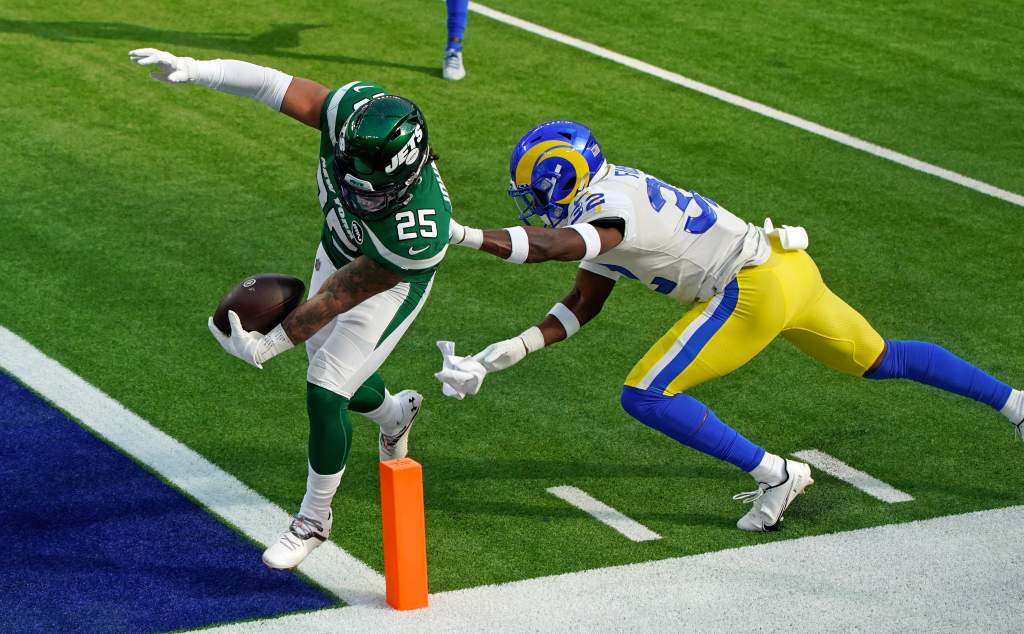
 Mandatory Credit: Kirby Lee-USA TODAY Sports

Spell RB: Ty Johnson vs. La’Mical Perine vs. Josh Adams

The primary rushing duties could become a battle as the season goes on. Veteran newcomer Tevin Coleman will probably at least start as the top option before giving way to rookie arrival Michael Carter. It’s fair to assume that Coleman, who worked with new offensive coordinator Mike LaFleur in San Francisco, has the early edge though Carter has reportedly impressed New York brass during his first spring sessions.

In training camp, however, there are more immediate, desperate matters to attend to, namely answering the question of who will be the third back.

Behind the Coleman and Carter tandem lies a trio of young projects that could’ve gained more clarity had Adam Gase not become obsessed with a Frank Gore farewell tour. Though injuries and a late placement on the COVID-19 list turned Perine’s rookie season into a wash but Johnson and Adams, spare parts from Detroit and Philadelphia respectively, impressed when called upon, uniting for 411 yards on 83 carries, good for an average of nearly five yards an attempt.

The battle between this trio isn’t a matter of playing time, but will determine roster spots. Even though he’s a Douglas draft pick (also chosen in the fourth round), Perine could be in the wrong place at the wrong time. His north/south style may not fit in  LaFleur’s preferred systems that value agility and athleticism, creating a wrong place at the wrong time situation. Meanwhile, the re-signed Adams has worked with Douglas before, sharing a single season with the Eagles.
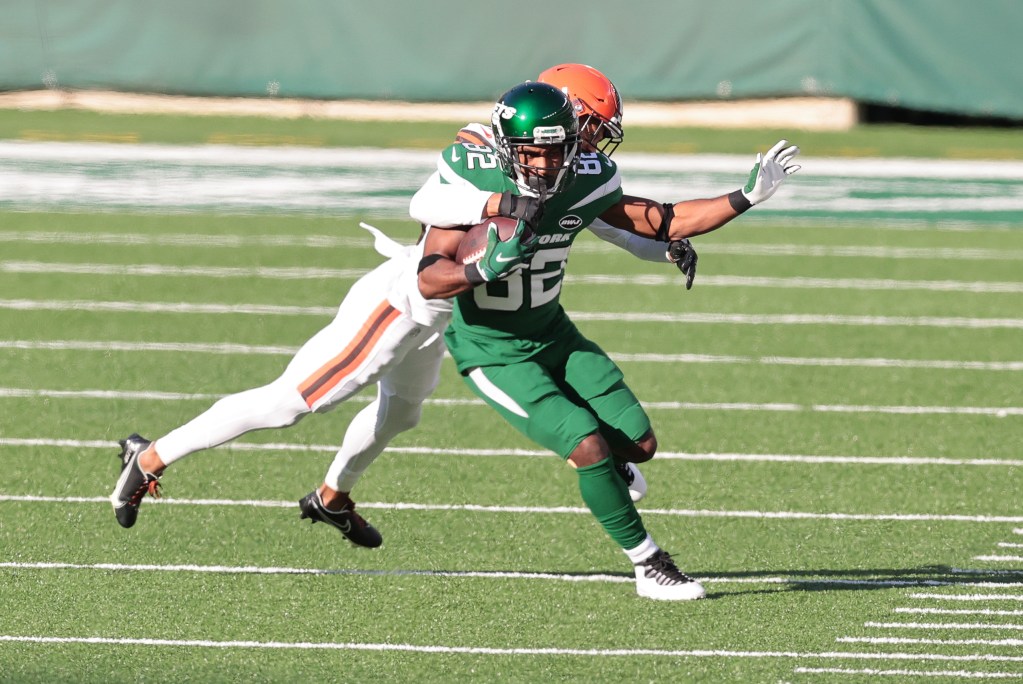
Mandatory Credit: Vincent Carchietta-USA TODAY Sports

Top Slot WR: Jamison Crowder vs. Elijah Moore

Over the past two seasons, Jamison Crowder has been far and away the Jets’ most consistent offensive weapon. Through that endeavor, he has become one of the NFL’s most reliable slot options. But does the fact he’s been a reliable weapon in woebegone New York say more about Crowder or just how dire the Jets’ situation has become?

Douglas and Co. spent the offseason upgrading their receiving corps and that included the slot depth chart. Drafting Moore with the second pick of the draft’s second day was seen as a steal by many and he seemingly arrived at the perfect time. The Jets were due some sizable cap savings upon Crowder’s release or trade and they could’ve easily had Moore take over. Instead, they restructured the final year of Crowder’s deal to focus on guaranteed money and will keep both of them in tow for Wilson’s first deal.

Crowder faces a bit of an uphill battle to get his snaps back, as he missed almost all spring activities during his contract dispute. There should still be an opportunity for him amongst the Jets’ revamped receiving corps but it’ll be tough to hold off the rise of a touted rookie.
. Mandatory Credit: Vincent Carchietta-USA TODAY Sports

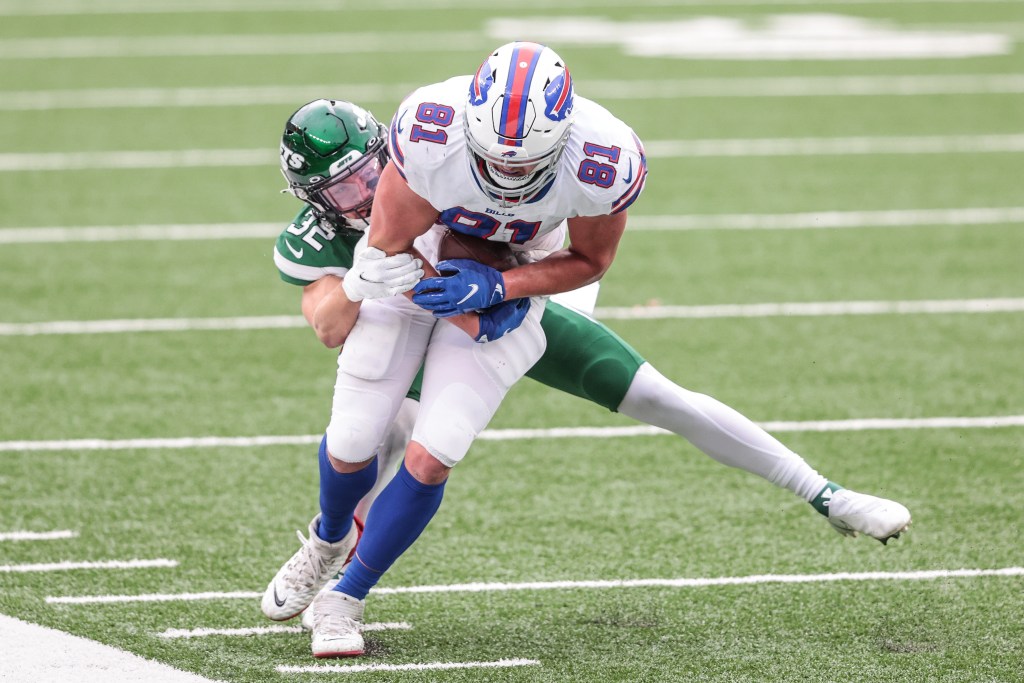
Starting TE: Chris Herndon vs. Tyler Kroft 

Entering his fourth year in New York, Herndon is a rare relic in green. Nothing, however, has lived up to the production of his rookie season (502 yards on 39 receptions) as the more recent stages of his career have been beset by a suspension, injuries, and inconsistency.

Though Herndon somewhat began to resemble his rookie self in the latter stages of last season, the Jets sent him a message this offseason. While they avoided the pricier options on the free agent market (i.e. Jonnu Smith, Hunter Henry), they added goal line option Tyler Kroft from Buffalo and re-upped with Daniel Brown. During minicamp, Herndon saw his first team reps go to Kroft and Ryan Griffin. Connor Hughes of The Athletic claimed that Herndon “struggled” to adjust to the new offensive playbook, playing a role in his demotion.

It’s been a while since Kroft was the primary option at tight end, last doing so in Cincinnati during the 2017 campaign. The Rutgers alum re-established himself as a reliable short-yardage and red zone target last season in Buffalo. Time will tell if the Jets turn over the full-time tight end reins to Kroft, or even give Griffin, Brown, or undrafted rookie Kenny Yeboah (11 touchdowns over the last two seasons at Temple and Ole Miss). But If Kroft’s signing even merely lights a fire under Herndon, it will have been well worth it.
 Mandatory Credit: Winslow Townson-USA TODAY Sports

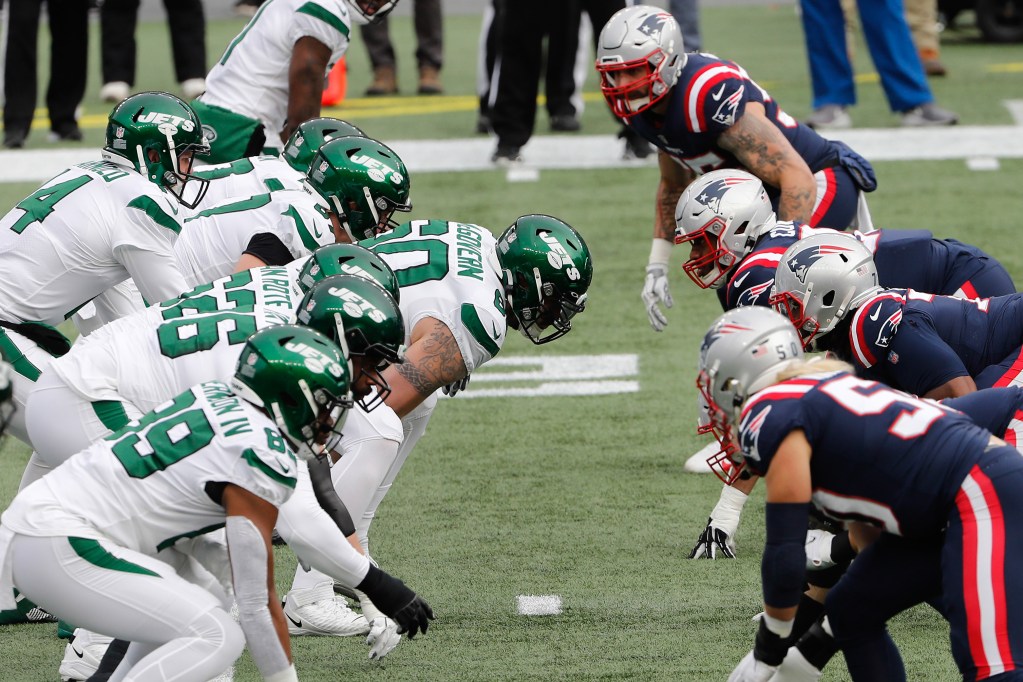
Offensive Line: RG Greg Van Roten vs. Newcomers

A Long Island native (Rockville Centre, to be precise), Van Roten was destined to make a difference in New York. While he endured a bit of an up-and-down season in terms of production, he partook in literally every snap over the Jets’ first 11 games and emerged as a leader and voice of reason when the team’s 2020 affairs became particularly dire.

With the Jets’ left side fortified with Mekhi Becton and Alijah Vera-Tucker, the focus turns to the right. Morgan Moses is a reliable one-year solution on the outside, while Van Roten appears to have a good grip on the interior. But the Jets brought in some interesting depth options, including the New York Islanders’ most celebrated new fan, Dan Feeney. Incumbent top left guard Alex Lewis is also set to move over to the right side, while one also can’t forget Cameron Clark, a 2020 fourth-rounder who spent last season preparing to make the transition from tackle to guard.

But Van Roten, who has shockingly tallied only a single accepted penalty in his NFL career, believes that the arrival of Saleh and LaFleur should help provide stability.

“They hire Saleh and it just feels like a weight has been lifted and hope has come back into the building,” Van Roten said, per team reporter Jack Bell. “All we ask for is a fresh start in this league and no one is happier than the Jets. Now we’re on page one, so let’s write this year’s chapter.”

Which offensive training camp battles will you keep an eye on? Follow @GeoffJMags on Twitter and continue the conversation.

New York Jets offseason recap 2021: Safeties

Marcus Maye’s lack of a long-term deal leaves the New York Jets in a prickly situation as year two of the post-Jamal Adams era looms.

Following the conclusion of minicamp activities, the NFL offseason is officially over. The next time the New York Jets convene in Florham Park, they’ll be getting ready for preseason and regular season action for the 2021 campaign. 

With the offseason in the rearview mirror, ESM looks back on the green offseason that was, position-by-position. We come to the penultimate portion of our reviews, with a look back on safeties in part nine…

(Photo: Getty)

How It Started

The Jets timeline is closing in on the one-year anniversary of the Jamal Adams trade with the Seattle Seahawks. It’s a deal that requires more time to fully grade and assess, as not all of the components have revealed themselves yet.

So far, it looks to be a push. Adams was an All-Pro with Seattle but was dealt mixed reviews otherwise and has yet to obtain the pricy long-term deal that led to his napalming of every bridge he head in New York. On the other side of the country, the one original piece with a name (Bradley McDougald) is already gone. The Jets later dealt the 2021 pieces (the 23rd and 86th selections) over to Minnesota in the opening round of the draft in April. Seattle’s last shipment is a first-rounder to be used next spring in Las Vegas.

The hullaballoo almost blinded the Jets and their fans to the fact that a 16-game season laid ahead. Adams’ attitude perhaps wasn’t missed, but his on-field intensity certainly was. The newly vacated strong side was originally occupied by McDougald before injuries forced third-round project Ashtyn Davis into the role prematurely. Undrafted free agents and spare parts from foreign practice squads had to take over when Davis, who struggled in coverage, was likewise lost for medical reasons.

Adams’ departure opened an opportunity for free safety Marcus Maye, the lone survivor from the Jets’ 2017 draft class. The second-round choice would embark on a career-best season that ended with a hoist of the Jets’ team MVP award named after Curtis Martin.

Mandatory Credit: Isaiah J. Downing-USA TODAY Sports

How It’s Going

Maye’s 2021 offseason saga recently reached its climax and it suggests a bit of a macabre future for the Jets’ ongoing renovations.

The two sides failed to close on a long-term contract leading Maye to play the 2021 in a bit of lame duck scenario: a franchise tag of over $10 million. While things won’t sink to the depths of the Adams saga…it’s probably too late in the offseason to make a trade anyway…watching homegrown, talented silver linings slip away is becoming a dangerous trend of Joe Douglas’ tenure.

As we previously discussed in the cornerbacks conversation, the Jets’ depth charts was in such dire straits that it was almost guaranteed some area would be neglected. The secondary was the unlucky department as there are no proven contributors locked up beyond 2021. LaMarcus Joyner, a versatile former Raider, is coming in on a one-year, $4.5 million deal. He can probably help stem the immediate bleeding, but, considering he’ll turn 31 in November, it’d be silly to fully rely on him as a long-term solution.

The safety spotlight now turns back to Davis, who has a lot to prove in his sophomore season. His will and fight can’t be denied: the former track star became one of college football’s most talked-about walk-ons after starring at Cal-Berkeley. He has earned positive reviews for his athleticism and physicality but often struggled to adapt to NFL coverages (ranking 85th amongst his safety peers, per Pro Football Focus). If Davis falters in an expanded role, the Jets may have to start from scratch.

Fifth-round choice Michael Carter II emerged from Duke as a safety, but the Jets will likely use him more often at cornerback. Behind Davis and Maye, several of the misfits who filled in are making their way back (i.e. Elijah Campbell and J.T. Hassell). The Jets also added Sharrod Neasman on a late, affordable deal (one year, $990,000) in June. Neasman’s shared Atlanta tenure with defensive coordinator Jeff Ulbrich could prove beneficial.

ashtyn davis, new york giants

Are They Better Off?

The conclusion of the Adams era deserves praise. Douglas was able to essentially turn a disgruntled safety that could never resist airing his grievances publicly into two premier draft choices. One was used to fortify the Jets’ anemic blocking, as the trade with the Vikings was made to select USC guard Alijah Vera-Tucker.

But while the distraction of Adams is gone, it’s time to replace the production he took with him. The Jets are laden with questions about the future at safety and a majority must be answered by the end of the 2021 season.

This season might well be the perfect time to do it. It’s a bit much to ask these Jets to make the postseason leap. At the same time, last year’s two-win nightmare was so garish that there’s little to no chance of diggings a deeper hole.

Thus, the Jets are, as a team, blessed with a season of having nothing, if anything to lose. Individuals, however, must make their case to stick around for the potential good times ahead. That applies for the secondary, particularly in a safety spot where there is no proven, consistent NFL talent locked up beyond Week 18. Essentially, this is a “prove it” season for the whole unit.

Davis bears perhaps the heaviest burden from a New York standpoint. Maye will be mostly playing for himself, showing not only the Jets but also their 31 brothers exactly why he should be paid like an elite safety. Davis, on the other hand, will likely get an opportunity to make an immediate and vital New York impact.

Adams is gone and the Jets earned an immediate cash out upon his departure. But the hard part still looms: finding the next Adams, the next hopeful to push this defense into the future.

Final Offseason Grade: C

Who will step up in the post-Adams era? Follow @GeoffJMags on Twitter and continue the conversation.
New York Jets: Three aftershocks from the Marcus Maye franchise tag

Maye will officially play the 2021 season on a franchise tag. How will that affect the New York Jets’ ongoing rebuild?

Tag, Marcus Maye is it.

Thursday marked the deadline for Maye and the New York Jets to come to a long-term deal. With the 4 p.m. cutoff long breached, Maye will play the 2021 season on a franchise tag worth over $10 million.

While the tag has Maye listed as the sixth-richest safety in football, there seems to a lingering sense of iciness between the safety and the team. NFL Network’s Ian Rapoport has claimed that tensions rose long before Thursday’s final horn, saying that the Jets’ offer went drastically lower than what Maye would be offered with the tag. Thus, 2021 has the makings of a lame duck season for Maye, who is coming a career-best campaign.

How does this affect the Jets this season and beyond? ESM investigates…

ashtyn davis, new york giants

Ashtyn Can’t Butcher An Opportunity

After the Jamal Adams saga ended in a fruitful trade, Maye stepped up and perhaps created this whole controversy in the first place. A similar opportunity awaits Ashtyn Davis, a second year strong safety who is projected to line up next to Maye this season.

Davis, a third-round pick out of Cal during the virtual draft of 2020, went from walk-on to projected day two choice, perhaps falling out of the second round due to surgery following his senior campaign. His rookie season was a bit of a wash, as he struggled when thrust into action after Adams was traded and Seattle arrival Bradley McDougald was lost to an injury. Davis likewise fell victim to a foot injury that ended his year after six games (one start).

Praised for his athleticism and physicality, the Jets hope that Davis can enjoy a breakout campaign similar to what Maye experienced last season. Beyond him, the secondary depth chart is disturbingly thin: Las Vegas import LaMarcus Joyner, 30, brings experience but will need a truly impressive season to factor in the Jets’ long-term plans. At cornerback, the Jets stockpiled project defenders like Michael Carter II, Jason Pinnock, and Brandin Echols. Starters Bless Austin and Bryce Hall have a lot of upside, but are no guarantee.

Needless to say, a Davis breakthrough would definitely give their defense a clearer path toward the future.

New York Giants, Jabrill Peppers
Mandatory Credit: Brad Mills-USA TODAY Sports

Safety First

There’s plenty of time for Maye and the Jets to change each other’s minds and it’s probably far too late in the offseason to consider a trade. But all signs currently point to a separation come next spring, so the Jets have to start planning now.

Both the 2022 free agency and draft classes have some strong names to keep an eye on. Marcus Williams, with whom Maye is tied in 2021 salary, should be one the marquee names, followed by Jabrill Peppers. The incoming rookie class is headlined by Notre Dame’s Kyle Hamilton (who could very well be a top ten pick) while redshirt sophomore Brandon Joseph could be an intriguing pick with the latter first round pick from the Seahawks. New York is currently projected to work with over $71 million in cap space in 2022, third-best in the league behind Indianapolis and Pittsburgh.

Frankly, the potential Maye exit always applies a certain amount of pressure of the offense. The past offseason saw the Jets in such dire straits that it was a near guarantee that at least one area was going to be neglected. A majority of the Jets’ offseason resources were shifted toward the offense and front seven, including free agency dollars (Corey Davis, Keelan Cole, Carl Lawson, Jarrad Davis). Their primary draft picks were dedicated to the offense, as each of their first four choices (Zach Wilson, Alijah Vera-Tucker, Elijah Moore, and Michael Carter) have been hired to put points on the board. If the anemic offense shows no signs of improving the season, the  secondary could wind up woefully neglected again.

New York Jets, Joe Douglas
Photo by Al Pereira/Getty Images)

Off-Broadway Joe

It doesn’t do anyone much good to write Maye’s New York farewell song just yet. But, if these next 17 games make up his final hours in green, it continues two disturbing trends in recent Jets history.

With Maye’s New York future in doubt, the 2017 draft class is officially an endangered species. Nothing more needs to be written about top pick Adams, but the class has been a scourge on not only the Jets, but the league as well. Three of the nine picks (including third-round receiver ArDarius Stewart) are already out of football and only one beyond the safeties (Texan-turned-Lion Chad Hansen) appeared in 2020 regular season action.

The Jets have not only had trouble drafting, they’ve had troubling keeping the homegrown talent that appears to have a future. Maye appeared to be on pace to break that trend, but the past few weeks have only commenced a countdown to his departure.

Could this serve as a commentary on the Joe Douglas era?

It’s easy to view this situations from both sides: Douglas and company want to see how Maye performs in year two of the post-Adams era and they save some money in the short and long-run (maybe the immediate savings could go toward secondary help and a backup quarterback…?). Maye believes he’s a top ten safety and wants to be paid as such.

No one can deny that Douglas knows the team’s needs and can work with an offseason budget, at least on paper. But there could be a lingering side effect of free agents being scared away by Douglas’ unwillingness to deal pricy long-term deals?

Simply put, there’s a little more pressure on the 2021 Jets to perform now, to showcase visible signs of improvement. Again, asking them to make the postseason leap seems like a little much: they’re trapped in a division with America’s powerful football sweethearts in Buffalo and there are too many established contenders to leapfrog for the wild card. But there has to be at least some semblance of hope out there, a “throat-clearing” year of sorts, something similar to what the Los Angeles Chargers did with Justin Herbert in tow.

Entering Herbert’s rookie year, there wasn’t much to be excited about from an LA perspective. They seemed destined for a rebuild period and were struggling to attract fans even when they were allowed to play in front of a crowd. But the Chargers went on to surprise a lot of people. Herbert had an exemplary rookie season and the team won seven games. Even their losses were impressive: they took Kansas City and New Orleans to overtime and sheer bad luck probably kept them away from a winning record.

Seven of the Chargers’ nine losses came by single digits and they won each of their final four games following a December shellacking from New England. Los Angeles is now everyone’s NFL preview dark horse and the good vibes attracted new starters like Corey Linsley, Oday Aboushi, Matt Feiler, and Jared Cook to the cause.

Patience has paid off in the early stages of this New York rebuilding stage. But in certain regards, the time is now.

How do you think the Jets’ plans will be affected by Maye’s franchise tag? Follow @GeoffJMags on Twitter and keep the conversation going.

Adjusted PFR sack numbers give the New York Jets a unique milestone

Mark Gastineau, jets

The 1981 New York Jets (unofficially) hold a unique mark in NFL history after Pro Football Reference unveiled adjusted sack totals.

Three decades later, the New York Sack Exchange is still cashing in.

Noted research and statistics service Pro Football Reference announced this week that the site will tally sacks accumulated prior to the 1982 season, when quarterback takedowns became an official stat. Thanks to historians John Turney and Nick Webster, PFR now has sack numbers dating back to 1960 season, accumulated through any evidence possible, including film, box scores, and documented play-by-play logs.

Through these pre-1982 tallies will be listed unofficial, PFR hopes to give “fans to gain a deeper appreciation of some of football’s biggest stars in the 1960s and 1970s”, whose defenders’ “greatness and impact can now be more readily quantified”.

Fans of the New York Jets will be particularly enthused by the new findings. For example, with the addition of 33.5 sacks earned over his first three seasons, Mark Gastineau now has triple digits in sacks (107.5 compared to 74). Joe Klecko (+54 after the adjustment) is another major beneficiary, as he and Gastineau each pass Shaun Ellis for the most sacks in franchise history. Others who move up include Gerry Philbin (65) and Verlon Briggs (58.5), each of whom played prior to 1982 and enter the top five.

The PFR adjustment also gives the 1981 Jets one of the most unique and difficult milestones in the NFL ledger: thanks to Klecko (20.5) and Gastineau (20), they become the only team in league history to feature two teammates with at least 20 sacks in a single season.

Beyond the Jets, Deacon Jones (1961-74) is one of the biggest beneficiaries of the new documentation. With 173.5 takedowns, all before the sack became an official stat, Jones has tallied the third-most sacks in NFL history. Bruce Smith (200) and Reggie White (198) remain the all-time leaders, while Jack Youngblood (+24.5), Alan Page (148.5), and Lawrence Taylor (+9.5) all enter the top ten.

Both sides of the New York football argument may have qualms with the reveal, however. Though Taylor moves up, neither Michael Strahan (who falls from 6th to 10th after the unofficial adjustments) or Gastineau (who recently called for his 1984 single-season sack record back after Strahan controversially broke it in 2001) technically hold the NFL’s single-season sack record. The honor now belongs to Al Baker, who was determined to have tallied 23 during his rookie year with Detroit in 1978.

“For some reason, and I’m not kidding you, without any prompting, tears just started running down my eyes,” Baker told Dan Hanzus, Gregg Rosenthal and Patrick Claybon on the latest Around The NFL podcast upon learning the news. “My wife was inside, I opened up the patio doors, and my wife, first thing she said was, ‘What’s wrong?’ and I said, nothing’s wrong and I said come look at this…We hugged and then I lost about an hour and a half, two hours. My daughter called. It was really emotional for my family. I guess at 6-foot-8, 290 pounds, that doesn’t sound really tough, but, we were all crying.”

What are your favorite New York Jets memories from the 1980s? Follow @GeoffJMags on Twitter and continue the conversation.
New York Jets offseason recap 2021: Cornerbacks

New York Jets, Bless Austin

The New York Jets opted to wait until the latter stages of the NFL Draft to address their issues at cornerback.

Following the conclusion of minicamp activities, the NFL offseason is officially over. The next time the New York Jets convene in Florham Park, they’ll be getting ready for preseason and regular season action for the 2021 campaign. 

With the offseason in the rearview mirror, ESM looks back on the green offseason that was, position-by-position. Our focus on the defense continues by looking back on the cornerback position…

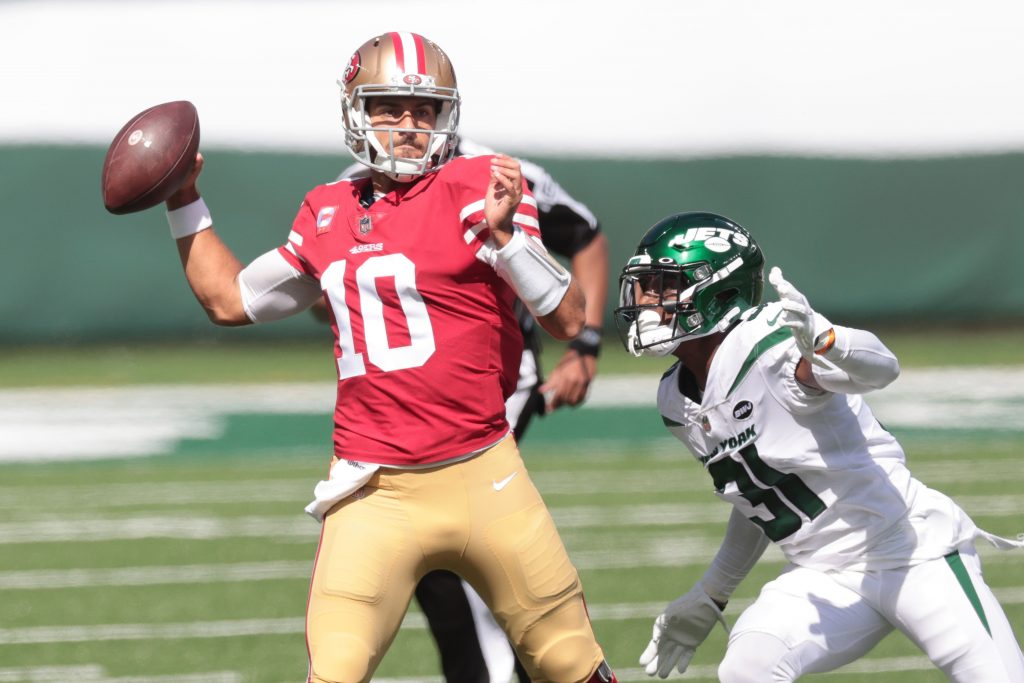
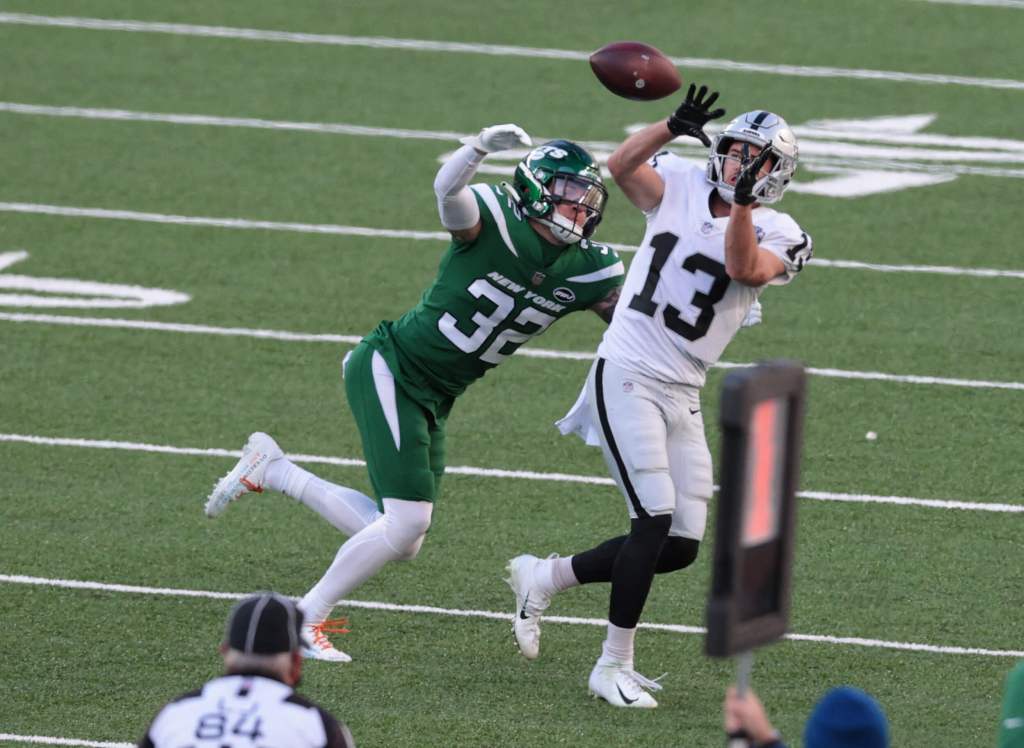
Sep 20, 2020; East Rutherford, New Jersey, USA; San Francisco 49ers quarterback Jimmy Garoppolo (10) throws a pass during the first quarter as New York Jets cornerback Blessuan Austin (31) defends at MetLife Stadium. Mandatory Credit: Vincent Carchietta-USA TODAY Sports

How It Started

Over the past two seasons…a pair of campaigns that could be informally referred to as the post-Trumaine Johnson era when it came to the cornerback depth chart…the Jets have tried to solve their cornerback issues in two different ways. First, they tried throwing veterans at the problem, but former Colts like Pierre Desir and Nate Hairston failed to resolve them. Both Desir and Hairston were part of the Jets’ autumn exodus of 2020, turning the primary corner slots over to younger talents.

To that end, the Jets have turned to the services of day three picks like Bless Austin and Bryce Hall. Austin was, for all intents and purposes, born to play metropolitan football as a Queens native and Rutgers alum. He’s been more than capable of playing an elite level, evidenced by the fact he was second in the Big Ten in pass breakups (14) during his sophomore season, though injuries have stunted his development. Over his first two NFL seasons, Austin has developed a reputation as a strong, aggressive hitter but he has struggled in coverage. Quarterbacks have tallied a 96.1 rating when targeting his receivers over his first two campaigns. Austin’s football story is one of the more inspiring in recent Jets memory, but he’s facing a make-or-break year in terms of on-field production.

Fellow projected starter Bryce Hall has a bit of a longer leash to work with. The Virginia alum was projected to be a top ten pick in 2019 by CBS Sports, but saw his stock fall after a season-ending ankle injury in his senior season. His personal plummet could work to the Jets’ benefit. Hall missed the first eight games of last season but provided a spark of hope for the future in the midst of a lost campaign by earning 36 tackles and an interception (a jaw-dropping one-handed takeaway in the Jets’ first win over the year against the Rams) over the second half of the year.

“He’s got length, he’s got a great brain and he’s got a thirst for the knowledge of the game,” new defensive coordinator Jeff Ulbrich said of Hall, per notes from the Jets. “That’s where eventually he’ll set himself apart I think because he’s just so detailed and he’s a guy that’s like got the callus on his finger from taking notes in practice.”

After the departures of Desir and Hairston, the Jets also employed the services of undrafted depth options like Javelin Guidry and Lamar Jackson. The former was particularly strong in slot coverage and could well play his way into another term with the team this summer. Former New York Giants draft pick Corey Ballentine arrived in November but made a far greater impact as a returner than a defender.

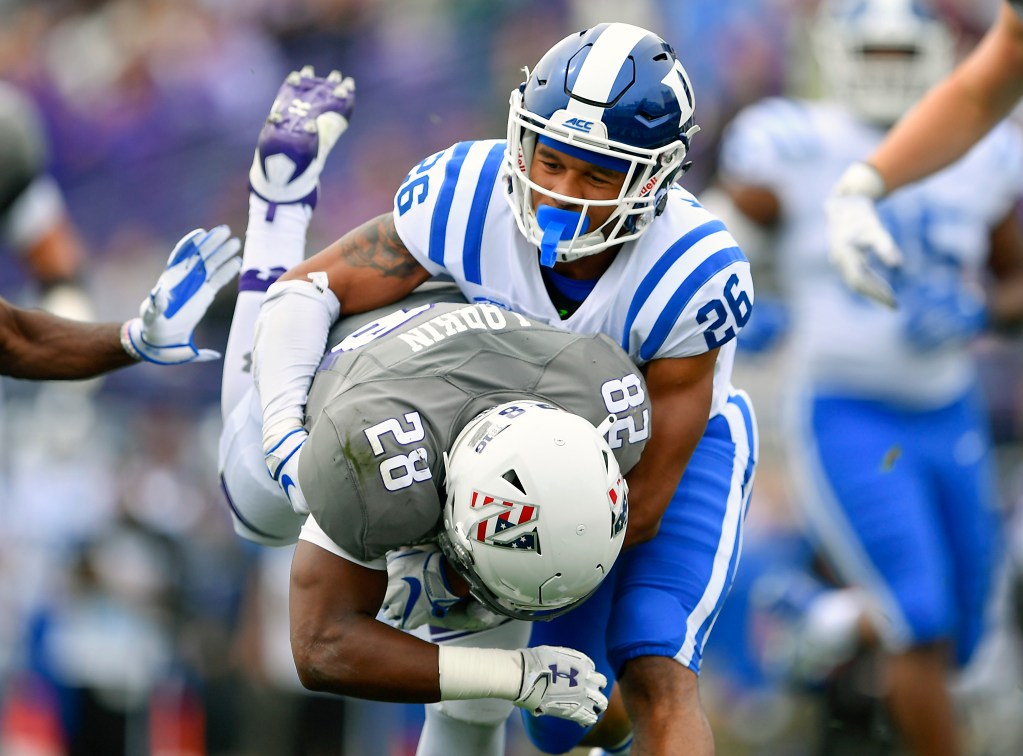
Sep 8, 2018; Evanston, IL, USA; Duke Blue Devils safety Michael Carter II (26) tackles Northwestern Wildcats running back Jeremy Larkin (28) in the first half at Ryan Field. Mandatory Credit: Quinn Harris-USA TODAY Sports

How It’s Going

One would assume a defensive-minded head coach like Robert Saleh would try to bolster the cornerback group. Saleh, if anyone, would know the benefits of acquiring veteran help in the secondary from his days in the Bay Area. For example, San Francisco foe-turned-friend Richard Sherman became a valuable mentor to Emmanuel Moseley during the 49ers’ Super Bowl run in 2019.

But the Jets’ 2021 offseason, despite several bastions of hope, was doomed from the start in the sense that so many areas needed adjusting that some position group was almost guaranteed to be neglected. The cornerback slot was made to bite the proverbial bullet.

The Jets were mostly quiet on the free agency front, re-signing journeyman Bennett Jackson and adding Justin Hardee, a former New Orleans Saint better known for his efforts as a gunner than a defender. They finally addressed the cornerback spot in earnest on the final day of last spring’s NFL Draft, adding Michael Carter II in the fifth round before picking up Jason Pinnock and Brandin Echols in the sixth. Carter (no relation to his fellow New York draft pick of the same name) could immediately contribute in the nickel and slot, while Pinnock and Echols are likely long-term projects whose immediate futures lie in special teams coverage. Each rookie, however, could be pressed into action if the top veteran names falter.

New York Jets, Brian Poole
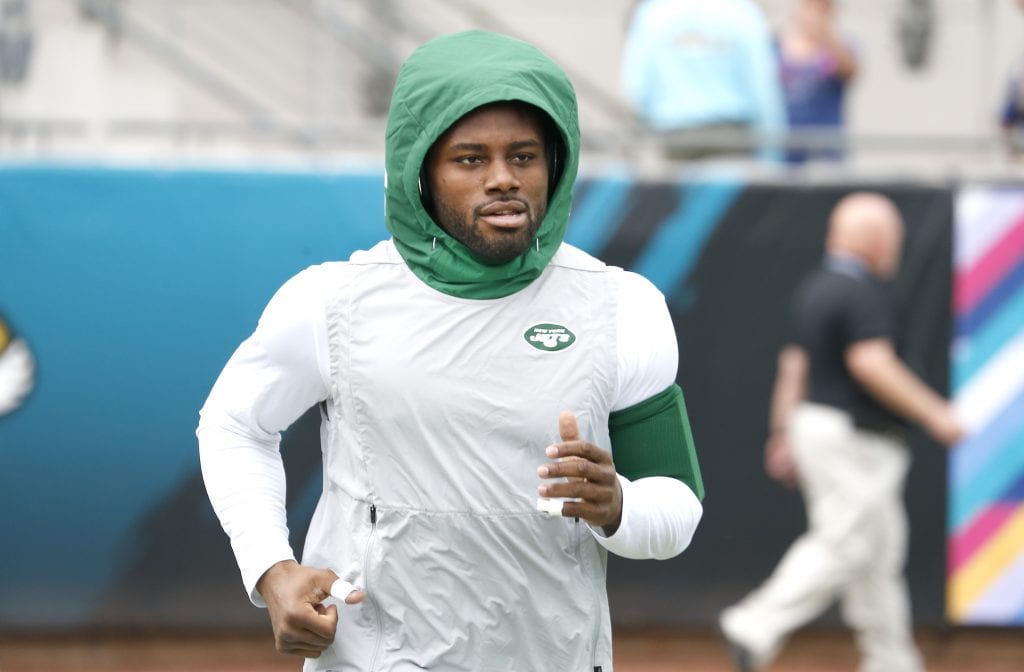
Oct 27, 2019; Jacksonville, FL, USA; New York Jets cornerback Brian Poole (34) jogs on the field before the game against the Jacksonville Jaguars at TIAA Bank Field. Mandatory Credit: Reinhold Matay-USA TODAY Sports

Are They Better Off?

The 2021 Jets’ cornerback endeavors are currently the definition of youth in revolt, as Hardee is the oldest representative at 27.

Much like the damage Le’Veon Bell left behind in the running back slot, the aftermath of the Johnson disaster possibly scared the Jets from bestowing big bucks on the free agent market. The 2021 class wasn’t exactly a game changer: the most notable names were either inked to expensive short-term deals (Kyle Fuller, one year for $9.5 million in Denver) or even pricier long options (Adoree Jackson to the Giants at $39 million over three years). None of the available names (William Jackson, Levi Wallace, and Shaq Griffin also among them) were going to push the Jets over the postseason threshold, so general manager Joe Douglas might deserve some kudos for not making a panic purchase.

Having said that, it’s surprising to see the Jets hold their ground with their current, unproven corner depth chart with veteran names like Sherman (one of Saleh’s most ardent supporters) and Brian Poole (a very serviceable green slot option over the last two seasons) lingering in free agency [EDIT, 11:55 a.m. ET: Sherman has been booked on charges of “Burglary Domestic Violence” in Seattle and has been denied bail]. It’s understandable that the Jets probably wish to ring in a new era with young, mostly homegrown talent, but that doesn’t mean that they should have to go about it alone.

Final Offseason Grade: C

Will the Jets regret waiting so long to address the cornerback slot? Follow @GeoffJMags on Twitter and continue the conversation

Long-term talks stall between Marcus Maye, New York Jets (Report)

According to Ian Rapoport, there appears to be no long-term agreement in the near future between Maye and the New York Jets.

Per Ian Rapoport of NFL Network, no long-term contract deal is expected between the New York Jets and safety Marcus Maye.

According to Rapoport, the Jets “not responded to his last proposal and that offer has been pulled off the table”. The safety was franchise tagged by the Jets in March, signing the one-year tender worth just over $10.6 million two weeks later. Maye’s tag makes him with sixth-highest safety for the 2021 season, tied with Marcus Williams of New Orleans. He will play on that tag unless a long-term can be reached by Thursday.

Both sides have equal footing in the argument for Maye’s long-term deal. Maye has been labeled one of the better safeties in the NFL, boasting an 82.1 Pro Football Focus grade in 2020 (fourth-best amongst safeties). The Jets, on the other hand, may be reluctant to offer a safety that’s set to turn 29 next March a long-term deal.

Shortly after the NFL Draft ended in May, general manager Joe Douglas said that re-upping with Maye was a “priority” after the selections.

“It’s still a priority to keep Marcus here long term,” Douglas said, per Max Goodmanof SI.com. “We have had productive texts back and forth with his agent and we’re hoping to really dive into this now that now that the draft’s over.”

In that same month, head coach Robert Saleh said he understood Maye’s side of the story, but reiterated that Douglas and the front office were working “relentlessly” on a long-term deal.

“I think these kids have earned the right to ask for whatever they can, especially when they do things the right way like (Maye) has,” Saleh said, per Adam Maya of NFL.com. “We had a really nice discussion and obviously him and his agent are working with Joe on trying to get his deal done, and hopefully that happens soon.”

Maye skipped organized team activities but attended the Jets’ minicamp proceedings in June. He’s coming off a season that saw him earn a career-best 88 tackles (4 for a loss, including a pair of sacks) and 11 pass breakups.

Will this reported stall between Maye and the Jets affect the team moving forward

New York Jets to host joint practices vs. Philadelphia

New York Jets

The New York Jets will now face the Eagles three times this year, as they’ll host a pair of joint practices prior to their summer clash.

Another chapter has added to the northeastern battle of green football.

The New York Jets announced on Tuesday that One Jets Drive will host joint practices with the Philadelphia Eagles at Atlantic Health Jets Training Center in Florham Park. These practices land on August 24 and 25, days before the teams face off in their respective preseason finales on August 27 at MetLife Stadium.

New York and Philadelphia have mostly kept their gridiron interactions limited to the final weeks of the summer due to their differing conferences, but are now set to meet three times throughout the course of the 2021 season. A regular season matchup looms on December 5 at East Rutherford, serving as the extra game in the newly-minted 17-contest schedule. The Jets have met the Eagles in an annual preseason contest since the turn of the century, their two-decade standing date broken only by the cancellation of the 2020 preseason amidst the COVID-19 pandemic. New York is winless against Philadelphia in 11 regular season meetings, the last showdown coming two seasons ago at Lincoln Financial Field.

In addition to the joint summer sessions with the Eagles, the Jets are also slated to visit Green Bay’s camp prior to their exhibition at Lambeau Field on August 21.

The announcement of Philadelphia’s invasion of Florham Park accompanied the reveal of Jets training camp practices that will be open to the public. Both of the Eagles’ visits are on the list, as is the Green and White scrimmage at MetLife Stadium, which will be the stadium’s first football hosted in nearly 18 months, dating back to an XFL contest between the New York Guardians and Los Angeles Wildcats.

Fans will also be welcome at the training camp practices in Florham Park on July 31st and August 2nd, 4th, 9th, and 11th. Autographs from players and staff will not be permitted, face coverings and proof of vaccination will not be required.

To download tickets to Jets training camp, click here.

Geoff Magliocchetti is on Twitter @GeoffJMags

New York Jets offseason recap 2021: Linebackers

new york jets, jarrad davis

Packed to the brim with potential, the New York Jets’ completely revamped linebacker corps must start producing on the field.

Following the conclusion of minicamp activities, the NFL offseason is officially over. The next time the New York Jets convene in Florham Park, they’ll be getting ready for preseason and regular season action for the 2021 campaign. 

With the offseason in the rearview mirror, ESM looks back on the green offseason that was, position-by-position. The second half of the front seven segments features the linebackers…

C.J. Mosley, New York Jets
USA Today

How It Started

A lot of attention and hullabaloo has been dedicated to the Jets’ constant turnover at quarterback, but a similar discussion could be had at linebacker. The Jets have had several marquee names to fill the slots. They used their 2016 first-rounder on Darron Lee (passing on names like Will Fuller, Jaylon Smith, Chris Jones, and Xavien Howard). Breakout defenders either turned out to be flukes (Jordan Jenkins) or went elsewhere (Tarell Basham). A de facto in-season firesale saw another casualty (Avery Williamson).

Medical absences have taken a particularly dangerous toll and it puts the Jets in an awkward position when it comes to C.J. Mosley. The former Baltimore Raven is in a bit of an awkward spot. He’s not only a rare leftover from the Mike Maccagnan era, but the prior general manager left a lasting legacy via a huge contract. Through the guaranteed clauses in his five-year, $85 million deal, Mosley has made $21.5 million thus far…for two games in green so far.

Mosley’s medical woes shouldn’t be held against him. Football is a physical, violent game and Mosley was one of many who weren’t comfortable playing amidst the height of the COVID-19 pandemic. He had every right sitting out last season. The timing was just rather unfortunate from a Jets standpoint, as he was expected to provide some stability and winning pedigree to the Jets’ beleaguered defensive corps. Blake Cashman is another one beset by medical absences. He rose up in Mosley’s absence but is entering a huge third season after three major shoulder surgeries.

In an appearance on a team podcast hosted by Eric Allen and Ethan Greenberg, Mosley had no doubt that he was ready to make major contributions to the Jets’ road back to respectability, comparing his de facto two-year absence to the brief retirement of Rob Gronkowski. The tight end was a major part of Tampa Bay’s Super Bowl endeavor after taking a year off.

“Yeah, I don’t have any doubts in myself…I’m here, so we’ll let the play do the talking,” Mosley said. “I’m happy to be back in the building with my teammates, to be around the locker room and the new energy. What we’re doing now is building a great foundation, setting this team on course to stack up wins and get to where we want to go.”

The Jets have completely started over, as all of their primary linebackers from last season have moved on. Jenkins failed to expand on an eight-sack season in 2019 and moved on to Houston with reliable depth option Neville Hewitt. Basham, coming off a career-best season on the outside, earned a two-year with the Cowboys while Harvey Langi returned to New England.

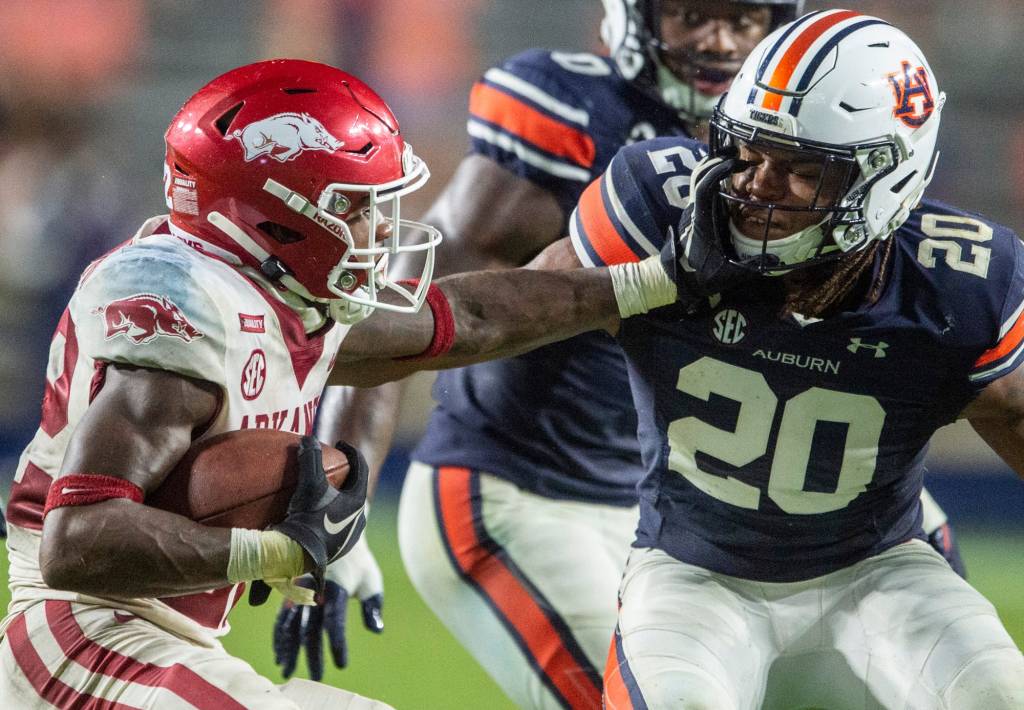
Arkansas running back Trelon Smith (22) stiff arms Auburn defensive back Jamien Sherwood (20) at Jordan Hare Stadium in Auburn, Ala., on Saturday, Oct. 10, 2020. Auburn defeated Arkansas 30-28.

How It’s Going

Head coach Robert Saleh and defensive coordinator Jeff Ulbrich are noted practitioners of the 4-3 defense, which the Jets haven’t run since the Rex Ryan days. Free agent newcomer Jarrad Davis will be one of the most vital pieces of this transition…and, by association, one of the Jets’ most fateful additions as they prepared to pen what feels like the most hopeful chapters of their never-ending rebuild.

Davis is about to embark on the textbook definition of a make-or-break season. He inked a fully guaranteed one-year, $5.5 million deal with the Jets after four seasons in Detroit, who made him a first-round pick in 2017. His career began on a strong note: he earned All-Rookie honors and eight sacks over his first two seasons, but the past two seasons have been a struggle.

Problems in coverage have been particularly worrisome. Over the past three seasons, quarterbacks have earned a 113.8 passer rating when targeting Davis’ assignments. Davis’ hasn’t been a complete disaster…he’s still capable of raising pressure…but it wasn’t enough for Detroit to pick up his fifth-year option. how he performs on this prove-it deal could well determine the path for the rest of his career.

The downfall of Davis could be traced back to the respective departures of Lions head coach Jim Caldwell and defensive coordinator Teryl Austin following his rookie season. Austin ran the 4-3 in Detroit (and later Cincinnati, who refused to draft defensive scheme fits), picking up where Davis had left off from his college days at Florida under then-defensive coordinator (and current Georgia Tech head coach) Geoff Collins. His speed, on display through a sub-4.6 40 time could also be huge as the Jets seek to bolster their pass rush (fellow free agent Del’Shawn Phillips should also help check that box). Through his experience in the 4-3, Davis has a prime opportunity to not only reclaim the narrative on his NFL career but showcase his leadership skills.

In addition to the returns of Mosley and Cashman (each of whom may face make-or-break campaigns through no fault of their own), the Jets made a pair of interesting selections in the latter stages of the draft. Jamien Sherwood and Hamsah Nasirildeen were each listed as safties, but the Jets almost immediately announced their intentions to turn them into linebackers. Sherwood, an Auburn alum, is a bit undersized for a linebacker but makes up for it with a wide wingspan and good coverage near the line of scrimmage. Florida State’s Nasirildeen could’ve been chosen during the first two days if not for a torn ACL from his junior season that limited him to two games last year. He gained a reputation as an aggressive hitter during his time in Tallahassee. An undefeated addition could wind up being undrafted outside rookie Hamilcar Rashed, who is two years removed a 14-sack season at Oregon State.

new york giants, jarrad davis

Are They Better Off?

On paper, there is a lot of potential in the Jets’ linebacking corps. But like many other areas on the team, it’s time to start capitalizing. There’s no use in holding Mosley and Cashman’s medical pasts against them. But if they’re ready to go, it’s completely fair to start asking them to contribute.

When it comes to the newcomers, they’re looking at the group with an eye on the future. Even if Davis fails to live up to his first-round billing, he could help the younger pieces learn the finer points of the 4-3 that figures to factor into their long-term future. The immediate action after the draftings of Sherwood and Nasirildeen shows that they have a plan for this group.

As we discussed in the defensive line portion, having a strong front seven and the pass rush that comes with it is going to be vital with a yearly pair of matchups with Josh Allen ahead for the next decade. Through these additions, the Jets bolstered both their pressure (Davis, Carl Lawson, Sheldon Rankins) and coverage (Sherwood and Nasrilideen). The names aren’t flash by any stretch, but the hopeful, hopefully game-changing, chapter of a perpetual rebuild has to start somewhere.

This linebacker group has both immediate intrigue (will Mosley and Cashman overcome their painful pasts?) and hope for the future. (Davis, Sherwood, Nasrilideen). They’ll certainly never be boring come Sundays.

Final Offseason Grade: B

Geoff Magliocchetti is on Twitter @GeoffJMags

New York Jets 2021 offseason recap: Defensive line

The arrival of Robert Saleh should help stabilize a New York Jets defensive line packed with young potential.

Following the conclusion of minicamp activities, the NFL offseason is officially over. The next time the New York Jets convene in Florham Park, they’ll be getting ready for preseason and regular season action for the 2021 campaign. 

With the offseason in the rearview mirror, ESM looks back on the green offseason that was, position-by-position. Our next portion turns to the front seven, starting with the defensive line…

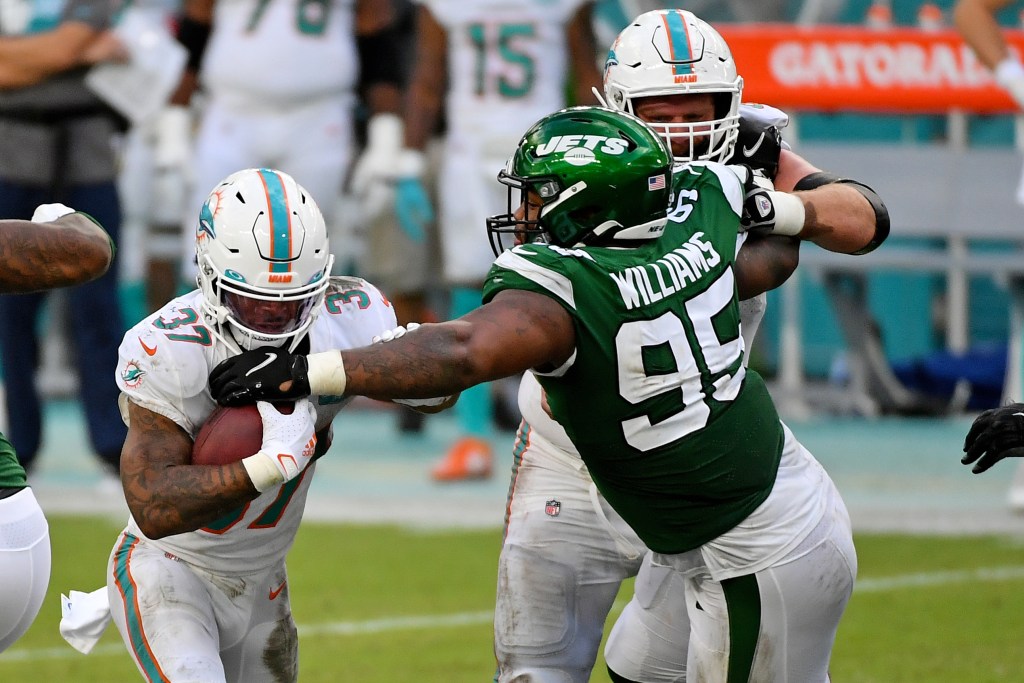
Oct 18, 2020; Miami Gardens, Florida, USA; New York Jets defensive tackle Quinnen Williams (95) reaches for Miami Dolphins running back Myles Gaskin (37) during the second half at Hard Rock Stadium. Mandatory Credit: Jasen Vinlove-USA TODAY Sports

How It Started

If you, the reader, often skipped these sections of the offseason recaps, this writer could hardly blame you. After all, reading them from a Jets fan’s perspective may be the Gang Green equivalent of watching Avengers: Infinity War and skipping to Thanos’ snap. 

But the Jets’ defensive line was a rare bright spot in 2020, featuring several breakouts from young pieces. By far the most impressive was that of Quinnen Williams, who immediately reclaimed the narrative on his NFL career after a sputtering rookie season. Williams’ greatest leaps came in the pass rush, more. than doubling his pressures (14 QB hits) and sack totals (7 after 2.5 in 2019). The third overall pick of the 2019 draft credited his resurgence to an adjusted workout and diet routine in a report from team correspondent Olivia Landis. He believes last season the precursor to something bigger.

“I didn’t want to be the player that I was my first year. I hit that goal and I wanted to say that I was on the right track for my career,” Williams said. “I feel like this is the stepping stone for me to get better and better every year.”

Williams wasn’t the only one whose introduction to the mainstream NFL conversation was washed out by the antics of the Jets’ 2020 season. Foley Fatukasi followed through on the promise shown at the end of the 2019 season while previous Super Bowl participant John Franklin-Myers had a career-best year in the interior. Together with Williams, both Fatukasi and Franklin-Myers were among Pro Football Focus’ top 35 best-graded interior defenders.

Admittedly, not everything was a breeze for the Jets’ front group. Kyle Phillips missed a majority of his sophomore season after impressing as an undrafted rookie, while the team bid farewell to veteran leader Steve McLendon through a de facto fire sale in October. McLendon was dealt to the Tampa Bay Buccaneers, where he eventually earned a Lombardi Trophy hoist in February. The Jets are also set back to bring back Ontario-based Nathan Shepherd. Chosen in 2018’s third round out of Fort Hays State, Shepherd has yet to live up to his day two billing but reportedly “turned heads” at minicamp last month.

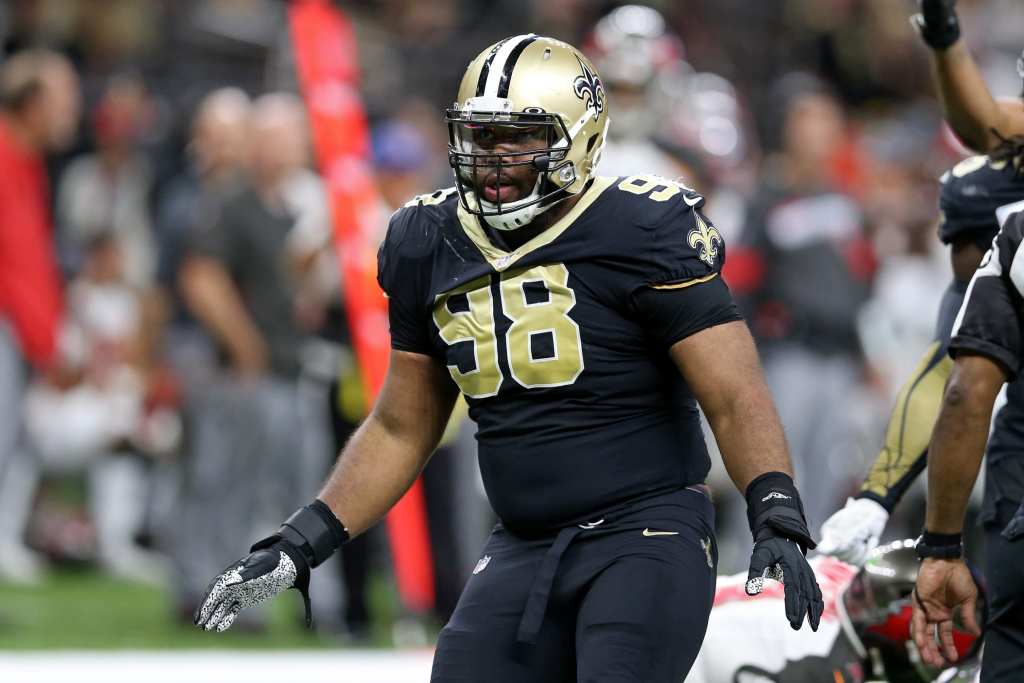
Oct 6, 2019; New Orleans, LA, USA; New Orleans Saints defensive tackle Sheldon Rankins (98) celebrates after a sack of Tampa Bay Buccaneers quarterback Jameis Winston (not pictured) in the second half at the Mercedes-Benz Superdome. Mandatory Credit: Chuck Cook-USA TODAY Sports

How It’s Going

The arrival of new head coach Robert Saleh has many projecting that the Jets will switch to a 4-3 setup, which will rely on a strong, rotating edge rush. Their defensive line additions saw them address that area, home to a long-gestating renovation project that hasn’t seen a consistently disruptive backfield invader since John Abraham’s departure.

When Saleh called tackle Sheldon Rankins about joining the cause, the former New Orleans Saint was all in.

“When he called me and expressed his interest and how much he really wanted me to be a part of this and the vision he had for me and Quinnen inside and Carl (Lawson) out on the edge, it got me fired up,” Rankins said, per Brian Costello of the New York Post. “It made me want to be a part of something special.”

One of the first moves the Jets made this offseason, from a roster perspective, was releasing DE Henry Anderson, who had failed to live up to the hype of a $25 million contract. Afforded an additional $8 million through Anderson’s release, the Jets surrounded their young core with veterans that should only up their pressure.

Casual observers dismissed the addition of defensive end Carl Lawson ($45 million over three years after four seasons in Cincinnati) by complaining about his pedestrian sack numbers (11.5 in the last three years after eight in his debut campaign). But Lawson has been one of the league’s most prevalent pressure artists in recent memory, his dominance on display through advanced stats. Even if Lawson wasn’t the one taking the quarterback down, played a major role in the thrower’s eventual demise. Lawson was one of only 11 defenders who reached double figures in ESPN’s “sacks created” category and, in a more conventional area, ranked sixth in QB pressures.

In addition to Rankins, the Jets also welcomed Saleh’s former San Francisco disciple Ronald Blair into the fold before using their final draft pick on DT Jonathan Marshall from Arkansas. Vinny Curry, who previously appeared on Philadelphia’s championship squad, can provide depth and veteran leadership.

carl lawson, new york jets

Are They Better Off?

The Jets need to plan for a future where they’re almost guaranteed to face Josh Allen (and possibly Tua Tagovailoa) twice a year until further notice. A strong pass rush is going to be vital if they want to pull themselves out of the playoff drought mire.

General manager Joe Douglas deserves some props for his activities on the defensive front this offseason. Few could’ve blamed the Jets for becoming complacent after the breakouts of Williams, Fatukasi, and Franklin-Myers. Instead, they upped the pressure by surrounding a defensive coach with elite defensive talents that will help foster in this latest…and most hopeful…chapter of the Jets perpetual rebuild. Lawson’s contract, for example, may be steep from a financial sense, as he’s the Jets’ biggest 2021 cap hit at over $14 million. But if he follows the promises of pressure on display over the last few seasons with the Bengals, the three-year deal could wind being one of the most consequential moves in Douglas’ tenure in both a short and long-term lens.

The green glory days have been characterized by strong defensive efforts. With the frontline additions, the Jets have set themselves up handsomely for what’s sure to be a dangerous, yet ambitious, road ahead.

Final Offseason Grade: B+

Are you more confident in the Jets’ defensive line with Robert Saleh in tow? Continue the conversation Twitter @GeoffJMags

Should the New York Jets look into WR N’Keal Harry?

n'keal harry, jets, patriots

Would the embattled first-round pick from New England fit into the New York Jets’ receiver evolution? ESM investigates.

Could an enemy of the New York Jets’ greatest enemy become their friend?

Wide receiver N’Keal Harry entered the NFL with a fair amount of hype as a 2019 first-round pick (32nd overall) of the New England Patriots. Fresh off three dominant seasons at Arizona State, the 6-foot-4 Harry was set to pick up where the (temporarily) retired Rob Gronkowski left off, serving as a big downfield target for Tom Brady. Alas, injuries ate away at his rookie season and he struggled to find a role in the post-Brady era.

Through two seasons, Harry has tallied 414 yards on 45 receptions, the latter tally being worst amongst first-round skill players. Those are tough numbers for the final pick of the 2019 first round, chosen before second-round standouts like A.J. Brown and D.K. Metcalf.

It appears that Harry is looking to hit the reset button before his third season gets underway. His agent Jamal Tooson released a statement detailing their desires for a trade.

“Through two seasons, he has 86 targets, which obviously hasn’t met the expectations the Patriots and N’Keal had when they drafted a dominant downfield threat who was virtually unstoppable at the point of attack in college,” Tooson’s statement, released on Tuesday, reads in part, per ESPN. “Following numerous conversations with the Patriots, I believe it’s time for a fresh start and best for both parties if N’Keal moves on before the start of training camp. That is why I have informed the Patriots today I am formally requesting a trade on behalf of my client.”

With Harry on the block, should the New York Jets inquire? ESM investigates…

The Case For Harry

What Harry could use right now is a stable situation where there’s relatively little to lose.

A change of scenery to such a locale helped fellow first-round receiver Sammy Watkins (Buffalo, 2014) reclaim the narrative on his NFL career. Watkins was in a bit of a different situation, as injuries derailed his career in Orchard Park. After a tough third season marred by injury, Watkins was shipped to the Los Angeles Rams and later caught on with the Kansas City Chiefs. Through those destinations, Watkins rediscovered his spark as a supporting piece on a contender. By the 2019-20 postseason, he was a vital contributor to a Super Bowl run. He recently earned himself a new contract in Baltimore (one-year, $6 million)

Alas for fans of green New York football, their “nothing to lose” situation stems from no one expecting anything out of them as they prepare to write the next chapter of their rebuild anthology. But they provide what Harry appears to be looking for: opportunities and relative peace.

The Jets’ offensive revolution this offseason yielded receiving building blocks of both the rookie (Elijah Moore) and veteran (Corey Davis, Keelan Cole) variety. While, on paper, Zach Wilson has a better arsenal to work with than anything granted to Sam Darnold, there is no clear-cut No. 1 receiver in this group yet. Adding Harry, a receiver with something to prove, could intensify an already-firey and potentially high-octane receiver situation in New York.

Additionally, the Jets have some day three draft pieces to work around if they were to inquire about Harry. A deal for the receiver likely wouldn’t cost, say, the 2022 second-rounder gleaned from the Darnold deal with Carolina. The Jets currently own three picks in the next spring’s sixth round, the extra pair stemming from trades of Steve McLendon (from Tampa Bay) and Jordan Willis (San Francisco).

The Case Against Harry

An arsenal of receivers with something to prove sounds delightful in a relative gap year. No one expects the Jets to do much in 2021, but the year can serve as an explosive coming attraction for what’s on the horizon for the Wilson/Robert Saleh era. Davis, Moore, Cole, as well as returnees Jamison Crowder and Denzel Mims, have a chance to prove their mettle as top targets.

At what point, however, does one have too much of a good, yet uncertain, thing?

The Jets did a solid job of avoiding co-authorship on redemption stories this offseason. Attempting to ghostwrite such a tome was one (of many) reasons the Le’Veon Bell gambit didn’t work out. Sure, they brought in some potential comeback stories…such as former San Francisco rusher Tevin Coleman…but those are ones they can not only afford (Coleman’s deal is a $2 million single season) but can stage with relatively little fanfare.

The Jets have enough things to worry about as they get to work in trying to snap a playoff drought that’s by far the longest in pro football. Adding a rare Bill Belichick washout just adds unwanted attention to what they’re trying to build.

The Verdict

Trades between the Jets and Patriots are rare, but there is precedent…the recently retired Demaryius Thomas began the final stages of his NFL journey through a 2019 deal and the teams swapped picks during the 2020 proceedings. Those picks have thus far netted James Morgan, Cameron Clark, and current rookie Hamsah Nasirildeen.

That alone should probably scare the Jets off in terms of bartering with New England. But even if you’re not superstitious, the Jets’ receiver room is fine as it is. Sure, if Harry emerged as a superstar in New York…succeeding where the almighty Belichick failed…it’d be fun to leave that lingering over the heads of Patriots fans. But, unlike Jerry Seinfeld, the Jets aren’t in any position to make moves out of spite.

If the Jets were in a further position of need when it came to receiver…i.e. the early stage of last season when Braxton Berrios and Jeff Smith were their top targets…it would’ve been understandable for them to rise to the occasion and send a pick or two over before Harry potentially hit the free agent market after final training camp cuts. But, frankly, Harry isn’t the Patriot they should have their eyes on. If anything, the team would be better served to try and land one of the New England backups (preferably Brian Hoyer) to serve as Wilson’s understudy and/or mentor.

Harry should find some takers, but it doesn’t make sense for the Jets to expedite the process right now.

Verdict: Pass

Should the Jets keep an eye on Harry? Continue the conversation on Twitter @GeoffJMags