New York Yankees: Why Trading Gio Urshela May be the Smarter Play

New York Yankees, Gio Urshela

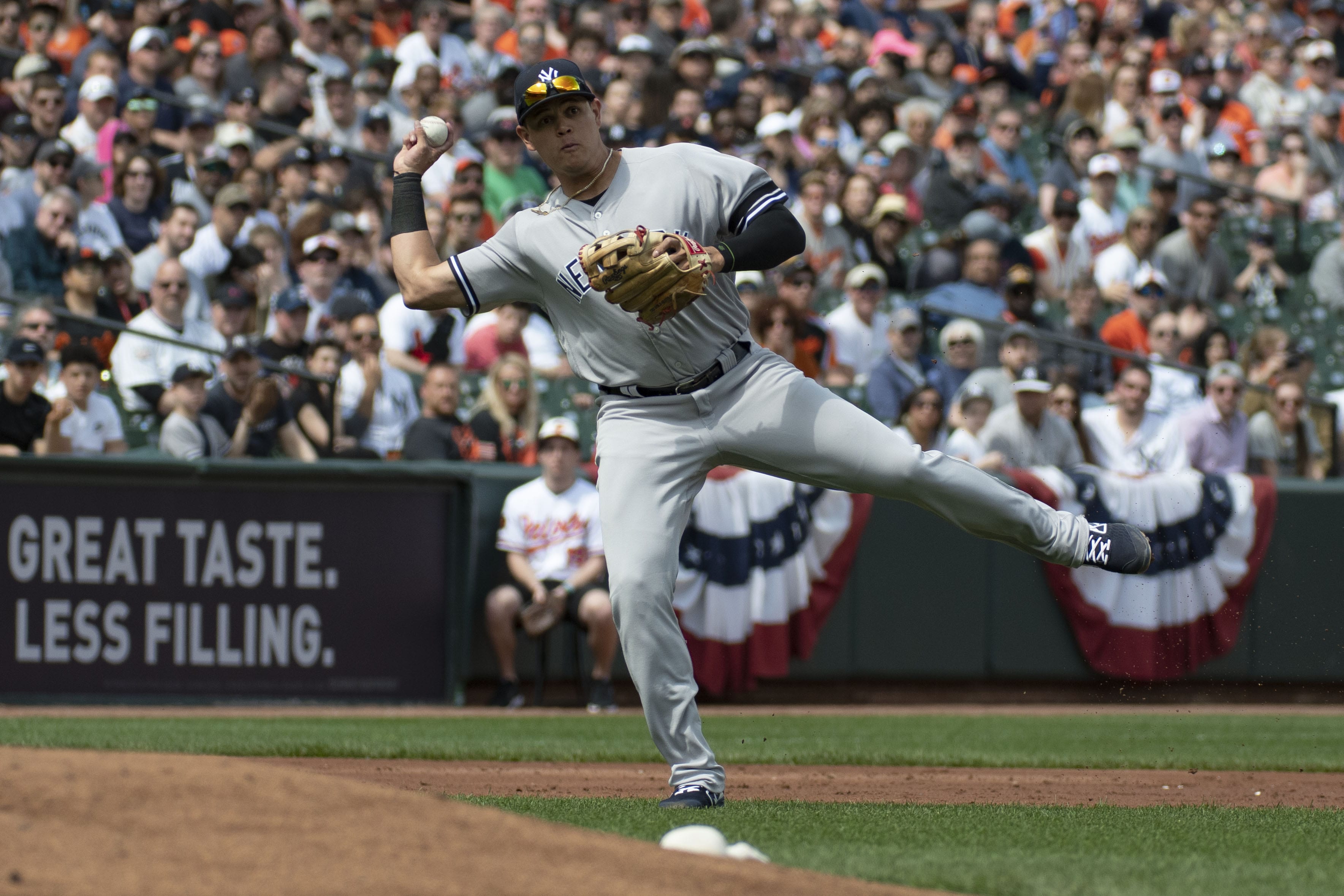
Recently, ESM writer Nathan Solomon asked on our site if the Yankees should trade Gio Urshela. Now, you know I’ve made the argument the New York Yankees ought to make room in the lineup for both players. And there seems to be far more interest for Andujar on the market than Urshela. But after reading the article, here’s why Nate’s onto something.

Baseball is What Have You Done For Me Lately

Think about how Andujar got his start in 2018. Brandon Drury was acquired to be our third baseman. But he had health problems forcing him to start the season on the IL. Andujar was called up. By the time Drury got well enough to play, Andujar had taken his job.

Fast forward almost 2 years. Gio has now usurped Andujar as the opening day third baseman with Cashman arguing “It’s Gio’s to lose”. And who could blame him? Urshela put up a great 2019 season, despite my noticing his deficiencies in the field.

Why Gio’s Trade Value is at its Highest Now

Look at Justin Verlander before getting traded to Houston, and after getting traded to Houston. He’s, basically peaks Justin Verlander, a la 2009-2012. It’s no wonder the Astros gave him a 2-year extension at 36 years old.

Urshela has played no more than 81 games in a season since coming up in 2015. He was a defensive whiz kid, but an offensive liability. Now, in his first full season as a pro, his defense can bounce back from double-digit errors he was charged with and has an opportunity to prove his 2019 was no fluke offensively.

What plays to Andujar’s disadvantage on the trade market is he is coming off of having his labrum in his shoulder surgically repaired. Last Yankee to do that, after putting up a good showing in his debut in the majors, was the recently DFAed Greg Bird.

Should They Trade Either Now?

No. It’s basically those two for your depth at third. But, if the right offer comes for one or the other, and the trade drastically improves the deficiencies the New York Yankees have in their rotation, shortstop, or center field… they need to jump at it. Either way, I don’t see both men being on the team come October 2020. One will be traded, I’m certain enough to place an uncomfortable about of money on it.

A Ten Part Breakdown of the Yankees Depth. Part 5: Shortstop

The New York Yankees created a depth crisis for themselves at shortstop in not offering Didi Gregorius a contract. The only position that’s in more dire need of attention is our starting pitching.

Just how bad is it?

In my last breakdown of the Yankees depth, I talked about how much of a mistake it would be to move Gleyber Torres over to shortstop. He’s far and away from a better second baseman than shortstop on a professional level. And you can’t move DJ over there because he only has a handful of innings playing the position as a pro, and they never hit him the ball in those innings.

That leaves career benchwarmer/utility man Tyler Wade and rookie utility man Thairo Estrada. For the Yankees to turn to one of them as their everyday shortstop in 2020 is ludicrous. It’s not out of the question that this could happen down the line, but most definitely not for 2020.

What about the minors?

The highest prospect we have at the position is Anthony Volpe, who we drafted this year. He’s expected to be major league ready by 2023 at the earliest. It could be longer as Volpe is only 18, and may be putting off playing to get his degree. Volpe is our 10th best prospect.

The next best prospect is Josh Smith, who’s currently at the short season single A level Staten Island Yankees. He’s projected to join the show in 2022. He’s 18 on the Yankees prospect list.

Then there is Oswald Peraza, who’s playing for the A affiliate Charleston River Dogs. He’s also projected to be MLB ready by 2022 and is 28th on the list.

So… no matter what… we have to bridge the gap to AT LEAST 2022 before a homegrown shortstop is ready?! And this is at the earliest.

The Choice is Clear

Resign Didi to a 3 year, $36 million contract. That’s $12 million a year, ensuring those kids only come up when they’re ready. And that’s $5 million less than what they’d pay him on the qualifying offer.

Mike Moustakas Signs With A Team, And It’s Not The New York Yankees

The New York Yankees were a dark horse landing spot for infielder Mike Moustakas, however he signed with the Cincinnati Reds before the Yankees could do anything. The Reds inked him to a four year, $64 million deal.

If the Yankees signed him, they would likely of wanted him to play first base and an occasional second base. He’s sort of a DJ LeMahieu type player with more power and less speed.

Moustakas played with the Brewers last season and was the second overall pick in the 2007 amatuer draft to the Royals. He hit .254 with 35 home runs and 87 RBIs in 2019.

The lefty power hitter is going to a Reds team that’s attempting a major turnaround. A few years ago, they were at the bottom of the NL Central but now look like possible contenders in said division.

Yankees shortstop Didi Gregorius is also a free agent, and there’s a chance that he could return to Cincinnati, the organization that drafted him. Moustakas will play second for the Reds, meaning that him and Didi would be the double play combo if Gregorius decides to sign there.

Over the last week or so, the free agent activity has heated up a bit and Moustakas is the first big name to come off the board. The Yankees have stayed quiet in the first month of the offseason, but there are still plenty of rumors swirling around the team.

The three big names in Strasburg, Cole, and Rendon are still on the board, and they may remain on the board for a while. However, you should expect the Yankees to go after a middle reliever or a utility man relatively soon.

A Successful 2020 Yankees Lineup Must Include Urshela and Andujar

New York Yankees, Miguel Andujar

Much is being made of the New York Yankees needing help to bolster their starting rotation. And it’s all merited. Our starting rotation, as it stands, going into 2020 is Masahiro Tanka (coming off of one of his worst regular seasons in professional American baseball), James Paxton, Luis Severino (after missing all but a handful of starts in September and a few playoff starts), JA Happ (after an absolutely dreadful season), and Jordan Montgomery (who has pitched a combined 31.1 innings since 2018). This is a rotation that needs help. We can’t ride our bullpen like we’ve been doing the last few years, because they’ll get exhausted by October, and we’ll have another year of missing the World Series. To put it in perspective, Chapman, Green, Ottavino, Britton, and Kahnle threw for 312 innings combined in 2019. Tanaka and Paxton threw for 332.2 innings combined.

Our offense needs to improve as well. We were one of the most feared lineups in baseball in 2019. But we struck out over 1,400 times in the regular season and striking out over 90 times throughout the postseason. Strikeouts are a liability that plague every team, and if we didn’t strike out as much as we did against Houston, it would have been us playing Washington in the World Series.

Our Murderers Row is Our Greatest Strength AND Weakness

Aaron Judge, Giancarlo Stanton, Gary Sanchez, Gleyber Torres, Luke Voit, these are guys with power that can take you deep in an instant. But good lord are they strikeout prone. Using Stanton’s strikeout totals from 2018 (the dude did miss practically all of 2019 after all) and add it up to the other 4’s strikeout totals from this year, you have 748 strikeouts throughout a given season. Edwin Encarnacion, who struck out 103 times during the regular season, struck out an appalling 13 times in October. The strikeouts have to come down, across the board if we want meaningful games played deep into October.

Why You Have to Include Andujar and Urshela in the 2020 Lineup

Gio Urshela has a lot to prove in 2020, namely that 2019 wasn’t a fluke year offensively. He also needs to show he can bounce back from playing a full season as, up till last year, he was a career backup third baseman/bench player. But he struck out 87 times last year, which was 3 fewer times than our offensive stalwart DJ LeMahieu.

Miguel Andujar has quite a bit riding on him too. It’s not easy coming back from surgically repairing a torn labrum after having a breakout first season performance as he did. The last Yankee in recent memory who did this was Greg Bird (remember his 2015 and how he never was the same again?). But there is far less riding on his shoulders as the main two things he has to prove are 1) That he’s healthy, and 2) That his defense improved since 2018.

I’ve used the comparison metric for these two men of “the first full season they played”, but I’ll expand to their full careers. Andujar has struck out 108 times in his career (97 times in 2018), with a career .318 OBP and a .819 OPS.  Gio Urshela has struck out 177 times in his career, with a career .313 OBP and a .735 (.889 in 2019) OPS. Gleyber Torres has a .338/.849 OBP/OPS, but has struck out over 200 times in his career. Aaron Judge is .394/.952 but has struck out over 500 times in his 4-year career.

This shows that Urshela and Andujar are capable of getting on base, SLUGGING their ways on base (on par with what Gleyber Torres can do) but are far less likely to strikeout in the key at-bat of the game. Torres and Judge are more adept at getting on base and slugging their ways on, but we’ve seen how strikeout happy they are.

The answer is clear. Both guys have to be in the lineup if you want to offset the K machine that is the New York Yankees Murderer’s Row. Otherwise, you’re in for another disappointing finish to a great season.

A 10 Part Breakdown of the Yankees Depth. Part 3: First Base

The New York Yankees have had a hard time finding a steady, everyday first baseman since Mark Teixeira. Allow me to rephrase that. The Yankees have had a hard time finding a steady, everyday first baseman since year 4 of Tex’s Yankees contract.

We’ve had some flash in the pan first basemen come and go since the 2012 season. But now we need to buckle down. First is one of those power positions where you’re meant to have an offensive force. And that’s why the Yankees front office is scrambling right now. But we also shouldn’t settle for a power-hitting first baseman who can’t field his position. It’s the third most thrown to a position in the infield behind pitcher and catcher.

Just How Bad Have the Yankees First Basemen Been?

Here’s a list of some previous Yankees we’ve depended on at first since the 2012 season:

Mark Teixeira, Chris Carter, Ji-man Choi, Larry Walker, Kelly Johnson, Chase Headly, Tyler Austin, Mark Reynolds, Neil Walker, Greg Bird, Mike Ford, DJ LeMahieu, and Luke Voit. That’s 13 men at one position in the span of 7 years. And at this rate, DJ, Luke Voit, and Mike Ford are going to be the only 3 on the active roster for 2020.

So How Bad Is It for 2020?

Officially, not as bad as I’m painting the picture as.

We got Voit, Ford, and DJ as our official first basemen for 2020. This is a good core of potential first basemen.

Let’s Talk About Defense

You need a rock-solid defensive first baseman. Period. That’s the busiest position in baseball short of the pitchers’ mound and catcher. The obvious nod right now, for many, is probably going to DJ LeMahieu. He was our starting first baseman for the playoffs, after all.

But did you see that error he committed in the ALDS against the Twins?

Look, he’s won a Gold Glove at 2nd. He’s won multiple Gold Gloves at 2nd. But he’s decidedly a second baseman by trade, with the next most reps he has is at third (watch out Miggy and Gio). He simply doesn’t have that impressive of a body of work at first base. The most games he played at 1st prior to last year was 4. You read that right. 4 career games at 1st base prior to the 2019 campaign.

To put it into perspective, Luke Voit has the EXACT SAME fielding percentage DJ LeMahiue has for his career at second base. There is something to be said about having someone play a position regularly. By this logic, Voit and Mike Ford are the CLEAR and present front runners for 1st base in 2020. And the edge needs to go to Voit, as Voit has better career defensive statistics than Mike Ford (at no fault to Ford. One can expect that of a career minor leaguer).

But What About Offense?

It depends entirely upon what you’re looking for at the position. DJ is a pure contact hitter. He has a career .302 batting average, averaging 150 hits per season since 2014. Last year was the best offensive statistical year he had (hitting over 20 home runs and driving in over 100 runs for the first time in his career). Meanwhile, in an injury-shortened season, Luke Voit hit .263, with 21 home runs, 62 rbi’s, 21 doubles, scored 72 times on 113 hits. Not bad for someone who hasn’t played a full season in the bigs yet.

Mike Ford, in 143 at-bats, hit 12 home runs, with a .259/.350/.559 slash line. He’s in a position to be the optimum prototypical first baseman offensively for 2020, a .260-.280 batting average, with 20+ home runs, and closer to 100 RBI’s. But… the same can be said for Luke Voit.

So who should get the nod?

Luke Voit has to be our starting first baseman for the 2020 campaign. He’s got more experience at the position and is built like a brick wall. In my brief time playing first in little league baseball, that’s your job as a first baseman, keep everything in front of you. And having a brick wall/NFL linebacker at first base makes it easier for you to keep all the throws in the infield. Mike Ford needs to be the backup first baseman. By the end of 2020 or 2021, Ford will be in a better position to take over more regularly at first base should the Yankees part ways with Voit. And that’s a good thing. The DJ LeMahieu experiment at first base was worthwhile but ultimately futile. His services are better suited to other positions on the team. And it’s clear that the Yankees want to move DJ over to second on a more permanent basis. Which is a mistake?

But more on that next time.

The Yankees have a $34 million dollar question, and his name is JA Happ

New York Yankees, J.A. Happ

JA Happ was an enigma for the New York Yankees this season. By and large, the 2020 season for Happ was an exercise in mediocrity. 34 home runs, over 161.1 innings pitched, 140 strikeouts, and an ERA of 4.91. Sure, he “figured it out” down the stretch, but it shouldn’t be a surprise to anyone that he was demoted to bullpen work in the playoffs.

But, the Yankees have a question that needs answering. The starting rotation is in shambles. You have Tanaka, Severino, and Paxton as your obvious front 3 based off last season. Sabathia retired, and no one is sure about Domingo German. Paxton is still under contract for the next 2 seasons, with a guaranteed option kicking in for 2021 if he makes 27 starts and pitches 165 innings. So what do you do with Happ? (mlb.com)

Do you start him?

The New York Yankees need to sign one, if not two, front line pitchers. During a free agency with Cole, Strasburg, Bumgartner, and Ryu on the market, you have to sign one of them. Yes, you can’t have 5 pitchers with all-star seasons, but could you imagine 4 straight starts with Severino, Paxton, Tanaka and one of those 4 I listed in a row? How can you NOT salivate?

The problem in retaining Happ is that a bad season this late in his career will ultimately lead to more bad seasons. The guy is 39 years old, scheduled to pitch till he’s 41, He’s averaged a 14-10 record over the length of his career with an ERA just under 4.00. And if the Domingo German situation resolves in such a way that he comes back to start, German is UNQUESTIONABLY the 5th guy on the totem pole. He had 153 strikeouts, 39 walks, gave up 69 runs on 125 hits over 143 innings. Oh, yea, and an 18-4 record. He’s a number 3 or number 4 starter. Happ is truly expendable, but who will take him for $34 million?

Trade options.

Mike Fires is probably one of the better trade options the Yankees could get. Should the A’s agree to pick up most of the rest of Happ’s contract, Fires is owed a meager $8.1 million for 2020. That’ll be the end of his contract. He’ll be 35 years old, and has been averaging a 14-6 record, 175 innings pitched, a 3.75 ERA, 130 K’s, and 40 walks over the last two seasons. He’s also averaging about 30 home runs a season over that span, but Happ also gave up 35 home runs over last year. So… you’re upgrading with Fires, as well as saving about half of what you’d pay Happ next year.

It’s unquestionable that Happ is the odd man out in the Yankees rotation next season. Trading him makes the most sense. If we don’t nab one of the big-name free agents, we can package Happ for the young prospective pitcher, by packaging Happ with someone like Nestor Cortes Jr., Luis Cesa, or even Jordan Montgomery. Other trade options exist, but Fires is the one I think makes the most sense.

This was just another prime example of the Yankees paying lip service. “Oh, we want to stay under the luxury tax, but we’re going to field a championships quality team.” You don’t field a championships caliber team by giving $50 million dollars to a 38-year-old with a career ERA of 3.99, a 121-90 record, and averaging 3.2 K’s per 9 innings.

Should the New York Mets trade JD Davis?

New York Mets, J.D. Davis

JD Davis had a breakout 2019 season offensively, but his poor defense might make him the perfect trade chip for the New York Mets.

JD Davis was the one big success story for the Mets 2018 offseason. He was the lone great acquisition that GM Brodie Van Wagenen made. Yet, his position on the team isn’t secure.

For all his offensive capabilities Davis is an awful defender. He was worth -16 DRS across both third base and left field in 2019. For a Mets team that was 31st in baseball in DRS, and had the second-worst DRS of any team over .500 since the stat has been recorded, he doesn’t fit long term.

There just doesn’t seem to be a spot for Davis to play for the Mets in 2020. He’s too good to be a bench bat, but his defense is too much of a liability for him to play every day. That makes him an ideal trade chip.

Unlike the Mets, many teams around MLB can hide a poor defender. In the AL he would fit perfectly as a DH. Not to mention that his value is at an all-time high coming off his 2019 season.

First, JD Davis is likely not a starter on the 2020 Mets. Brodie Van Wagenen has been adamant about playing Jeff McNeil at third base and has made it clear the Mets plan to upgrade at center field this year.

If that’s the case Davis would be a bench bat for the majority of the season sitting behind McNeil, Brandon Nimmo, and Michael Conforto. So, instead of letting a valuable resource like Davis sit on the bench wouldn’t it make more sense to trade him in an effort to get the best possible replacement for Zack Wheeler or the best upgrade in center field.

For example, centering a trade for Starling Marte around JD Davis would immediately improve the Mets defense and still give them a top-end bat at the position.

Maybe the Mets prefer to target a starting pitcher and trade JD Davis for a pitcher like Matthew Boyd to replace Zack Wheeler.

These are moves that can only happen because JD Davis’ value is at an all-time high. It opens up so many more avenues to make the team better as a whole.

Would it suck to lose a young cost-controlled player like Davis, absolutely. However, when a team is cash strapped as the Mets are sometimes you have to sacrifice to gain.

How the New Rules Will Impact the 2020 New York Yankees

New York Yankees, Gleyber Torres

The New York Yankees have been dead set in forming a team in a particular way. Backload the bullpen and keep minimal bench players. However, the new rules MLB will be implementing for 2020 will drastically affect the Yankees.

For starters, relief pitchers will now be required to face a minimum of 3 batters per appearance. Gone are the days of the lefty/righty specialist that… let’s face it, those guys were a waste of roster space. If you can’t get righty’s out as a pitcher, get your butt back to the minors. This will help strengthen our bullpen so that we only have the BEST pitchers on the roster.

However, the number of pitchers we can have on the roster will be capped. We have had more pitchers in the bullpen than position players in the last 5 years. Now, once the league and players association agree to terms, we will see more position players on the roster than pitchers. Which, after seeing the number of position players we saw on the IL last season… dear God, we need more position players on the active roster. This will result in several tough decisions on who we should keep, and who we’ll have to cut.

The rosters will also expand to 26 players during the regular season, expanding to 27 for doubleheaders. For September, we’ll see only 28 players on the roster.

Who wants to see the end of the 40 man rosters in September, right at the start of the playoff push? Look at the utter collapse we had this September, right at the time when we had to make a concerted push for the best record in baseball! Do you want to live through THAT again?!

So, we’ll have to strengthen our already strong bullpen by making sure we have pitchers who are capable of going MINIMUM one full inning every time. We’ll have to also ensure that the bullpen is ONLY comprised of our strongest pitchers when we cap the number of pitchers we can have on the roster. We’ll also have more room in the dugout for position players by seeing 26 men on the roster throughout the entire season. We’ll also have to make any trade deadline decisions by the summer trade deadline. That’s it! No more waiver trades toward the start of the fall.

I may be cheerfully optimistic, but these are all decisions we needed last year. Look at it this way, we will have more room to ensure Miguel Andujar, Mike Ford, and Clint Frazier are all on the roster as a bare minimum! No more juggling who can stay up or who spends time in the minors. This will reduce the probability we’ll lose someone due to them running out of options, which would result in us likely having to give up a guy like Frazier, Tauchman, or Higashioka.

Bring on the changes. The Yankees need them.

The Washington Nationals Jump Out To 2-0 World Series Lead

Could the New York Yankees pursue Max Scherzer in a trade?

The Washington Nationals have taken a 2-0 series lead over the Houston Astros after dominating them 12-3 in game two on Wednesday night. They won game one on Tuesday by a score of 5-4. The most impressive part of their 2-0 series lead is the fact that both games were won on the road against the Astros two best pitchers.

The Nats scored five off of Gerrit Cole in game one, getting some very timely hitting unlike what the New York Yankees did in the ALCS. They tagged four off of Justin Verlander in game two before getting three off of Ryan Pressley.

Anthony Rendon hit a two-run double in the first inning before Alex Bregman responded with a two-run homerun. It stayed tied at two until the seventh when the Nationals put up a six-spot thanks to a solo-shot off the bat of Kurt Suzuki and three weakly hit singles. They put up three more in the eighth and one more in the ninth.

Now, the series shifts back to Washington for the next three games. Anibal Sanchez gets the ball on Friday against Zack Greinke, and Patrick Corbin will get the ball on Saturday as the Astros will go with a bullpen game.

The real question is, what happened to the Astros? They’ve played awful in the World Series. The best part of their team, their starting pitching, has failed them and now their backs are against the wall.

Friday is absolutely a must win game for Houston. Losing on Friday puts them down 3-0, forcing them to win their next four for another title. To have a shot, they ideally need to sweep in D.C., but may be able to make two of three on the road work.

If they want a shot, the Astros need to figure a lot out fast.

New York Mets: The Season Finale

New York Mets, Noah Syndergaard

As the New York Mets went into the All-Star break, fans were fed up and sick of watching this underachieving team. At the end of the season, everyone is starving for more and cannot wait for 2020 to finally arrive. Most of those feelings is due to the Mets ending their season on a high note with a walk-off win to cap off a sweep of the Atlanta Braves.

Dom Smith was one of the biggest reasons why this Mets team had so much heart. He supported his first base competitor, Pete Alonso, all season and pumped up the crowd while he was injured. Unfortunately, he has spent the last two months on the shelf. So it was safe to say he was pumped up for his first at bat since July.

Smith jumped all over Grant Dayton’s fastball to launch a three-run walk off home run to end the Mets season in jubilation. The home run was a symbol of how resilient the Mets were all year. When their bullpen put them behind, their offense did whatever they could to back them up.

Syndergaard’s Finds His Groove

Through his catcher drama and his poor performances, the last four starts were unlike the Syndergaard we saw in the second half. He figured things out with Tomas Nido as he threw seven innings, allowing three runs and striking out nine. His ERA finished at 4.28 and it will be interesting to see what the Mets decide to do with him in the offseason.

The Mets just missed out on the playoffs but played amazing baseball during the second half. They went 46-26 and could have easily won 50 games if a couple rough games went their way. Despite missing the playoffs, they give plenty of reasons to think a postseason run is in them next season. Before they get to 2020, they will have to patch a bunch of holes and find answers to a lot of questions.

The talent is up and down this roster, but it is just a matter of if they can put it all together for an extended period of time.