Returning New York Jets receivers in an interesting spot

The makeover on the New York Jets’ receiving depth chart has left some of their incumbents in a slightly compromising position.


The New York Jets’ offseason renovations to their wide receiver depth chart were so transformative and aesthetically pleasing, the powers that be at HGTV probably took notice.

This time last year, the Jets’ more optimistic hopes at receiver included a first-round washout seeking to extend his career (Breshad Perriman) and an artifact from the New England antique shop that’s now playing lacrosse (Chris Hogan). That island of misfit toys didn’t even have the benefit of a minicamp or preseason to build chemistry and the absence was quite apparent once the season began.

Jets management spent the ensuing offseason restocking the arsenal in preparation for a new franchise quarterback’s arrival. Through their offensive splurging, New York has created a group that has the aura of a happy medium: not quite reminiscent of the Don Maynard/George Sauer days but certainly an upgrade over last season. Former Tennessee Titan Corey Davis is projected to be the top catcher while first-round talent Elijah Moore fell into the Jets’ lap in the early stages of round two last April. Davis’ fellow AFC South transfer Keelan Cole is likewise hopping on board.

While there’s no “established” No. 1 receiver in this group…though one could argue Davis is fairly close…the group is stacked with potential and is part of by far the most potent offensive attack they’ve had in recent memory.

The hype of the newcomers has cast a slight pall on the rest of the depth chart: what happens to the leftovers of the Adam Gase era?

As the Jets carry on with minicamp practices in Florham Park, six receivers linger from the 2020 season. The status of two may be well accounted for: Crowder has one more year on his (renegotiated) contract and the Jets have some decent hopes for 2020 second-round choice Denzel Mims, who gets another de facto rookie year after working through injuries in the last.

The outliers are all Joe Douglas signings that are now facing an uphill battle to make the roster of a team that might have some expectations attached to it. Last season’s calamities didn’t exactly give them a chance to showcase their talents. Mismanagement from a beleaguered coaching staff in over its head and injuries/medical protocols didn’t exactly give them a chance to make a case to stay for the potential glory days ahead. This week’s minicamp and the rest of the summer schedule will provide fateful opportunities to extend their NFL careers.

At the forefront of the list are Braxton Berrios and Vyncint Smith, the most experienced catchers amongst the retained. Berrios was the only listed receiver who partook in all 16 games last season, setting career-bests with 394 yards on 37 receptions. The former Patriot also served as the Jets’ primary return man, sharing kickoff duties with in-season acquisition Corey Ballentine.

While the Florham Park focus during minicamp and organized team activities have centered on newcomers like Moore and Zach Wilson, Berrios managed to stand out during the proceedings, developing an early rapport with Wilson. The Miami alum even managed to go somewhat viral when raced off to a touchdown to the tune of a farewell head nod to cornerback Jason Pinnock.

“Brax is smart guy, I think that’s one of his best attributes,” Wilson said of Berrios, per DJ Bien-Aime of the New York Daily News. “He’s a slippery player he gets in there he runs some great routes.”

Berrios has become a bit of the prototypical journeyman receiver, one that shined a team that had nothing to lose. In the midst of the Jets’ woebegone 2020, Berrios established himself as a reliable option on the screen and on the jet sweep (29 yards on a trio of rushing attempts, building on a dual-threat potential originally showcased with the Hurricanes). He also handled the primary slot duties when the top weapon, Crowder, was medically sidelined.

Back in January, before the Jets loaded up on receiving help, Berrios explained to team reporter Ethan Greenberg his ambitious desire to become a “Swiss Army Knife” in the ongoing attempt to keep his New York career rolling.

“At the end of the day, my role is to flourish wherever I’m playing,” Berrios said. “I took over in that slot position and tried to do what I could to put our team in the best position to win. When he came back, obviously that was diminished because he’s the starting slot receiver. That took reps off my count, but I tried to get in where I fit in. I would do anything. I started coming out of the backfield a lot more.”

Berrios has also held down the special teams fort as the Jets try to get over the loss of Pro Bowler Andre Roberts. In 2019, he was one of two returners to average over 10 yards on punts (the other being Diontae Johnson in Pittsburgh).

Elsewhere on the Jets’ depth chart is the case of Smith, another relatively long-tenured Jet as he enters his third year with the team. The former Houston Texan was one of the earliest signings of the offseason, rejoining on a new contract back in March. Injury issues limited to seven games and prevented him from building on career-best numbers from 2019 (225 yards on 17 receptions and a 19-yard rushing touchdown).

Smith’s misfortune opened up the opportunity for Berrios but the quick reunion (one year, $1 million contract) shows that the Jets were at least impressed enough to give him a chance to earn his roster spot back. He got off to a tough start in minicamp (a dropped ball led to a Wilson interception, per Connor Hughes of The Athletic) but later recovered with a deep diving grab from James Morgan.

The rest of the returnees are a group of speedy, unique talents who will be interesting to view through a new regime and aided with the benefit of three summer exhibitions this time around. Former college quarterback Jeff Smith earned a solid look last season with 167 receptions on 17 receptions. The prior coaching staff had high hopes for undrafted free agent Lawrence Cager, a touchdown specialist and Berrios’ fellow former Hurricane who was denied a true opportunity due to injuries, a trend that unfortunately continued during OTAs. Other comebackers include Josh Malone and DJ Montgomery.

Temptation is there to eliminate any past reminder of the past two seasons, campaigns that yielded a combined nine wins and untold amounts of offensive horror. But diamonds in the roughest of football roughs could help the Jets navigate this new terrain and help get the tenure of a new guard rife with offensive hope off to a good start.

Geoff Magliocchetti is on Twitter @GeoffJMags

The New York Jets can’t ignore the (backup) quarterback problem much longer

Robert Saleh doesn’t seem too worried about it, but the New York Jets’ backup quarterback situation creates an eerie offensive aura.

Rejoice, New York and New Jersey, for it’s officially summer in the metropolitan area.

Don’t turn your calendar to June 21 just yet. It’s perfectly fine if you haven’t run to the ice cream truck for a Choco Taco. Summer in the city is often welcomed not by the beach, blockbusters, and burgers…but rather a New York Jets quarterback controversy.

Now, rest assured, Jets fans, you who have been granted legitimate hope in the form of Zach Wilson. The second overall pick of April’s draft is the latest (and, the Jets certainly hope, last for a while) name chosen to lead Gang Green into the 21st century. Time will tell if he lives up to his status as the long-awaited passing prophet absent since Joe Namath hung up his helmet adorned with a green oval, but there’s no doubt that he is the man the Jets envision starting in three, five, ten years from now.

This time around, however, the problem lies behind Wilson.

As New York commences their minicamp proceedings this week, three quarterbacks reside on the current passing ledgers. Wilson is far and away the top option, with James Morgan and Mike White sitting behind him. There’s not much in common between the three, with the glaring exception that they all have the same number of regular season passes in the National Football League: zero.

The goose egg is a startling contrast to the last few attempts the Jets have made in providing insurance, both mentally and physically, to their would-be backup quarterback. Todd Bowles’ tenure began with Ryan Fitzpatrick set to mentor Geno Smith before an infamous training camp altercation thrust the bearded Harvard alum into the starter’s role (and deeper into the hearts of the American football fan). After being used as a stopgap the year before, Josh McCown was re-signed with the purpose of being the Yoda to Sam Darnold’s Luke Skywalker. Super Bowl MVP Joe Flacco took over the role last season, though it was clear to the Jets that there was no saving Darnold from the Adam Gase era, leading to Wilson’s selection. Years beforehand, Mark Sanchez earned some of his final football hours thanks to the late-career efforts of fellow two-time AFC finalist Mark Brunell.

New York Jets, Mark Sanchez
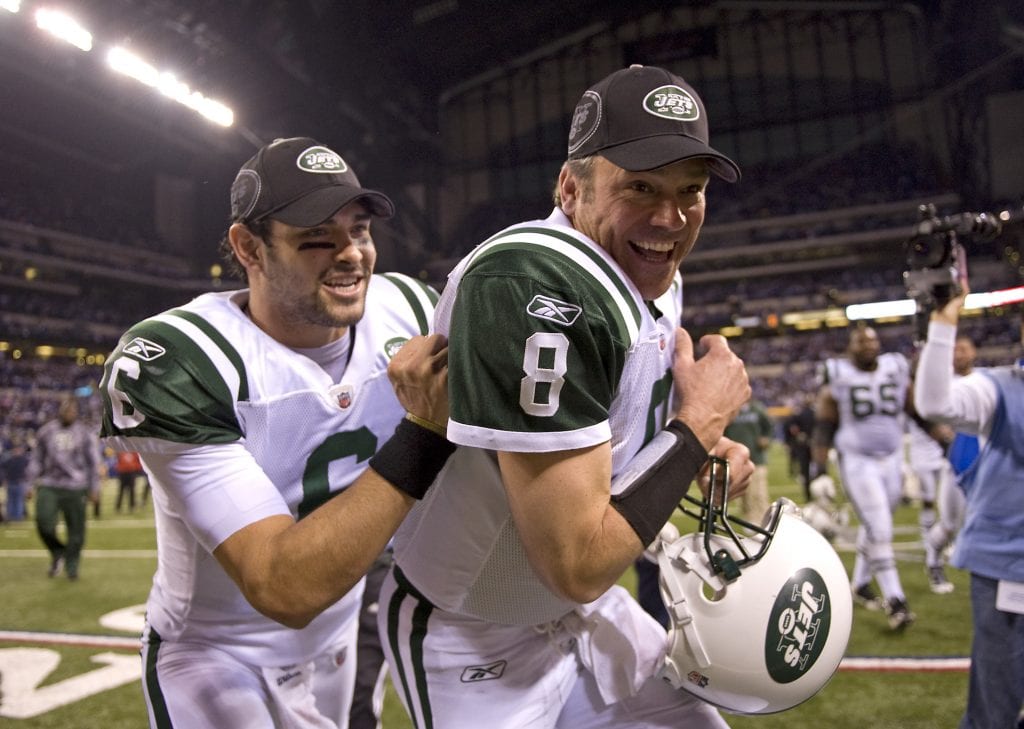
NY Jets quarterback #6 Mark Sanchez runs off the field with Mark Brunell after the Jets win 17-16. The New York Jets defeated the Indianapolis Cols 17-16 in an AFC Wild-card game at Lucas Oil Stadium in Indianapolis, IN, January 8, 2011. ***** ALL NEW YORK NEWSPAPERS OUT —- ALL NEW YORK NEWSPAPERS OUT ***** (Photo by Anthony J. Causi/Icon SMI/Corbis/Icon Sportswire via Getty Images)Mar


Flacco switched his shades of green in the offseason, moving on to Philadelphia to mentor (and possibly compete with) another young hopeful, Jalen Hurts. For the three weeks between the Darnold trade and the draft’s opening night, Morgan and White were the only quarterbacks on the roster before Wilson heard his name called in Cleveland.

Yet, Jets coach Robert Saleh doesn’t sound overly enthused about bringing in a backup any time soon. Speaking after the Jets’ minicamp proceedings on Monday, Saleh seemed to hint that bringing one in at this point in time wouldn’t have much of a purpose at this point in time.

“If you just bring in a veteran who doesn’t know your scheme, he’s learning just like the rookie is,” Saleh said, per Brian Costello of the New York Post. “Aside from helping him with rehab…and study habits, which I think Zach and that entire quarterback room is already ahead of the curve on how they handle their bodies and study, I don’t know if there’s much value aside from being comfortable that if the crap hits the fan you have a veteran who has played football. It’s more of a comforting feeling rather than working your ass off to develop the quarterbacks who are already in the building.”

The role of the backup quarterback may well be the most underrated job in professional sports. Sometimes, the role proves to be bizarrely rewarding. Fitzpatrick, for example, has built a 17-year NFL career through quasi-Winston Wolf endeavors, solving starting quarterback problems in various locales. He’s spending the 2021 season in Washington, which is still buzzing from the antics of Taylor Heinicke, the Old Dominion legend who viral for playing respectably during the NFC Wild Card playoffs against Tampa Bay last winter. Charlie Whitehurst, he of a Christ-like physical appearance and nearly 400 pass attempts over 11 NFL seasons, earned a cult following as “Clipboard Jesus”.

In these modern NFL Sundays, dominated by the social media behemoth of Twitter, it doesn’t take much for overzealous fans, even facetious supporters looking for engagements, to start calling for the backup’s name. Once he’s in, the primary directive is simple: do not be the reason your team fails to prevail. For instance, Heinicke (26-of-44, 306 yards, 46 rushing yards, 2 total scores, 1 interception) was far from the primary reason that Washington fell to the eventual Super Bowl champions, and it convinced the Football Team to bring him back on a two-year deal. The same couldn’t be said about, say, 2019’s Pittsburgh Steelers, who failed to keep up the same offensive production with Mason Rudolph and Devlin Hodges after Ben Roethlisberger went down.

But when a rookie quarterback, an anointed franchise man, joins the fold, the backup takes on double duty: serving as a mentor or even holding down the fort while the freshman gets his NFL legs.

The latter concept is an endangered species. Kansas City’s gambit…remaining in immediate contention with effective incumbent Alex Smith before turning the reigns over to future champion Patrick Mahomes…probably bought it some time. The Los Angeles Chargers were set to roll with such a strategy before a medical emergency forced the chosen veteran, Tyrod Taylor, to vacate the starter’s role in favor of eventual Rookie of the Year Justin Herbert. Miami partially employed it, but never truly committed to Tua Tagovailoa last season. When thrust into a surprise playoff run, they turned to, who else, Fitzpatrick.

Right now, neither of the understudies on the Jets’ roster seems capable of fulfilling those roles. The fourth-round selection of Morgan was bizarre when it happened (especially when Gabriel Davis went to Buffalo three picks later) and was made even more puzzling when the Florida International alum couldn’t even earn a dressing during a meaningless two-win season. White, a fifth-round pick in Dallas back in 2018, at least has the benefit of a couple of preseasons under his belt, but those numbers (68.5 passer rating over eight contests) aren’t inspiring.

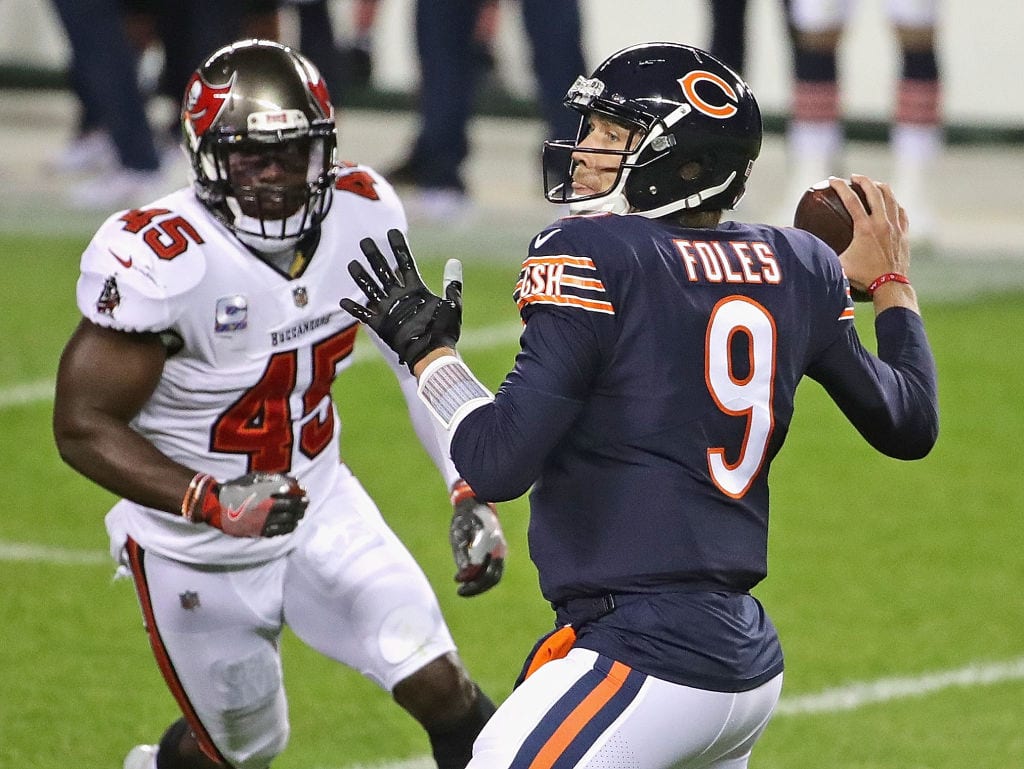
CHICAGO, ILLINOIS – OCTOBER 08: Nick Foles #9 of the Chicago Bears passes under pressure from Devin White #45 of the Tampa Bay Buccaneers at Soldier Field on October 08, 2020 in Chicago, Illinois. The Bears defeated the Bucs 20-19. (Photo by Jonathan Daniel/Getty Images)

The Jets have actually had ample opportunities to address the area this offseason, but have curiously passed on each one. Brian Hoyer, another thrower who has extended his career through sizable backup endeavors, was brought in for a workout but he chose to continue his third tenure in New England. Nick Mullens, a former pupil of the Jets’ new offensive coordinator Mike LaFleur back in San Francisco, seemed like another prime candidate before he joined Flacco and Hurts in Philadelphia. The free agent market is relatively shriveled at this point, with the best option perhaps being a trade with Chicago, inquiring about Nick Foles. Flacco’s fellow Super Bowl MVP is a popular entry in the backup quarterback Mount Rushmore who won the 52nd alongside current Jets general manager Joe Douglas, the latter then residing in the Eagles’ front office. He’s expendable in Chicago through the arrivals of veteran Andy Dalton and rookie Justin Fields.

Between Saleh’s words and the logistics and protocols involved with a new entry, it’s probably not wise to assume that Jets (who have a decent amount of extra draft picks to barter with) will be welcoming Foles to their minicamp proceedings this week. But they’d be better off trying to solve the situation sooner rather than later.

As the Darnold era quickly proved, the Jets can hope all they want that a certain prospect will pan out, but they need to have both guidance and insurance working with the rookie. Darnold would routinely mention that his best days came under the watch of McCown, years after Mark Sanchez built a strong relationship with Brunell. Otherwise relatively quiet on the football timeline, the early summer months can be a perfect time for Wilson to work with a mentor. By neglecting this area for so long, they’ve wasted some valuable time in Wilson’s development.

One can have the highest hopes and dreams for Wilson, and it’s abundantly clear that the Jets have such fantasies in store for him. However, when the prized rookie comes in and is somehow tied for the title of the most experienced man in the room…that’s a controversy.

Geoff Magliocchetti is on Twitter @GeoffJMags
New York Jets run game could be the long-sought offensive gamechanger

As Le’Veon Bell burns another bridge, the New York Jets’ current rushing attack could become one of their most impactful areas.

For Le’Veon Bell, it appears to be three teams down and 29 to go.

The former New York Jets running back has apparently torched another bridge for himself when it comes to NFL employment, as Bell said he would “retire first” before playing another season with Andy Reid’s Kansas City Chiefs. Bell’s declaration came, of all places, in an Instagram comment section, as fans bombarded him with questions on a post revealing someone spent over $700 at McDonald’s. Bell joined the eventual AFC champions mid-season after the Jets let him go after 17 games in green but was used sparingly (63 carries over nine games). He has since apologized for the arena in which he posted his comments, but reiterated his displeasure for his time in Kansas City. 

The Bell experiment, one that cost the Jets over $52 million, came at a curious time on the NFL timeline, one that has placed an increased reliance upon aerial antics. Since 2010, only two top-ten rushers (Marshawn Lynch, LeGarrette Blount) have hoisted the Lombardi Trophy. No leading rusher has triumphed since Terrell Davis in 1998. Thus, it was odd to see the Jets shell out so much for a dying art in the modern NFL, one that may have indirectly played a role in the recent offensive overhaul that ended the Sam Darnold era. With so much being dealt to Bell, other areas (i.e. receiving and blocking) were neglected.

Bell’s latest overpass arson allows his former employers to look back and realize just how much the situation behind the quarterback has improved. Interestingly, the Jets have gone for a more minimalist approach, adding two-time Super Bowl participant Tevin Coleman on a short deal worth $2 million, retaining a trio of young veteran projects in La’Mical Perine, Ty Johnson, Josh Adams, and a draft pick Michael Carter. Attention has centered on the Jets’ passing transactions, including a new quarterback (Zach Wilson) and several big-play threats (Elijah Moore, Corey Davis, Keelan Cole). The Jets have also been renovating the offensive line, adding extra first-round choice Alijah Vera-Tucker to work next to Mehi Becton. New York also reportedly remains in the Morgan Moses conversation.

But despite the obvious upgrades in the passing game, this new approach when it comes to the rushers, one more conventional in the lens of the modern NFL, could be what truly awakens a dormant offense.

The relatively ignorance of the Jets run game is understandable in a sense: the Jets haven’t had a game-changing receiver since the magic of the Brandon Marshall/Eric Decker tandem during the star-crossed 2015 campaign. Robby Anderson nearly became that guy, but the Jets let him walk to Carolina with relatively little resistance. But trying to reverse fortunes fully through the passing game didn’t work out the last time around. It’s simply not fair to place the responsibilities of a metropolitan resurrection on players like Wilson and Moore. A strong run game in this year of development could help lighten that burden.

Even with legitimate improvements that truly make the Jets a better team…and not only because last year’s two-win campaign really couldn’t have made things much worse…asking the Jets to make the playoffs is going to be a tall task until on-field results prove otherwise. This season provides the perfect opportunity to experiment and work through any lingering issues they have before they plan to reintroduce themselves to professional relevancy. If they pull off an upset or two along the way, even if it’s as simple as topping the mediocre Patriots to end a ten-game losing streak against the Flying Elvises, call it an added bonus.

The developmental group of rushers can help them work toward the modest, yet attainable, goal.

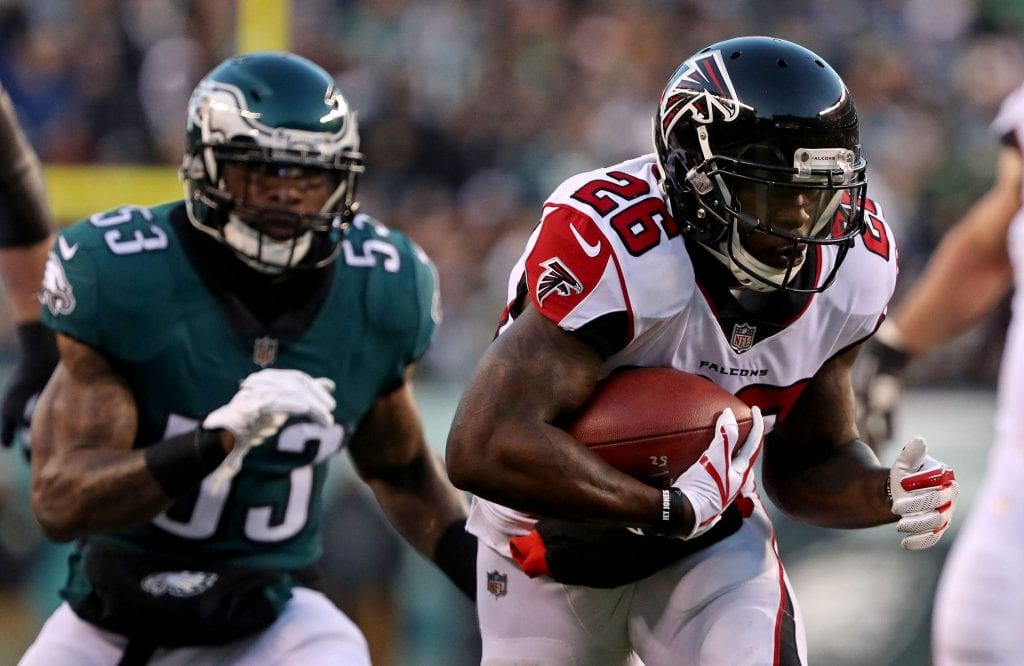
Jan 13, 2018; Philadelphia, PA, USA; Atlanta Falcons running back Tevin Coleman (26) runs the ball against Philadelphia Eagles outside linebacker Nigel Bradham (53) during the first quarter in the NFC Divisional playoff game at Lincoln Financial Field. Mandatory Credit: Bill Streicher-USA TODAY Sports

Gold in a former 49er

Signing Coleman helps with the issues of youth and inexperience. The former Falcon and 49er has played an integral role in championship-contending squads and is a rare New York representative (though one of several veteran acquisitions) that brings playoff experience with him. Knee and shoulder ailments limited him to 87 total yards of offense over eight games last season in San Francisco. But, arriving on an affordable one-year deal and having proved serviceable in a lesser-heralded but nonetheless essential role, Coleman’s redemption story is one the Jets can afford to co-author (unlike that of Julio Jones).

New Jets head coach Robert Saleh knows about the impact Coleman can have on a team. One of his primary tasks in practice as the 49ers’ defensive coordinator was to find a way to stop Coleman, who spent the last two seasons in the Bay Area with Saleh. He believes Coleman personifies the “all gas, no brake” mantra

“His leadership, his on-the-field-demeanor, just all of it, his practice habits, he represents what we covet,” Saleh in a report from Dennis Waszak Jr. of the Associated Press. “When he gets the ball in his hand and he makes that one cut, it’s like he’s shot out of a cannon. He’s got tremendous speed, he’s got a tremendous mindset when the ball is in his hand, in terms of breaking tackles, falling forward, creating positive yardage.”

Though Coleman is by far the most accomplished name in the Jets’ current rushing room, it’s far from a guarantee that he’s going to be the primary ground option. The seventh-year veteran is faced with a goal of not only making an impact with his new employers but potentially extending his NFL career into his 30s.

“I’m a fast guy, I’m a strong guy, I’m big,” The 28-year-old said in Waszak’s report. “So I’ve definitely got a lot in my tank to prove myself.”

jets, michael carter
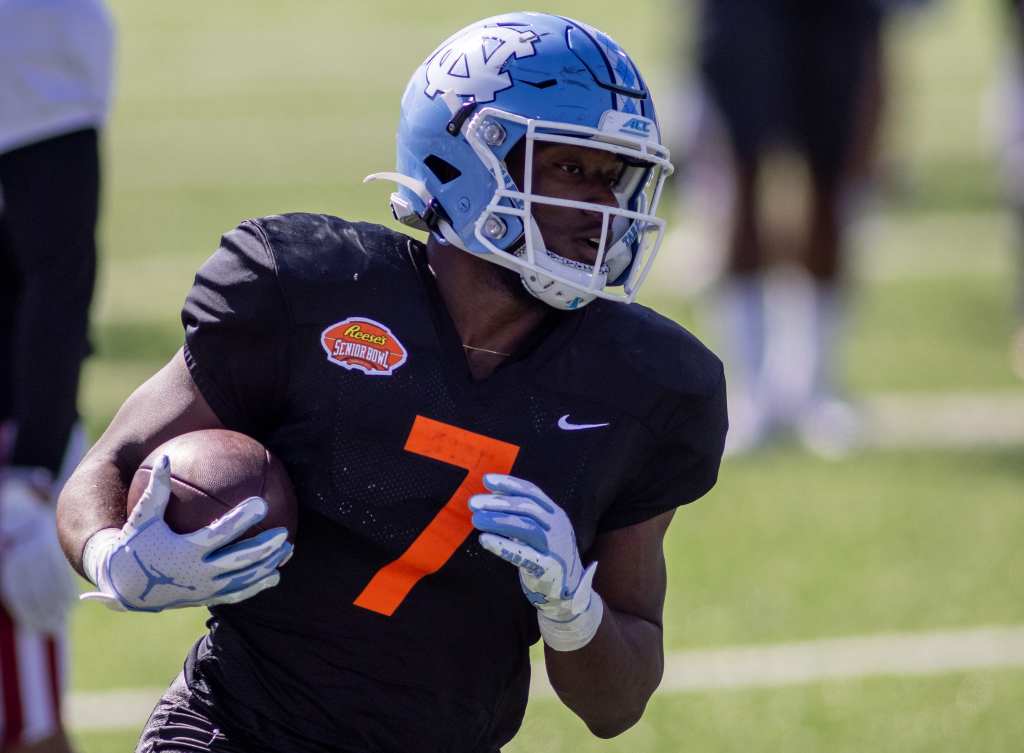
Jan 28, 2021; National running back Michael Carter of North Carolina (7) runs the ball during National practice at Hancock Whitney Stadium in Mobile, Alabama, USA; Mandatory Credit: Vasha Hunt-USA TODAY Sports

UNC You at the Top?

A lot of good vibes emerged from the Jets’ optional workouts earlier this month, if only because the sense of existential dread of the Adam Gase era has vanished along with the vanquished head coach. In fact, one can chalk any positive feeling the Jets have had since last holiday season on the Monkey’s Paw-style condition that last season was so unbearable that any offseason move would’ve felt like a step in the right direction.

One of the more subtle moves of that endeavor was the drafting of Michael Carter…namely the running back Michael Carter, though the Jets also have hopes for his fellow Michael Carter, this one being an untreated cornerback out of Duke.

The offensive Carter is a rusher from North Carolina, chosen in the early stages of the draft’s third day. Saturday at the draft is often a test of one’s football will, a day where you’re more likely to find Star Wars characters and orangutans than immediate starters. The Force, however, appears to be strong with Carter.

The former Tar Hell earned rave reviews during the voluntary portions of OTAs and instantly became a favorite target of fellow rookie Zach Wilson. A common theme in praise for Carter appears to be that he personifies the outside zone tendencies new offensive coordinator Mike LaFleur would love to implement. It was one of the first things Carter noticed when the Jets made him the 107th overall pick of the draft earlier this spring.

“I think my change of direction and my stop-start ability, I think it compliments this system well,” Carter said in a report from DJ Bien-Aime of the New York Daily News. “I’ve been running pretty much wide zone since I was born. So it’s something that really comes naturally to me. We read a lot of it in college, even in high school I did, even in youth football I did. So I’m very familiar with it. I’m just excited to get in the system.”

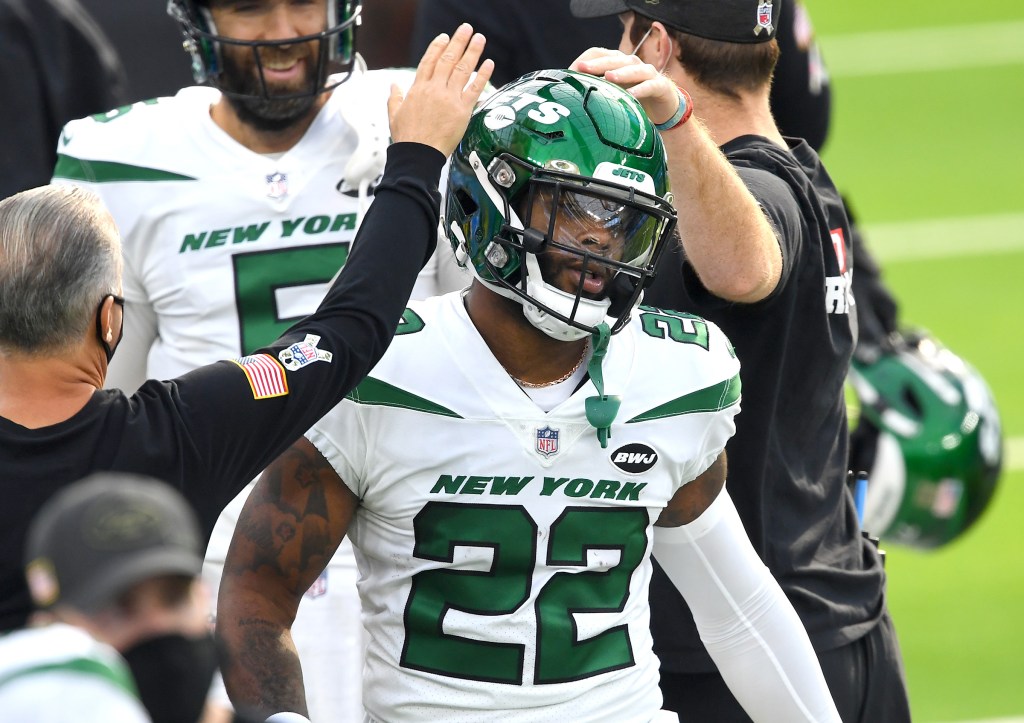
Nov 22, 2020; Inglewood, California, USA; New York Jets running back La’Mical Perine (22) is congratulated after scoring a touchdown against the Los Angeles Chargers in the first quarter at SoFi Stadium. Mandatory Credit: Jayne Kamin-Oncea-USA TODAY Sports

Left Behind

The Jets have engaged in a de facto purge of the Gase era, one that has left little, if any, reminder of the former New York boss on its 2021 masthead.

Perine, Johnson, and Adams (the lattermost earning a new one-year deal for next season) are three of the rare leftovers from Gase’s cursed watch, namely the truly garish latter of his two campaigns. Conventional wisdom seemed to hint at a great opportunity for the group when Bell was let go, as the Jets’ instant removal from the playoff picture gave them plenty of opportunities to hold auditions for future roles. Gase, however, instead opted to give the 38-year-old Frank Gore a de facto retirement tour, almost writing his application to the 16,000-yard club for (Gore did reach that number, sitting third all-time behind Emmitt Smith and Walter Payton).

To the casual observer, Perine seems destined to become an unfortunate casualty, even if his status as a Jets seems defined by being in the wrong place at the wrong time. This time last season, he was in Carter’s position as a fourth-round pick that could make a difference but any hopes of impressing during the spring/summer practice traditions were undone by factors far beyond his or anyone remotely associated with football’s control: the COVID-19 pandemic. Perine himself carved out an opportunity (232 yards on 64 carries) but his season was plagued by both an ankle injury and placement on the COVID/reserve list.

Perine’s propensity for north/south style rushing as compared to speed and agility cherished by LaFleur has led some to label him the odd man out, ending his green career before it can truly get started. The return of preseason football should offer the Florida alum and 2019 Orange Bowl MVP an interesting, new opportunity as he embarks on one of the more intriguing battles of training camp.

Meanwhile, Johnson and Adams account for what passes as the closest thing the Jets have had to consistency in their run game since the underrated days of Chris Ivory. With Gore and Perine both missing a December tilt against Las Vegas, the pair provided the most lucrative rushing game the Jets had had in several seasons. It was forgotten in the wake of Gregg Williams’ doomed final blitz, but the two united for 178 yards. Johnson even reached triple digits, the first in New York since Isaiah Crowell’s one shining green moment in 2018.

Denied a full showcase by Gase’s Gore gambit last fall, Johnson and Adams face a bit of an uphill battle in carrying on their metropolitan careers. But the pair is mostly used to it, as they’ve built sizable tenures considering where they began. Johnson was drafted by Detroit in 2019’s sixth round but made the most of his limited opportunity by earning a 4.7 average on his 54 carries. Adams was undrafted out of Notre Dame but wound up joining current Jets general manager Joe Douglas’ former stomping ground in Philadelphia. He played his way into the Eagles’ roster when injuries ate at the veteran rushers. Competing in summer showdowns should be nothing new, but if they make it, they’ll provide an invaluable service to a long-sought hopeful chapter of the Jets’ perpetual rebuild.

Geoff Magliocchetti is on Twitter @GeoffJMags
New York Jets: Analyzing the fateful moves of Joe Douglas’ tenure (so far)

Today in 2019, the New York Jets named Joe Douglas their general manager. ESM looks back on his most impactful moves, for better or worse.

Two years ago, a man named Joe opened a campaign that ran on change and reform. Today, he’s at the helm of one of the most renowned, yet volatile, systems in the world and trying to get his constituents back on track in the face of an ongoing crisis.

On this day two years ago, Joe Douglas became general manager of the New York Jets.

Douglas inherited a ghastly gridiron crunch from Mike Maccagnan after the latter’s shocking post-draft firing in 2019. The Jets were in the midst of an eight-year playoff drought and hadn’t had a winning record since 2015, the first year of Maccagnan’s star-crossed term.

Two years later, however, much hasn’t changed in terms of on-field numbers. Douglas has overseen a mere nine wins over two seasons (besting only Detroit, Jacksonville, and Cincinnati) and saw the franchise plunge to new single-season lows last season through a 2-14 ledger. Even though they bested the single win of Rich Kotite’s doomed group in 1996, the Jets endured a franchise-worst 13-game losing streak to open the year, leading Douglas to start almost entirely from scratch in 2021. The playoff drought has been extended to a decade, the longest active streak in the NFL after Cleveland and Tampa Bay each earned postseason invites last winter.

In his brief time, Douglas has made several transactions that will affect the Jets’ future fortunes and perhaps his own metropolitan future. ESM looks back at the most impactful moves to date, for better and worse…

New York Jets, Mekhi Becton

Better: The Drafting of Mekhi Becton

For his first draft pick at the helm of the Jets, Douglas opted to select Louisville tackle Mekhi Becton with the 11th overall choice in the 2020 proceedings. There was no shortage of talent in the middle stages of the virtual draft’s opening night, as Henry Ruggs, Tristan Wirfs, Jerry Jeudy, CeeDee Lamb, and Justin Jefferson all heard their names called with the next eleven selections after Becton.

Analysis: For the time being, the draft of Becton is Douglas’ magnum opus. He made the selection in a thankless position: for every one fan/analyst/scout who wanted a blocker, there was another likely upset that Douglas passed on the plethora of receiving talent available in the slot. But after Becton served as a rare silver lining in Adam Gase’s dirge, Douglas publicly declared that he would base future decisions around Becton.

“I think he’s a player that is going to help us long-term,” Douglas said in November, per Max Goodman of Sports Illustrated. “We’re excited about working with him every day because you talk about a young man that loves football. He’s very smart. He’s tough as nails and has rare size and athleticism. There’s a lot of desire from him to want to be the best player that he can be so we’ve made it our mission to bend over backward to try to help him reach his goals.”

The selection of Becton also snapped a dangerous streak in Jets history: he was the first opening-round offensive lineman chosen by the Jets since the legendary pairing of D’Brickashaw Ferguson and Nick Mangold in 2006, ending a period of blocking negligence exacerbated not only by Maccagnan but by Mike Tannenbaum and John Idzik before him. Additionally, shrewd maneuvering by Douglas allowed the Jets to pick up a big-play receiver anyway, using a second-round choice on Baylor’s Denzel Mims.

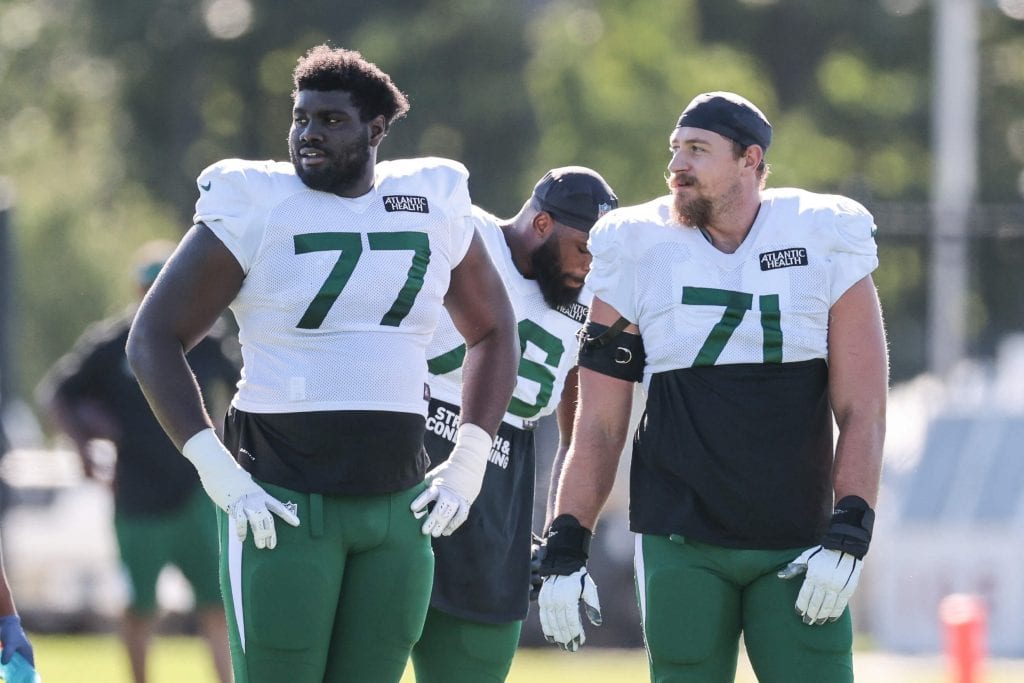
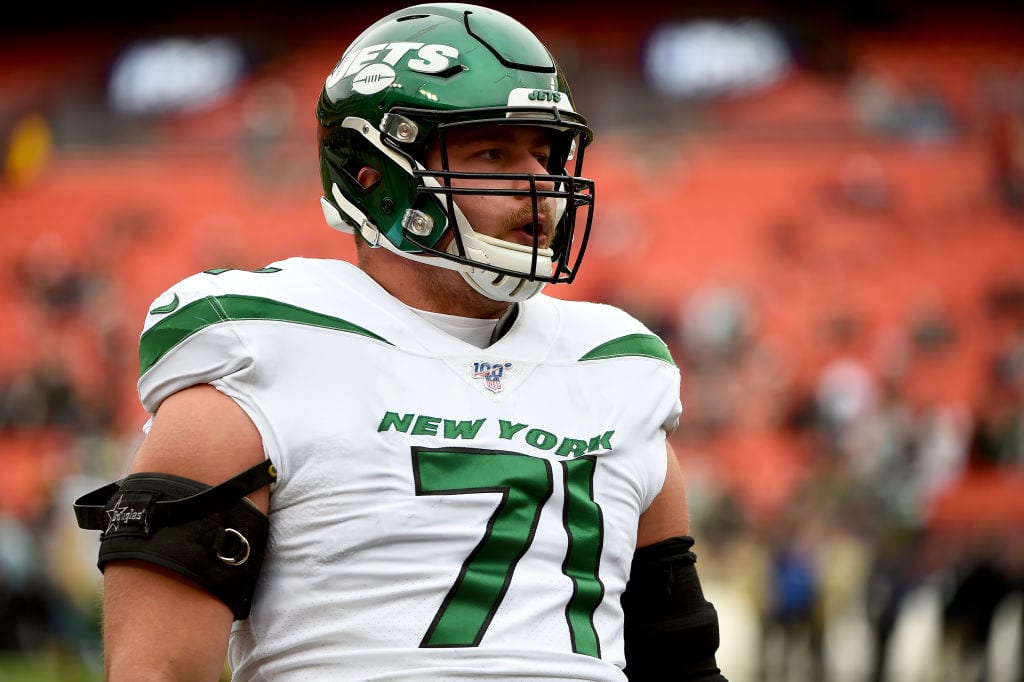
LANDOVER, MD – NOVEMBER 17: Alex Lewis #71 of the New York Jets looks on prior to the game against the Washington Redskins at FedExField on November 17, 2019 in Landover, Maryland. (Photo by Will Newton/Getty Images)

Worse: The Veteran Building Block(er)s 

Douglas’ blocking renovations didn’t begin with Becton. In the month before he scribbled Becton’s name onto a draft card, Douglas bestowed over $17 million in 2020 cap space to George Fant, Connor McGovern, and Greg Van Roten. When he took office during the summer of 2019, among his first moves were trading a late pick to Baltimore for Alex Lewis and convincing All-Pro Ryan Kalil to postpone his retirement.

Analysis: Douglas had the right idea: he wanted to stock up on blockers to help his pre-packaged franchise quarterback Sam Darnold out. Alas, the moves he made only hastened the end of the Darnold era.

Part of the issues stems from Douglas signing the wrong names. Jack Conklin was reportedly interested in coming aboard (and Le’Veon Bell pleaded for the Jets to sign his fellow Michigan State alum on Twitter), but he instead embarked on an All-Pro season in Cleveland. Worse yet, the consolation prizes caused the Jets to neglect other areas of need, namely the weaponry necessary for Darnold to succeed. Luring Amari Cooper over from Dallas was probably always a pipe dream, but they missed out on serviceable parts like Emmanuel Sanders. They also made little effort to retain Robby Anderson, who went on to post career-best numbers in Carolina.

In the absence of marquee blocking signing, the Jets were forced to make do with washouts from first rounds past (Breshad Perriman) as well as former Patriots without the Belichick touch (Chris Hogan). The tough luck created a football situation where no good Douglas deed went unpunished.

New York Jets, Jamal Adams
Dec 29, 2019; Orchard Park, New York, USA; New York Jets strong safety Jamal Adams (33) warms up prior to the game against the Buffalo Bills at New Era Field. Mandatory Credit: Rich Barnes-USA TODAY Sports

Too Soon: The Jamal Adams Trade

Once it became clear that Adams, the face of the franchise during the Maccagnan era, wanted out of New York it was on Douglas to somehow salvage the situation. Adams didn’t make things easier by telling metropolitan horror stories any chance he could. Despite Adams’ tales, Douglas eventually worked out a deal with Seattle in August 2020. The deal netted two first-round picks, a third-round pick, and veteran cornerback Bradley McDougald.

Analysis: It’s hard to fully analyze the Adams trade as there are still lingering aftershocks in the 2022 draft; the Jets own Seattle’s first-round choice while the Seahawks own a metropolitan fourth-round pick.

As of this moment, a lot of the Adams fallout has shifted toward the Jets’ favor. While McDougald partook in only seven games and doesn’t appear to be heading back (continuing a disturbingly common trend of Douglas’ veteran acquisitions not panning out), the Jets used the Seattle capital to bolster their offensive line, trading the 2021 first-rounder to Minnesota that led to a move up the draft board for Alijah Vera-Tucker. The fact that Adams’ cantankerousness followed him to the Pacific Northwest…he has yet to sign a long-term deal…only further shifts the current lead in the Jets’ direction.

There’s no use in grading the trade when several major names from it haven’t played a single regular season down yet. But the fact that Douglas turned a disgruntled superstar into a landmark blocker and a first-round pick to be named later is an inspiring sign. The same philosophy could apply to the trade that sent Darnold to Carolina, a deal that saw Douglas land a second-round choice (in 2022) for a quarterback that has yet to post a passer rating above 85 or throw more than 20 touchdown passes.

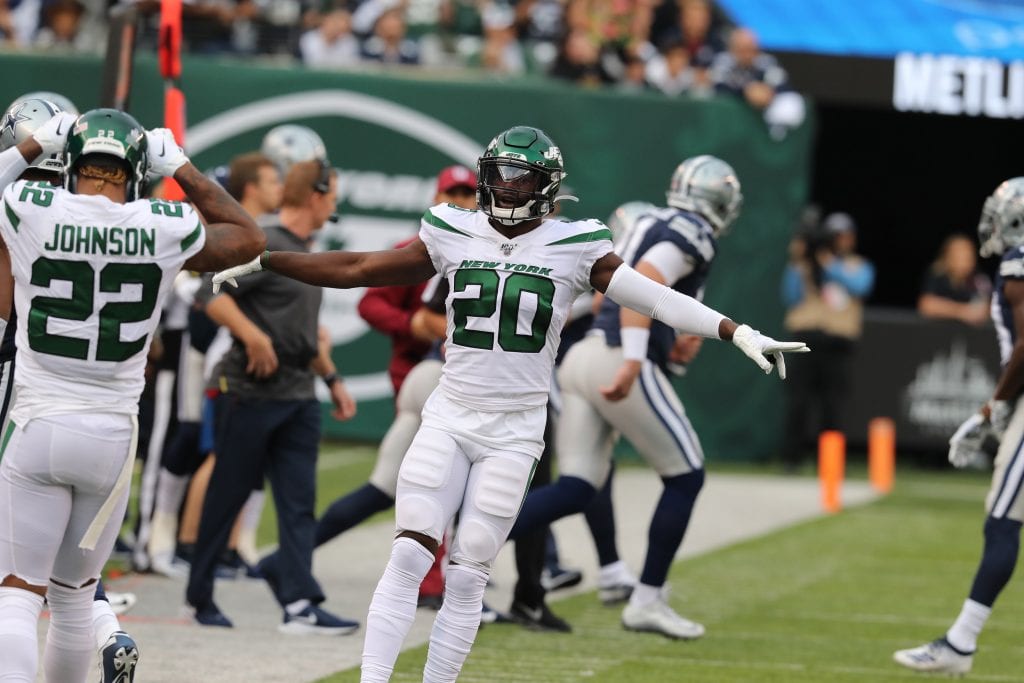
EAST RUTHERFORD, NEW JERSEY – OCTOBER 13: Safety Marcus Maye #20 of the New York Jets celebrates a stop against the Dallas Cowboys in the first half at MetLife Stadium on October 13, 2019 in East Rutherford, New Jersey. (Photo by Al Pereira/Getty Images)

Better: Franchise Tagging Marcus Maye

Both the SEC and the earlier days of the 2017 draft are still represented in the Jets’ secondary through the prescience of Marcus Maye. The Florida alum was bestowed the franchise tag in the early stages of the 2021 offseason, a move that makes him the 10th-highest-paid safety in the league in 2021 (over $10.6 million guaranteed).

Analysis: After the Adams debacle, Douglas had to carefully navigate the situation with Maye. The Florida alum was close with Adams and was one of the few name-brand talents leftover once Adams and Anderson donned new helmets. For all intents and purposes, things have gone well in the early going. Maye, who at the very least made sure the Jets appeared in the SportsCenter Top 10, earned a sizable new contract while Douglas and Co. bought some time for Maye to further consider New York and set the table for an affordable long-term deal.

While Maye appears to be holding out of offseason activities, possibly until he gets that longer contract, the conversations surround him inspire hope and optimism, unlike last year’s melancholy Adams situation.

“Marcus Maye fits every system and he’ll be just fine,” new head coach Robert Saleh said in a report from Brian Costello of the New York Post. “I think these kids have earned the right to ask for whatever they can, especially when they do things the right way like he has. Joe and his staff are working relentlessly to get something done. We go with it and we support him all around the organization.”

New York Jets, Adam Gase
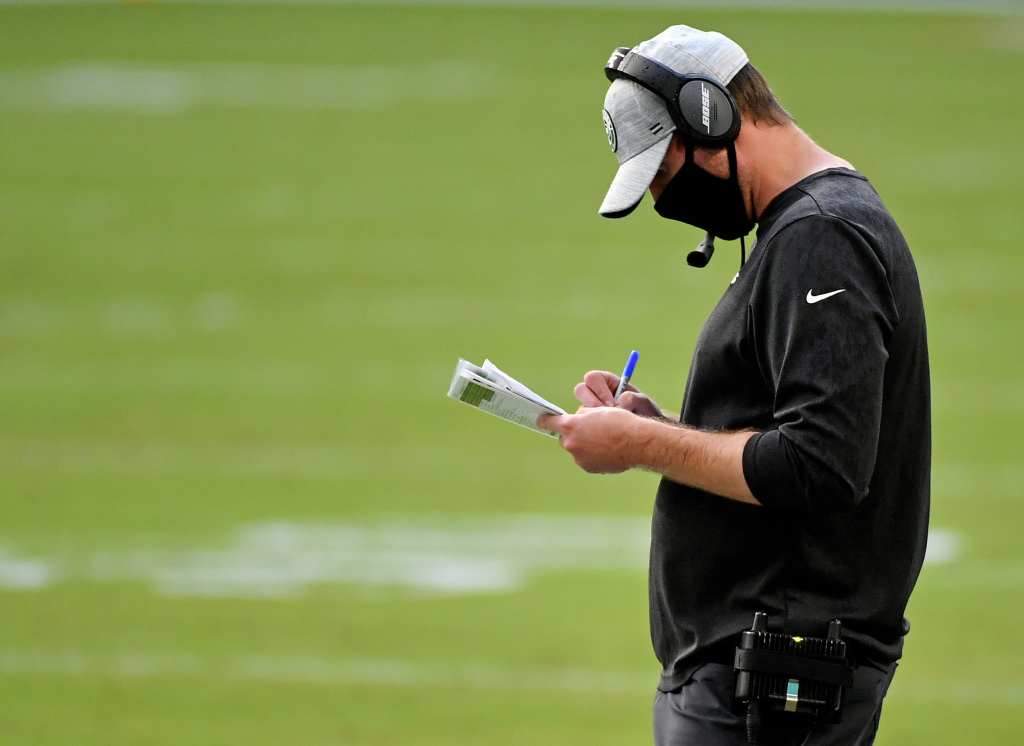
Oct 18, 2020; Miami Gardens, Florida, USA; New York Jets head coach Adam Gase looks at a play card during the first half against the Miami Dolphins at Hard Rock Stadium. Mandatory Credit: Jasen Vinlove-USA TODAY Sports

Worse: Putting Up with Adam Gase

Douglas took over the Jets at an interesting, if not contemptuous, point on the Jets timeline. His immediate predecessor was not Maccagnan, but rather Adam Gase, who more or less won a battle of wills to remain in New York. Gase was granted interim general managing duties after Maccagnan was let go and was maintained as the head coach upon Douglas’ arrival. He would last two seasons at the helm before Douglas dismissed him, paving the way for Saleh’s hire.

Analysis: The Jets were able to mask a 1-7 start in Gase’s first year at the helm by winning six of their final eight games (mostly against competition equally, if not more, doomed). But an even more brutal start in year two…one that saw the Jets lose their first six games by multiple possessions…should’ve been all the evidence that Gase wasn’t going to be the one to lead New York to the promised land.

Sure, it had been a while since the Jets executed an in-season firing (with Charley Winner getting ousted for Ken Shipp in 1975), but early firings have become more common in today’s NFL. A playoff berth in year one couldn’t save Ben McAdoo with New York’s blue squad. Steve Wilks was granted only one year in Arizona once it became clear they could get Kliff Kingsbury. It’s not like Douglas wasn’t afraid to pull the plug on others; the Jets instituted an early-season fire sale that bid farewell to Bell, Steve McLendon, and Avery Williamson. Defensive coordinator Gregg Williams was likewise given the boot after his infamous blitz against Las Vegas cost the Jets their first win of 2020.

To make matters worse, once Gase couldn’t even take advantage of the macabre gift of consequence-free football that could’ve been used as research and development for the future. For example, he chose to give Frank Gore a retirement tour instead of giving young projects like La’Mical Perine, Ty Johnson, and Josh Adams a chance. Letting Gase finish out the season helped offseason questions linger and kept the Jets on a path of uncertainty.

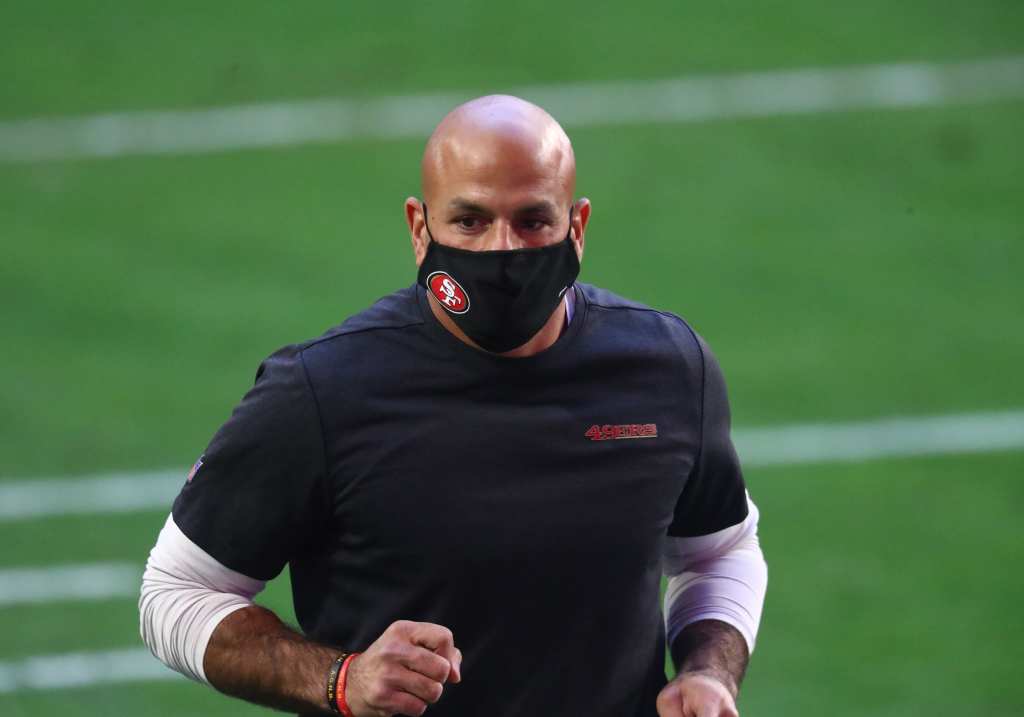
Jan 3, 2021; Glendale, Arizona, USA; San Francisco 49ers defensive coordinator Robert Saleh against the Seattle Seahawks at State Farm Stadium. Mandatory Credit: Mark J. Rebilas-USA TODAY Sports

Too Soon: The San Francisco Treats

With the eventual purge of Gase and his coaching staff (save for the apparently immortal Brant Boyer) and the drafting of Zach Wilson, Douglas now officially has his signature on this team. The process will now be overseen on a day-to-day basis by a staff headed by Saleh and fellow former 49er Mike LaFleur, who is tasked with awakening an anemic New York offense.

Analysis: It’s foolhardy to grade any transaction without a single down of evidence, so the jury is obviously still out on Saleh. It’s an interesting approach for the Jets to take, for the Jets to go with a defensive-minded boss in an NFL landscape that increasingly favorites the offense (whether it’s inadvertent or not). It’s also somewhat surprising to see them hire a first-time head coach for a team full of unproven misfit toys. Time will tell how the gambit, similar to the Todd Bowles hire in 2015, plays out.

Having said that, the ultimate difference between the Gase and Saleh hires is who is praising the hire. When Gase arrived, it was praised mostly by the hot take artists like Colin “2020 AFC championship tickets at MetLife Stadium” Cowherd. This time, however, the Jets’ hire has been praised by on-field talent both domestically and abroad.

Much like the hire on this day two days ago…a hire where Douglas was plucked from a Philadelphia squad still celebrating its Super Bowl…Jets fans are filled with hope. But hope can only take you so far…it’s time to perform and find results, through, and in spite of, these moves.

Geoff Magliocchetti is on Twitter @GeoffJMags

New York Jets select shifty UNC running back Michael Carter, what to know

jets, michael carter

The New York Jets have selected RB Michael Carter from the University of North Carolina with the 107th pick in the 2021 NFL Draft. After drafting QB Zach Wilson from Bringham Young University, IOL Alijah Vera Tucker, and certified weapon from Ole Miss Elijah Moore. Now, the plan to put Zach Wilson in the best position possible continues. The Jets drafted a talented back in Carter.

In High School, Carter ran for over 2,500 yards in his senior season. The explosiveness carried over to Chapel Hill as he had 3,404 yards in his time with the Tarheels. That number puts him in the record books with the fourth best total in the school’s history. His burst and athleticism is evident in all facets of his game.

Last season on the ground, he rushed for a whopping 8.0 yards per carry, which was fifth in the NCAA last season. He also had 684 yards before contact, which was fourth best in the college ranks last year. On top of that, he had 267 yards receiving and 11 total scores last season. Oh yeah, and he did this alongside fellow draft pick and now Bronco running back Javonte Williams.

His talent is apparent, and he’s an even better guy off the field. He was voted team captain, and despite the fact he and Williams could’ve been at odds competing for reps, he was happy taking whatever role possible to benefit the team. Carter projects as a top-tier change of pace back at the next level, and he will slot in with Tevin Coleman, La’Mical Perine, and Ty Johnson as the backfield committee looks set heading into the 2021-22 season. This should allow the pressure on Zach Wilson to continue to ease while providing Mike LaFleur even more weapons in his first season as Offensive Coordinator.

New York Jets: A fullback could create new offensive avenues

Employing a fullback would be a familiar way for the newly minted New York Jets coaching staff to find an offensive spark.

The modern NFL is one ruled by “Big Offense”, an athletic denomination ruled by a deity known as fantasy football. Scoring four touchdowns in a losing effort has become more common and no less frustrating. Three of the seven highest-scoring games in NFL history have come in the last decade.

These phenomena and more have made the New York Jets’ offensive ineptitude all the more impressive from a macabre standpoint.

Enough has been written about how the Jets have lacked a true franchise quarterback solution since the Nixon resignation, but last year’s edition hit astonishing new lows. They failed to break the 300-yard plateau in all but five of their games last season. The two-touchdown threshold was crossed only seven times. New York has been victimized for two of the six shutouts tallied over the past couple of seasons.

In short, the Jets’ offense could use whatever help it can get. New assistance can spawn from the annals of NFL history if they’re willing to try. Reviving old properties appears to be good enough for Hollywood, so why can’t it work for the Jets? No one’s saying, of course, that the Jets have to go too far…so don’t expect to see, say, the T-formation or goalposts in the middle of the end zone at MetLife Stadium next season. But the team could be well-served by employing the services of a fullback as they start to traverse a new era.

Now, the fullback hasn’t fully gone the way of the single-bar facemask just yet, but it’s certainly an endangered species. We’re certainly far beyond the days where the man in the role was a household name on a championship team like Daryl Johnston, Mike Alstott, or even William “Refridgerator” Perry. But there appears to be a correlation between teams that employ a fullback in their modern roster and recent success.

“Not every team uses my position,” Derek Watt, then of the Los Angeles Chargers, told Nick Wagoner and Eric Williams of ESPN in 2019. “But teams that do, at least a handful that remained in the playoffs late last year, a majority of them had a fullback on the roster. I’m not saying that correlates to anything, but those teams that made it deep in the playoffs did have a fullback. That’s just an observation.”

Watt, now with the Pittsburgh Steelers, was sixth-round pick of the Chargers in 2016 and worked his way into the lineup during the 2018 season. A year after, Watt earned 10 touches (7 carries, 3 receptions), all but three of which went for first downs. To his point about fullbacks and postseason endeavors, three of the eight Divisional round participants (Baltimore, San Francisco, Minnesota), used a fullback on over 30 percent of their offensive (Patrick Ricard, Kyle Juszczyk, and C.J. Ham respectively). Others, Tennessee, have used tight ends (like Jonnu Smith) in the spot. The tournament’s Super Bowl champion, the Kansas City Chiefs, has kept 2014 All-Pro Anthony Sherman on retainer for the past eight seasons.

The Jets are no strangers to fullback endeavors, as the turn of the century has seen them employ crucial contributors like Richie Anderson and Tony Richardson. Names from the past include Brad Baxter, Roger Vick, Mike Augustyniak, Clark Gaines, and future Super Bowl MVP and Hall of Famer John Riggins. New York has mostly eschewed the concept since the end of the Rex Ryan era, when he tried to replace the retiring Richardson with Lex Hilliard and John “The Terminator” Conner. XFL draftee Tommy Bohanon was briefly considered during Todd Bowles’ time with offensive coordinator Chan Gailey.

Adam Gase attempted to turn 2019 draftee Trevon Wesco into a bit of a power option, and the concept somewhat paid off during his rookie season. Wesco earned three first downs on four touches during his debut campaign, but Gase mostly abandoned the concept when a fullback gambit failed to yield a first down in an early crucial juncture of the Jets’ loss to Arizona last October.

With the Gase era mercifully over, you’d think the Jets would be wise to cut off all ties from the previous regime, include those established in the starting lineup. But the Jets are now armed with a coaching staff that knows how to work the position and how to tinker with it to achieve maximum firepower.

If the Jets are to reintroduce a fullback to their lineup on a consistent basis, their timing will likely never be better. Robert Saleh and his San Francisco (including new offensive boss Mike LaFleur) imports know what it’s like to reap the benefits of a fullback’s work, having played witness to the rise of Juszczyk (pronounced YOOZ-check) over the past four seasons in the Bay Area. Each has ended in an invite to the Pro Bowl, including the virtual edition held last month. Those in Baltimore previously saw what Juszczyk was capable of when he first joined the team as a fourth-round pick in 2013. But Juszczyk truly began to hone his powers with the 49ers, his dominance perhaps summitting last season. Not only did Juszczyk score a career-best six touchdowns, but his blocking helped pave the way for a rushing unit decimated by injuries. Two of those rushers, Raheem Mostert and Jeff Wilson Jr., earned at least 4.8 yards per carry with triple-digit carries. In the aforementioned 2019 playoff run, Juszczyk became the first fullback since Alstott to score a touchdown in the Super Bowl.

During his opening statements, Saleh hinted that the Jets hope to emulate the offensive gameplans Kyle Shanahan has established. In addition to the work he put in with Juszczyk over the past four seasons, Shanahan would also utilize Patrick DiMarco as a receiver during his time in Atlanta under Dan Quinn.

“Mike LaFleur has been with Kyle for I think he’s going on eight years now of professional football, which has been his entire career and nobody in the world knows it better than he does,” Saleh said, per notes from the Jets. “To be able to have him and to get John Benton along with us as run game coordinator, we’re really excited about them being able to install the system and implement the vision that we all want to see.”

Wouldn’t you know it, a certain 49er is up for free agency.

Juszczyk is set to hit the open market following the expiration of a four-year, $21 million deal inked in 2017. Nothing more needs to be said about the Jets’ blessed cap space situation, so a slightly larger deal would definitely be something worth investigating. The work Juszczyk did with his blocking last season would also help soothe some concerns the Jets have about their primary run game, which is out of sorts after the highly publicized Le’Veon Bell departure. His blocking can bestow confidence to a rushing attack that’s currently poised to be led by 2020 fourth-rounder La’mical Perine.

Taboo as the position may be, it’s a risk the Jets almost can’t afford not to take. Even if they miss out on Juszczyk, the upcoming draft provides several attractive backup plans like Senior Bowl standout and Cotton Bowl Classic MVP Rhamondre Stevenson out of Oklahoma, who could be worth looking at with one half of their third-round pair.

The modern NFL’s focus on offense makes the Jets’ ineptitude all the more shocking. It may be time to go against the trend in a more positive, refreshing way.

“When you look at the teams who are doing well, particularly late in the season, they typically have a power formation—or what I call ‘big-boy football,'” Earnest Byner, a former fullback and three-decade NFL veteran as a player and coach. told Brent Sobleski of Bleacher Report in 2016. “When it comes down to it, those teams are going to get you into a box and beat you up.”

“this sets the tone for a comeback of two-back offenses. When you need him, you better have a guy who can put a helmet on the linebacker to get the runner to the second level.”

Geoff Magliocchetti is on Twitter @GeoffJMags